• Thanks for stopping by. Logging in to a registered account will remove all generic ads. Please reach out with any questions or concerns.

Liberal (Minority/Majority) Government 2025 - ???

And the land expropriations that are to follow? Yeah, the constituents are already upset, alot of land needs to be expropriated even by Steve McKinnon's admission.

Ya, that will be a sticky thorn.

Id be pissed too if I was living the rural dream and some dude from Ottawa told me they are going to take a chunk of my paradise to run tracks through it for Ottawa and Toronto votes.

Bleeds into my firearms stance and ownership of private property.
 
I'm not sure if the CP right-of-way is wide enough to be twinned west of Smith's Falls, or if it is suitable for even 100 mph.

It's not suitable. A quick look on Google Maps shows that thing would ride like some cheap roller coaster. At the speeds being considered turn radius becomes something like 5 km. Need gentle curves.

I think the project team looked at this and realized that between Smiths Falls and Peterborough they'd have to spend double digit billions and expropriate anyway. So might as well spend the marginally more and do it right.

The one area I'm genuinely sympathetic to rural residents is roads getting severed. But that is what substantially drives the cost up. This thing could be closer to the lower bound on price if we didn't give a damn about cutting rural roads.
 
A bunch of you are cheering for it for one reason only. You desperately want a win for Mark Carney, whos honeymoon is waning (trust me, it is).
Are you cheering against it because you want the CPC to win? PP used to be for it. Support is still in their policy paper. Come an actual election campaign, if both support it, you'll be stuck with the PPC or something.
 
As I pointed out earlier - of the 7 ridings east of Toronto to Ottawa and then the riding east of Ottawa to the Quebec border, 6 of those 7 are held by Conservatives.

Would those ridings support the HSR project ? Or are you saying the LPC is inflicting this on CPC ridings ?
 
Ya, that will be a sticky thorn.

Id be pissed too if I was living the rural dream and some dude from Ottawa told me they are going to take a chunk of my paradise to run tracks through it for Ottawa and Toronto votes.

Bleeds into my firearms stance and ownership of private property.
Imagine how the folks in the Lost Villages felt when the Seaway was built (a friend is one - she grew up in a town that ceased to exist).

How does this country do any if the bottom line that nobody is ever impacted? I suspected there were displaced landowners to build many of the CF bases in the country, and the same thing would happen if, as some propose, to cluster bases near major urban centres.
 
And the land expropriations that are to follow? Yeah, the constituents are already upset, alot of land needs to be expropriated even by Steve McKinnon's admission.
The reality is this - lands fall into Public or Crown lands (I know you know this), so anytime something of any scale is built land will either come from the public side (and sale/expropriated) or the Crown side.

Look at the land being gathered for the new Radar sites - its for Defense purposes but people are still against the expropriation of their land. Its a natural reaction to this, its completely understandable. No one wants to see their 'castle' and all the work that they put into it be destroyed. Sadly, sometimes there is no other way.

My parents had their house/land expropriated by the City of Windsor back in 1996. It had been in the family since 1941. They did what they could to prevent it but it was a done deal, the city bought up all the homes/land on their entire 2 blocks and tore them all done to wide/straighten out a major city road. My Dad wept and was bitter for years afterwards. I saw trees that his father/mother had planted by hand back in 1942/43 ripped down, extensive flowerbeds and vegetables gardens plowed under. The house ripped down and the foundation tore up. It was hard for them. When I ask him now what its like to drive along the street that has been widen/straighten out, making travel quicker and flow seamlessly, he admits now that its a good thing and he understands that its benefited the city/people overall - but he's still bitter about it.
 
Would those ridings support the HSR project ? Or are you saying the LPC is inflicting this on CPC ridings ?
I've only researched that the 7 ridings - I listed them earlier - fall into the 1 Liberal and 6 Conservative camp. I've done no other research.
 
Imagine how the folks in the Lost Villages felt when the Seaway was built (a friend is one - she grew up in a town that ceased to exist).

How does this country do any if the bottom line that nobody is ever impacted? I suspected there were displaced landowners to build many of the CF bases in the country, and the same thing would happen if, as some propose, to cluster bases near major urban centres.

I think you are getting too emotionally involved in this. You're getting no argument from me. I am simply saying I can empathize with a property owner in this scenario.

I am in Halifax, what you lot do up there is best left up there.
 
And the land expropriations that are to follow? Yeah, the constituents are already upset, alot of land needs to be expropriated even by Steve McKinnon's admission.

Ya that will be a sticky thorn.

Id be pissed too if I was living the rural dream and some dude from Ottawa told me they are going to take a chunk of my paradise to run tracks through it for Ottawa and Toronto votes.

Bleeds into my firearms stance and ownership of private property.

That's not accurate. They aren't expropriating "a lot of land". It's less than say a freeway. I believe it's less than 100m wide for the most part.

What happened though is that they didn't want to disclose the exact routing (and drive expropriation prices up). So they drew a 10 km wide corridor and sent notices that everybody in there was in the study zone. This is probably 10-15x the number of people actually impacted.
 
That's not accurate. They aren't expropriating "a lot of land". It's less than say a freeway. I believe it's less than 100m wide for the most part.

What happened though is that they didn't want to disclose the exact routing (and drive expropriation prices up). So they drew a 10 km wide corridor and sent notices that everybody in there was in the study zone. This is probably 10-15x the number of people actually impacted.

That does sounds better, but I will wait and see what actually comes out of the murky ether. If anything ever does.
 
  • Like
Reactions: ytz
It's not suitable. A quick look on Google Maps shows that thing would ride like some cheap roller coaster. At the speeds being considered turn radius becomes something like 5 km. Need gentle curves.

I think the project team looked at this and realized that between Smiths Falls and Peterborough they'd have to spend double digit billions and expropriate anyway. So might as well spend the marginally more and do it right.

The one area I'm genuinely sympathetic to rural residents is roads getting severed. But that is what substantially drives the cost up. This thing could be closer to the lower bound on price if we didn't give a damn about cutting rural roads.
from a practical view, every above ground electrified rail system in Canada fails regularly in winter weather and none of the operators has been able to provide a fix. The weather to the east of Peterborough is just plain brutal and 90 billion dollars is a hell of a price to pay for a part-time system
 
from a practical view, every above ground electrified rail system in Canada fails regularly in winter weather and none of the operators has been able to provide a fix. The weather to the east of Peterborough is just plain brutal and 90 billion dollars is a hell of a price to pay for a part-time system
How does Russia do its electrical rail system across some of the most brutal weather in the world through Siberia?

How does Switzerland handle their electrical rail system through the Alps in Jan/Feb? What about Finland? Or Sweden? Or Norway.

We are not reinventing the wheel here.
 
from a practical view, every above ground electrified rail system in Canada fails regularly in winter weather and none of the operators has been able to provide a fix. The weather to the east of Peterborough is just plain brutal and 90 billion dollars is a hell of a price to pay for a part-time system

Cause ya know, Japan, Korea, China, Sweden, Russia, Austria and Switzerland famously don't get snow....

Just because Canadians are uniquely incompetent at building something doesn't make a technology useless.

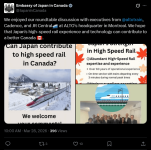
By the way, the government recognized this. That's why every consortium building had an experienced builder from countries that had already done this. In this case the winning consortium has SNCF. The company that built the French HSR network. There's also consultations like this so we can learn from others:

1000053564.png
 
For the Liberals are always great no matter what pro HSR crowd, here is a quick google AI

High-speed rail (HSR) generally fails or faces extreme challenges in areas with low population density, long distances between major urban centers, high land acquisition costs, and dominant car/airline cultures, notably in Canada, Australia, and parts of the US. It struggles when terrain is difficult, land ownership is private/expensive, or infrastructure investment favors highways over rail.

Key Environments Where HSR Does Not Work/Is Challenging:
  • Low-Density or Vast Areas: Countries like Canada and Australia have sparse populations spread over immense distances, making the per-capita cost of HSR astronomically high.
  • Existing Freight Rail Dominance: In the US, high-speed passenger trains face difficulties sharing tracks with heavy, long freight trains. Building dedicated, grade-separated tracks is immensely expensive.
  • High Land Acquisition & Legal Costs: In regions with strong private property rights (e.g., California), acquiring land for straight, specialized tracks leads to lengthy legal battles and high costs.
  • Political and Cultural Barriers: Areas with high car dependency, such as North America, have historical policies favoring highway and airport investment over rail infrastructure.
  • Urban Sprawl & Topography: Dense urban centers with already congested infrastructure make it difficult to build new rail lines in or out of cities
Common Reasons for Failure:
  • Funding and Profitability: HSR projects often face challenges in reaching ridership goals that justify construction costs, which are much higher in the US than in Asia.
  • Competition: When highways are developed and air travel is inexpensive, HSR struggles to compete as a faster or more convenient option.

 
I don't care who builds this. As long as it gets built. I was fine voting for O'Toole who supported the previous version of this project.
I am pretty sure this aint on the list of things this nation has been begging for, maybe you.

O'Toole was weak as a leader, hence why he got tossed
 
For the Liberals are always great no matter what pro HSR crowd, here is a quick google AI

High-speed rail (HSR) generally fails or faces extreme challenges in areas with low population density, long distances between major urban centers, high land acquisition costs, and dominant car/airline cultures, notably in Canada, Australia, and parts of the US. It struggles when terrain is difficult, land ownership is private/expensive, or infrastructure investment favors highways over rail.

Key Environments Where HSR Does Not Work/Is Challenging:
  • Low-Density or Vast Areas: Countries like Canada and Australia have sparse populations spread over immense distances, making the per-capita cost of HSR astronomically high.
  • Existing Freight Rail Dominance: In the US, high-speed passenger trains face difficulties sharing tracks with heavy, long freight trains. Building dedicated, grade-separated tracks is immensely expensive.
  • High Land Acquisition & Legal Costs: In regions with strong private property rights (e.g., California), acquiring land for straight, specialized tracks leads to lengthy legal battles and high costs.
  • Political and Cultural Barriers: Areas with high car dependency, such as North America, have historical policies favoring highway and airport investment over rail infrastructure.
  • Urban Sprawl & Topography: Dense urban centers with already congested infrastructure make it difficult to build new rail lines in or out of cities
Common Reasons for Failure:
  • Funding and Profitability: HSR projects often face challenges in reaching ridership goals that justify construction costs, which are much higher in the US than in Asia.
  • Competition: When highways are developed and air travel is inexpensive, HSR struggles to compete as a faster or more convenient option.

You can read the "HSR wont work in Canada" input from here lmao. The density of the corridor in question is about on par with the Madrid region...sparsely populated area that is. AI slop lol.
 
Back
Top