

• Thanks for stopping by. Logging in to a registered account will remove all generic ads. Please reach out with any questions or concerns.

Multi Domain Task Force - Canada

That's an interesting structure. Graphically it looks like this in Wikipedia.

960px-7th_Infantry_Division_-_Multi-Domain_Command_Pacific_-_Organization_2026.png


There are a few comments I have:

1. The SBCT structures are relatively unchanged since SBCTs haven't gone through a major Transformation in Contact review (That was IBCTs --> MBCTs and currently ABCTs). 1 SBCT has lost its engineer battalion and 2 SBCT have gained an MFRC but that seems to be it.

2. Note that there is no divisional sustainment brigade. Each of the four brigades retain their organic brigade support battalions (BSB) in roughly the same way that three of them retain their own artillery. It makes you wonder if a fires bde and a sustainment brigade will consolidate those in the future and, eventually, a sustainment brigade formed with the addition of a maintenance and logistics battalions and consolidation of the BSBs.

3. IMHO, 1 MDTF should become a fires brigade by retaining all of its own assets and having the two M777 battalions and their respective forward support companies moved over. The current issue may be the limited range of the M777 supporting the mobile Strykers. IMHO the US Army's stalled plan to buy wheeled SPs like Archer or MGS Boxer needs to move forward. Maybe now that GDLS has shown off the GDLS 10x10 MGS Grizzley, it will make sense to the US to buy a few hundred of those for their remaining Stryker brigades. That would provide sufficient mobility for the CS battalions to join the rocket battalion in a proper fires brigade, which function can easily be added in 1 MDTF.

(Not to toot my own horn but you'll have seen structures similar to this one in my own previous napkin forces like this one for an expeditionary armoured division - Note the size of ~11,340 personnel and the absence of the aviation brigade which I consider a corps asset. Note also the inclusion of the 2nd Pan-Domain Regiment (2 PD) - in my 2 Fires Brigade (2 FB). 2 PD is a beefed up version of 7 ID's 1 MDEB.)
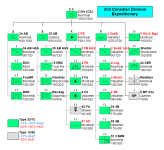
3 Ed Figure 7 2 Cdn Div A.png

🍻
 
That's an interesting structure. Graphically it looks like this in Wikipedia.

960px-7th_Infantry_Division_-_Multi-Domain_Command_Pacific_-_Organization_2026.png


There are a few comments I have:

1. The SBCT structures are relatively unchanged since SBCTs haven't gone through a major Transformation in Contact review (That was IBCTs --> MBCTs and currently ABCTs). 1 SBCT has lost its engineer battalion and 2 SBCT have gained an MFRC but that seems to be it.

2. Note that there is no divisional sustainment brigade. Each of the four brigades retain their organic brigade support battalions (BSB) in roughly the same way that three of them retain their own artillery. It makes you wonder if a fires bde and a sustainment brigade will consolidate those in the future and, eventually, a sustainment brigade formed with the addition of a maintenance and logistics battalions and consolidation of the BSBs.

3. IMHO, 1 MDTF should become a fires brigade by retaining all of its own assets and having the two M777 battalions and their respective forward support companies moved over. The current issue may be the limited range of the M777 supporting the mobile Strykers. IMHO the US Army's stalled plan to buy wheeled SPs like Archer or MGS Boxer needs to move forward. Maybe now that GDLS has shown off the GDLS 10x10 MGS Grizzley, it will make sense to the US to buy a few hundred of those for their remaining Stryker brigades. That would provide sufficient mobility for the CS battalions to join the rocket battalion in a proper fires brigade, which function can easily be added in 1 MDTF.

(Not to toot my own horn but you'll have seen structures similar to this one in my own previous napkin forces like this one for an expeditionary armoured division - Note the size of ~11,340 personnel and the absence of the aviation brigade which I consider a corps asset. Note also the inclusion of the 2nd Pan-Domain Regiment (2 PD) - in my 2 Fires Brigade (2 FB). 2 PD is a beefed up version of 7 ID's 1 MDEB.)

View attachment 100894

🍻

I am starting to think that one of the reasons the "cavalry" debate is so fraught is that given all the ISR assets being pushed downwards to the infantry battalions it appears as if the infantry is taking over thee recce and shield roles of the cavalry.

Concurrently long range precision fires are squeezing the airforce and army aviation.

The net result is that more formations are starting to look like the British Recce Strike Brigade.

7ID MDC-Pac = 7 Recce Strike Div.
 
It is interesting to look at this alignment in conjunction with the sister divs in I Corps.

All of them, 4, 7, 11 and 25 are based on two triangular infantry brigades with no cavalry and a developing MFRC.

4 and 7 are based on Strykers and 11 and 25 are based on ISVs.

11 retains a parachute qualified brigade as one of its two MBCTs.

4 has an ABCT attached. The only one available to I Corps.

So I Corps 4 divs command 4 Stryker Brigades, 4 ISV based MBCTs with one of them airborne qualified and a single Bradley-Abrams ABCT.

All divisions retain a Combat Aviation Brigade or similar.

All have integral sustainment brigades.

The Arty picture seems to be developing.

11 and 7 have not formed a DivArty complex but 7 has the MDTF and retained arty battalions in the brigades with 18 M777s each.

4 and 25 have DivArties with 4 holding 36 M777s for its two Stryker Brigades and 18 M109s for its ABCT. 4 has no HIMARS or MRLS but I Corps also has 17 Field Artillery Brigade with two rocket battalions. I am guessing that the ABCT and the FAB would likely be paired in the main effort. Recce Strike.

Meanwhile 25 Divarty now comprises 16 M119, 12 M777s and 16 HIMARS. It also has an Int and EW Battalion which seems to be moving into MDEB terrain and the Div GOC is looking for long range UAVs like Gray Eagle so that he can fully exploit his LRPF HIMARS.

The only thing missing is an IFPC GBAD battalion for 25 ID
 
I am starting to think that one of the reasons the "cavalry" debate is so fraught is that given all the ISR assets being pushed downwards to the infantry battalions it appears as if the infantry is taking over thee recce and shield roles of the cavalry.

Concurrently long range precision fires are squeezing the airforce and army aviation.

The net result is that more formations are starting to look like the British Recce Strike Brigade.

7ID MDC-Pac = 7 Recce Strike Div.
I used to poo-poo the Brit's recce strike brigade. I'm still pretty sure I don't want to merge recce and artillery in one brigade. I see the value of recce/strike and the distinction of a deep and close battle within the division construct as artillery does both and recce doesn't (to that extent).

In my own mind I've added a single regiment to be the ground based deep role in my division. Here represented by the SherF signified by a tracked unit doing both recce and anti-armour functions (through a variety of means). I've got my own idea of what such a unit should have besides recce and anti-armour equipment (including its own FOOs, AD, engineers and infantry) but am not settled on the whole thing including its actual size and whether it should be able to function on more than two axes and what its doctrine for offensive operations should be.

🍻
 
I used to poo-poo the Brit's recce strike brigade. I'm still pretty sure I don't want to merge recce and artillery in one brigade. I see the value of recce/strike and the distinction of a deep and close battle within the division construct as artillery does both and recce doesn't (to that extent).

In my own mind I've added a single regiment to be the ground based deep role in my division. Here represented by the SherF signified by a tracked unit doing both recce and anti-armour functions (through a variety of means). I've got my own idea of what such a unit should have besides recce and anti-armour equipment (including its own FOOs, AD, engineers and infantry) but am not settled on the whole thing including its actual size and whether it should be able to function on more than two axes and what its doctrine for offensive operations should be.

🍻

Whoever they are, as they're likely to be surrounded, they should probably receive training in escape and evasion skills ;)
 
It is interesting to look at this alignment in conjunction with the sister divs in I Corps.
Here's another interesting similarity. None of them have a protection brigade as was set out in the 2022 projections for the Army 2030 force structure. Too bad Canada hasn't caught up. IMHO, protection brigades are superfluous. Their assets should be: part of other divisional brigades (eg AD as part of fires); be simply stand alone divisional troops (e.g. engineers and MPs); or part of theatre/corps troops (e.g. CBRN)

🍻
 
IMHO, 1 MDTF should become a fires brigade by retaining all of its own assets and having the two M777 battalions and their respective forward support companies moved over. The current issue may be the limited range of the M777 supporting the mobile Strykers. IMHO the US Army's stalled plan to buy wheeled SPs like Archer or MGS Boxer needs to move forward. Maybe now that GDLS has shown off the GDLS 10x10 MGS Grizzley, it will make sense to the US to buy a few hundred of those for their remaining Stryker brigades. That would provide sufficient mobility for the CS battalions to join the rocket battalion in a proper fires brigade, which function can easily be added in 1 MDTF.

I think you might be missing the point of the MDTF here. It's a rear echelon formation that does everything from air defence, to long range strike, to SIGINT, to EW, to Space Based ISR to offensive cyber. I have questions about how much of this is complementary and/or should be in the same brigade. But at minimum, I think treating it like a Fires brigade belies its purpose and the optionality it was supposed to create.

Also the reason the SBCTs still have their BSBs is part of this. Optionality. Allows them to be detached and deployed separately. Or even in theater, allows that brigade to manoeuvre more independently. You can, it course, ask if that's a good idea.

For us, the CA is getting a new Joint ISR Regiment. The Space Wing can now deploy Space Support Teams (SSTs). And the CA has 21 EWR. Throw in a Cyber Team, the upcoming HIMARS regiment and some air defence, and this would be a crude MDTF.
 
I used to poo-poo the Brit's recce strike brigade. I'm still pretty sure I don't want to merge recce and artillery in one brigade. I see the value of recce/strike and the distinction of a deep and close battle within the division construct as artillery does both and recce doesn't (to that extent).

To some extent. The concept of recce has to change in the age of drones and space based ISR.

The American MDTF aims to sense deep and attack deep, often through non-Kinetic means (Cyber, EW). All the Kinetic effects start 70 km out and go further. They're not really focused on MLRS. More PrSM, Dark Eagle and Tomahawks. They are really meant to fight at 300+ km.

The British concept is different. They really are a tactical level formation. The limits of their fires are 300 km with PrSM. They don't have deep sense and non-kinetic capabilities integral to them. They are spotters for tube and HIMARS.

I don't think either is correct. The MDTF seems weird subordinate to a Division. Seems like a theatre level formation. Flip side, I'd be weary in this day and age of a division not being able to sense deep, or employ EW and Cyber by itself.
 
I think you might be missing the point of the MDTF here. It's a rear echelon formation that does everything from air defence, to long range strike, to SIGINT, to EW, to Space Based ISR to offensive cyber. I have questions about how much of this is complementary and/or should be in the same brigade. But at minimum, I think treating it like a Fires brigade belies its purpose and the optionality it was supposed to create.
I don't think that I'm missing the point at all.

MDTF's original concept was to be a theatre level resource designed to use deep fires to take out opposing A2/AD systems to allow penetration of enemy defensive sectors. The MDEB was the sensor/analysis function and the rocket battalion its strike capability. The AD battalion for its own defence. It was not originally designed as part of a division.

Similarly, the SBCT was originally originally designed as a mid weight, more protected than an IBCT and lighter than an ABCT, deployable force for short of MCO operations. Just prior to 2022, the US Army was reinventing itself into new divisional structures. The SBCT was a lost puppy looking for a role. Initially it was slotted as the third brigade in some armored divisions. But in any case, the independent deployable SBCT concept was losing favour.

The structure that 7 ID has is a new one. It is merging two disparate elements into one division but IMHO, it is not merely an administrative function. The division is clearly in an experimental mode (I'm not sure if it is a new phase of TiC for the remaining MDTFs and SBCTs or a stand alone effort for the Pacific) but quite clearly there will be changes. As I said above, the artillery in an SBCT is M777 which is less and less a valuable system because of its range and mobility restrictions. A change of tube artillery battalions to being under command of a fires or MDTF does not change the basic find/analyze and strike function of the MDTF. Modern artillery brigades in all divisions are changing to this concept of multi-domain fusion.

The key element here is the MDEB which is an outgrowth of an ICEWS battalion which is appearing in all divisions. Here's a recent article about the fluidity of the ICEWS. The question is whether the MDEB as constituted in 7th ID is fundamentally different or identical to the ICEWS in, for example, 101 Airborne Div as the available weapon systems get deeper and deeper strike capabilities.

The real point is that because of range reach, the fundamental role of div arty is changing, or at least needs to change. The wide variety and reach of sensors available at the div level, combined with the wide variety of effector systems, makes it critical that, at the div level, there be a fusion cell that translates all sensor data into an appropriate effect. The ICEWS is a step in that direction. Where it is located and how it does its job is still being experimented with. IMHO, it is a natural fit in a fires brigade because of the reach that this brigade has across and beyond the entire div area. MDTFs were basically conversions of five existing fires brigades. They basically still mimic that structure but with greater assets and reach than before. I think you'll find that there will be convergence of the functions between an existing divisional arty brigades and the MDTF with the only real distinction being the reach of the weapon systems involved where some of these brigades have more tactical reach and others more strategic.
Also the reason the SBCTs still have their BSBs is part of this. Optionality. Allows them to be detached and deployed separately. Or even in theater, allows that brigade to manoeuvre more independently. You can, it course, ask if that's a good idea.
Intellectually the US is moving (has moved?) away from the idea of a BCT as the lowest form of independently deployable tactical entity. IMHO, the 7ID structure is more of an artifact of preexisting organizations which remain under transition.
For us, the CA is getting a new Joint ISR Regiment. The Space Wing can now deploy Space Support Teams (SSTs). And the CA has 21 EWR. Throw in a Cyber Team, the upcoming HIMARS regiment and some air defence, and this would be a crude MDTF.
I won't be looking at Canada as an example of what future organizations look like. 1 Div (CA), as it is being restructured, has more to do with force generation of small bits and pieces rather than creating a standard deployable division model. I'd like to think that there is a vision for a proper deployable division but my cynicism leaves me with the impression that the army will continue to ad hoc itself into the field.

IMHO, the army consists of two primary organizations - those designed for the close fight and those designed to support that fight as well as fighting a deep battle. It seems inevitable (barring the usual cap badge infighting) that in this new world where the battle in the third dimension has transitioned from the 1980s air-land battle into something entirely new and pervasive, that indirect effects - whether fires or EW - and all domain sensors need to be solidly fused.

🍻
 
  • Insightful
Reactions: ytz
To some extent. The concept of recce has to change in the age of drones and space based ISR.
No doubt. But it extends beyond those sensors in that recce should no longer be pure recce, but an agency that can fight on a broader, more porous battlefield. In effect the deep area well forward of the effects that are the main battle fought by the division's manoeuvre brigades.
The American MDTF aims to sense deep and attack deep, often through non-Kinetic means (Cyber, EW). All the Kinetic effects start 70 km out and go further. They're not really focused on MLRS. More PrSM, Dark Eagle and Tomahawks. They are really meant to fight at 300+ km.
Exactly, but my point, as stated in my previous post, is that there is functionally no difference between the job being done by a divisional arty bde and an MDTF except its reach as achieved by its effectors. While the two brigades look at different target zones and engage them with different rockets, the basic functions of the total organization and its fusion actions are the same.
The British concept is different. They really are a tactical level formation. The limits of their fires are 300 km with PrSM. They don't have deep sense and non-kinetic capabilities integral to them. They are spotters for tube and HIMARS.
1 DRSBCT is an organization based on Cold War concepts and the strategic deployment model of their support to continental NATO. They were building it around AJAX but in a chiefly pre-drone era. They weren't "merely spotters;" they were meant to fight albeit not decisively. Their organization and tactics need to evolve, particulalry in how they group their artillery.
I don't think either is correct. The MDTF seems weird subordinate to a Division. Seems like a theatre level formation. Flip side, I'd be weary in this day and age of a division not being able to sense deep, or employ EW and Cyber by itself.
Here we totally agree on both counts. Hence my view that an MDTF, in form and function, is merely a divisional arty brigade but capable of deeper reach. Functionally they should operate identically making massive use of all available sensors, a highly capable fusion function, and appropriate kinetic and non kinetic effectors suited to the tactical or strategic range they are expected to operate at.

🍻
 
Last edited:
  • Insightful
Reactions: ytz
The MDTF is an awkward attempt to embrace MDO, without understanding the underlying doctrinal concepts

Pan/Multi-Domain Operations

Domains

Land
Sea (Water)
Air
Space
Cyber

Adaptive Dispersed Operations

.....

Does the modern Land Battle look more like an Air Battle, or even a Sea Battle?

No terrain anchors. No secure flanks. No front or rear. No linearity.

Instead a host of bubbles. Some as small as sections and platoons. Some overlapping. Some not. Some operating within higher bubbles. Some operating outside of any support.

In all cases command has to "keep their head on a swivel" and be aware of all the domains that influence it and it can influence.

....

Is Multi-Domain Operations just Joint Operations repackaged? Does it get away from capbadge parochialism?

....

7 ID (MDC-Pac) doesn't work in isolation. It fits within I Corps along with 4, 11 and 25 Divs as well as 17 FAB as the principal combat element of US Army Pacific. The senior element in USARPAC is 8th Army in South Korea but the centre of gravity of USARPAC seems to be Hawaii.

USARPAC has two other major combat elements.

94th Army Air and Missile Defence Command

And

3rd Multi-Domain Task Force.

How large a protective bubble, or bubbles, can those two organizations project.

Was 3 MDTF duplicating 1 MDTF? Did they work side by side or did one work close and one deep covering the entire theater? And if one was working close how did its MDEB differ from 25 Divs ICEW? And how did the LRPFs Battalions of the MDTFs differ from the Corps Field Artillery Brigade armed with HIMARS?

....

Moving outwards USARPAC reports to US Pacific Command which means it works alongside I MEF and III MEF and III MEF has its two MLRs and a short staffed Regiment while I MEF is a full Division that supports the continued deployment of three Battle Group sized MEUs.

The Marines also have their own Air Force but they too are heavying up on Long Range Precision Fires and all manner of UxVs.

And of course US Pacific Command has its own Air Force, Navy, Space and Cyber Elements.

...

But

Squad
Platoon
Company
Battalion
Brigade
Division
Corps
Army Command
Combined Command

Theoretically when a Squad got into trouble it should be able to call on all the assets available to the Combined Force Commander....
Were there enough resources available centrally to be able to assist every Squad in trouble?
Could information be passed, and decisions made, in a sufficiently timely fashion to manage all those dispersed Squads?

...

Ukraine is fighting a war that in many senses, I think, is more like Vietnam than WW2 but with Ukraine playing Giap's hand.
The US playbook is all about concentration - bringing mass to the schwerpunkt and the grand battle.
The wars that the US has lost, and that Russia is in the process of losing, have been more like partisan or guerilla wars, the ultimate in dispersed operations.

And in those dispersed operations each individual element, like a lone frigate at sea, is responsible for its own all round defence in all domains, its own bubble, while maintaining an ability to act effectively offensively in conjunction with others. Frigates with sensors, helicopters and missiles find their analogs in infantry squads with sensors, drones and missiles.

Every level of command has a need for its own Multi-Domain co-ordination element.
 
Back
Top