• Thanks for stopping by. Logging in to a registered account will remove all generic ads. Please reach out with any questions or concerns.

Ottawa set to announce purchase of APVs (from CBC news)

Ex-Dragoon

Army.ca Fixture
Reaction score
17
Points
430
http://www.cbc.ca/canada/story/2007/07/09/arctic-cda.html
Ottawa to announce new Arctic patrol vessels
Last Updated: Monday, July 9, 2007 | 5:43 AM ET
CBC News
The Conservative government is expected to announce the purchase of six new Arctic patrol vessels Monday, following through on a promise to defend the country's northern regions.
Prime Minister Stephen Harper will make the announcement during a ceremony at the Canadian Forces base Esquimalt on Vancouver Island.
Defence Minister Gordon O'Connor, Natural Resources Minister Gary Lunn and Agriculture Minister Chuck Strahl will attend the ceremony.
Harper pledged during the federal election campaign to defend the Arctic, promising to spend billions to buy new underwater sensors, build an army base in Cambridge Bay, construct a deepwater port near Iqaluit and buy three naval ice-breakers.
Monday's announcement won't be the purchase of ice-breakers, but of six smaller Arctic patrol vessels.
"Any additional activity or resources that we apply to the North will increase our claim to sovereignty," said Pierre LeBlanc, the former CF commander in the North.
Documents obtained by the CBC indicate the military has evaluated four possible sites to base the vessels, including Iqaluit.
But LeBlanc says Iqaluit isn't the right location because it is nowhere near the Northwest Passage. Canada's military, he says, should be centred right in the middle of the Arctic, at Resolute Bay.
"Iqaluit is completely on the east coast of Canada and it would take ages to go to the West Coast from Iqaluit," he said.
"In terms of Canadian sovereignty, I think it would be the wrong place."
The military already has a base there, he said, and it would simply be a matter of expanding it.
 
Ex-Dragoon said:
http://www.cbc.ca/canada/story/2007/07/09/arctic-cda.html
Ottawa to announce new Arctic patrol vessels
Last Updated: Monday, July 9, 2007 | 5:43 AM ET
CBC News
The Conservative government is expected to announce the purchase of six new Arctic patrol vessels Monday, following through on a promise to defend the country's northern regions.
Prime Minister Stephen Harper will make the announcement during a ceremony at the Canadian Forces base Esquimalt on Vancouver Island.
Defence Minister Gordon O'Connor, Natural Resources Minister Gary Lunn and Agriculture Minister Chuck Strahl will attend the ceremony.
Harper pledged during the federal election campaign to defend the Arctic, promising to spend billions to buy new underwater sensors, build an army base in Cambridge Bay, construct a deepwater port near Iqaluit and buy three naval ice-breakers.
Monday's announcement won't be the purchase of ice-breakers, but of six smaller Arctic patrol vessels.
"Any additional activity or resources that we apply to the North will increase our claim to sovereignty," said Pierre LeBlanc, the former CF commander in the North.
Documents obtained by the CBC indicate the military has evaluated four possible sites to base the vessels, including Iqaluit.
But LeBlanc says Iqaluit isn't the right location because it is nowhere near the Northwest Passage. Canada's military, he says, should be centred right in the middle of the Arctic, at Resolute Bay.
"Iqaluit is completely on the east coast of Canada and it would take ages to go to the West Coast from Iqaluit," he said.
"In terms of Canadian sovereignty, I think it would be the wrong place."
The military already has a base there, he said, and it would simply be a matter of expanding it.

Wouldn't we need heavier ships to operate out of Resolute Bay 24/7/365?


Matthew.  :salute:
 
Its already been said these would not be ice breakers just ice capable ships
 
Ex-Dragoon said:
Its already been said these would not be ice breakers just ice capable ships

Let me ask the dumb question.
What is the difference?
Is ice capable the ability to withstand collision with ice bergs or floes rather then being able to break up the ice?
 
http://www.cbc.ca/canada/story/2007/07/09/arctic-cda.html

The federal government will fund the construction of six to eight new Arctic patrol ships to help reassert Canada's sovereignty over the North, Prime Minister Stephen Harper said Monday. The Polar Class 5 Arctic Offshore Patrol Ships will be custom-built, state of the art and made in Canada, Harper said during a ceremony at Canadian Forces Base Esquimalt on Vancouver Island.

...

The ships will cost about $3.1 billion, with about $4.3 billion for operations and maintenance over their 25-year lifespan. "Canada has a choice when it comes to defending our sovereignty over the Arctic," Harper said. "Either we use it or we lose it. And make no mistake — this government intends to use it."

He said the ships' hulls will be reinforced with steel and be able to crunch though ice up to a metre thick, allowing the ships to patrol the length of the Northwest Passage during months when a Canadian naval presence is necessary.

The vessels will be armed and will have a helicopter landing pad, Harper added. Harper also said the government will construct a deepwater port somewhere in the Far North, with the location to be announced soon. The port will be used as an operation base for the new patrol vessels. Defence Minister Gordon O'Connor, Natural Resources Minister Gary Lunn and Agriculture Minister Chuck Strahl were among those at CFB Esquimalt for the announcement.

During the run-up to the 2006 federal election, Harper promised to boost defence in the Arctic, spend billions to buy new underwater sensors, build an army base in Cambridge Bay, construct a deepwater port near Iqaluit and buy three naval ice-breakers.

4 possible sites for Arctic port. Documents obtained by CBC News indicate the military has evaluated four possible sites to base the vessels, including Iqaluit.  Before Harper made the official announcement, Pierre LeBlanc, the former CF commander in the North, welcomed the idea of new resources for the North.

"Any additional activity or resources that we apply to the North will increase our claim to sovereignty," said LeBlanc.

However, he said, Iqaluit wouldn't be the best location because it is nowhere near the Northwest Passage. Canada's military should be centred right in the middle of the Arctic, at Resolute Bay, LeBlanc said. "Iqaluit is completely on the East Coast of Canada and it would take ages to go to the West Coast from Iqaluit," he said. "In terms of Canadian sovereignty, I think it would be the wrong place." He recommended that the military should expand the presence it already has at Resolute Bay.
 
Bit of detail from the event....

Prime Minister Stephen Harper Announces New Arctic Offshore Patrol Ships
Gov't of Canada news release, 9 Jul 07
http://news.gc.ca/web/view/en/index.jsp?articleid=335789&categoryid=1&category=News+Releases&

Prime Minister Stephen Harper today announced the construction of up to eight Polar Class 5 Arctic Offshore Patrol Ships and the establishment of a deep water port in the far North.

“Canada has a choice when it comes to defending our sovereignty over the Arctic. We either use it or lose it. And make no mistake, this Government intends to use it. Because Canada’s Arctic is central to our national identity as a northern nation. It is part of our history. And it represents the tremendous potential of our future,” said Prime Minister Harper.

These new Polar Class 5 Arctic Offshore Patrol Ships will be custom-designed and built in Canada, and will be amongst the heaviest, most versatile armed naval vessels capable of sustained operations in ice. With steel-reinforced hulls, they will be capable of operating in ice up to one metre thick, and each vessel will also be equipped with a helicopter landing pad. They will be able to patrol the length of the Northwest Passage during the summer navigable season and its approaches year-round, and will also be capable of full operations on the East and West Coasts throughout the year.

To conduct sea-borne surveillance operations in the Arctic, a deep water port will be constructed to allow the patrol ships to re-supply and re-fuel.

“In defending our nation’s sovereignty, nothing is as fundamental as protecting Canada’s territorial integrity; our borders, our airspace and our waters,” said the Prime Minister. “More and more, as global commerce routes chart a path to Canada’s North and as the oil, gas and minerals of this frontier become more valuable, northern resource development will grow ever more critical to our country.”

The estimated cost of acquiring the Arctic Offshore Patrol Ships is $3.1 billion, with approximately $4.3 billion provided for operations and maintenance over their 25-year lifespan.

The procurement strategy will conform to the Canadian Shipbuilding Policy Framework, which requires the federal government to procure, repair and refit vessels in Canada.
 
Backgrounder
Arctic/Offshore Patrol Ships


BG–07.023 - July 10, 2007

In the current and future security environment, the Government of Canada must have effective tools for exercising control of Canada’s Exclusive Economic Zones (EEZs, or 200 nautical mile limit) in all three oceans, particularly the Arctic. This Government recognizes that an increased Canadian Forces (CF) presence in the Arctic is essential to achieving our goals in this region, which is critical to our national interest and sense of identity.

Currently, the Canadian Navy can patrol the coastal waters of Canada’s East and West Coasts, but it does not have the capability to effectively patrol all three oceans. The Navy can only operate in northern waters for a short period of time, and only when there is no ice.

While the Navy can effectively patrol our close coastal waters in the Atlantic and Pacific with its Maritime Coastal Defence Vessels (MCDVs), these ships cannot be used effectively out to the limits of Canada’s EEZs. They have limited ability to operate in the open ocean, limited speed, limited capacity to support boarding operations and lack the ability to support a helicopter. The Navy must use its large combatant vessels – destroyers and frigates, which are expensive to operate and already over-tasked - to patrol the open ocean.

To fill this capability gap, the Navy will acquire up to eight Arctic/Offshore Patrol Ships (A/OPS). The estimated cost of acquiring these ships is $3.1 billion, with approximately $4.3 billion provided for operations and maintenance over the 25-year lifespan of the ship.

The multi-purpose, ice-capable offshore patrol ship will enhance Canada’s ability to enforce its right, under international law, to be notified when foreign ships enter Canadian waters. The primary tasks of the A/OPS would be to conduct sea-borne surveillance operations in Canada’s EEZs, including the Arctic; provide cross-governmental situation awareness of activities and events in the regions; and cooperate with other elements of the CF and other federal government departments to assert and enforce Canadian sovereignty, when and where necessary.

These ships will also provide the flexibility for the Navy to operate in both the Arctic and offshore environments, allowing them to be used year-round in a variety of roles, including domestic surveillance, search and rescue and support to other government departments.

The Arctic/Offshore Patrol Ship offers the best blend of capabilities in one platform; however, a ship with these capabilities does not currently exist and would have to be designed to meet a series of high-level requirements:

Seakeeping: The A/OPSs must be able to operate independently and effectively in Canada’s EEZs, including such diverse environments as the Canadian Arctic, the Grand Banks of Newfoundland and the Northwest Coast of the Queen Charlotte Islands. The ship must also be capable of navigating the St. Lawrence River year-round and berthing at Quebec City.

Ice Capability: The hull of the A/OPS must be ice strengthened to operate in medium first-year ice, which may include old ice inclusions - old ice that is denser and may strike the hull of the ship. This ice capability is exclusively for the ships’ own mobility, not to provide icebreaking services to other ships.

Endurance/Range: The ship must have the ability to sustain operations for up to four months and must have a range of at least 6,000 nautical miles.

Command and Control: The ship’s electronic equipment must have the ability to ensure safety of navigation and flight, as well as sufficient command, control and communications capability to provide and receive real-time information to and from the CF Common Operating Picture.

Speed: The ship must be able to maintain an economical speed of 14 knots and attain a maximum speed of at least 20 knots.

Armament: The ship must have gun armament to assert Canadian sovereignty.

Boat Operations: The ship’s crew must be able to conduct boat operations in up to sea state four, support operations ashore via landing craft and support naval boarding parties.

Class Life: The ships should remain operational for 25 years.

The ship may also be designed to embark and operate an on-board helicopter, as well as house one flying crew and one maintenance crew.
Procurement Strategy

The two-phased process of procuring the A/OPS will be an innovative, fair and transparent means of guaranteeing the requirements of the CF are met in a timely manner, while ensuring value for Canadians’ tax dollars and maximizing opportunities for Canadian industry. Industrial and regional benefits totalling 100 per cent of the contract value would be sought for the implementation contract.

A project definition phase of 24 months will be needed to develop the functional design, refine the high-level statement of operational requirements (SORs), complete and issue the Request for Proposal (RFP) for the implementation phase of the project and evaluate responses. A competitive process will be used to select a Definition, Engineering, Logistics and Management Support (DELMS) contractor, who will develop the design used to refine the requirements and provide input into the RFP. During this time, consulting engineering contractors will also deliver a functional design for the infrastructure needed to support the A/OPS.

Throughout the project definition phase, industry will be kept engaged and informed of progress and design work. Interest from industry will be sought through a Letter of Interest to allow potential bidders to self-identify, and qualified teams will be invited to comment on the draft project implementation (PI) RFP. The definition phase of the procurement process would end with the release and evaluation of this RFP.

The implementation phase of the process would involve the successful contractor completing a detailed design of the ships, followed by construction and the provision of integrated logistics support, and initial in-service support. Delivery of the first Arctic/Offshore Patrol Ship is expected in 2013.

The procurement strategy would conform to the Canadian Shipbuilding Policy Framework, which provides that the federal government will continue to procure, repair and refit vessels in Canada, subject to operational requirements and the continued existence of a competitive domestic marketplace.

This acquisition will create long-term industrial development for Canadians. The Government's policy requires that prime contractors on defence procurements undertake business activities in Canada, usually in an amount equal to the value of the contract they have won. This helps Canadian companies maintain globally competitive operations in the country and effectively support future national security requirements.

The acquisition of these ships will deliver maximum high-quality industrial benefits to Canadians and the Canadian shipbuilding industry is well positioned to play a significant role as this project proceeds.


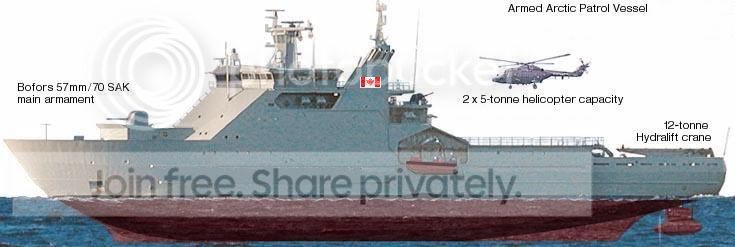
I was emailed this article, as well as a picture.  I am unable to track down a link for the picture, but am attempting to prove that it is valid.

cid_76556151811072007-19c9.jpg
 
The picture appears to be a (Canadian) representation of the Norwegian 'Svalbard' class.

http://www.sfu.ca/casr/bg-icebreaker-svalbard.htm
http://www.sfu.ca/casr/doc-dnd-icebreaker.htm
 
From the Globe and Mail story:
http://www.theglobeandmail.com/servlet/story/LAC.20070710.HARPERSUB10/TPStory/Front

Each will be about 100 metres long and displace about 3,000 metric tonnes...

Svalbard displaces over 6,000 t:
http://www.sfu.ca/casr/bg-icebreaker-svalbard.htm

Unless the story is inaccurate (good chance!) the 3,000 tonnes figure is ridiculous.

Mark
Ottawa


Having spent many months on CCGS St. Catherines (300 ft corvette weathership)....have fun!!
 
I have started a related topic in the Navy News forum, if people are interested:  http://forums.navy.ca/forums/threads/64037.0.html

 
GAP: More on St. Catharines  here--apparently actually an ex-frigate:
http://www.ccg-gcc.gc.ca/usque-ad-mare/chapter08-09_e.htm

Mark
Ottawa
 
I wonder how often the Navy will be rotating folks in and out of the Arctic fleet?  In the old days of the Communicator Research Op (Comm Rsch Op) trade we used to have personnel at Churchill, Inuvik and a number of other Arctic sites.  They were accompanied postings, and a number of the fellows liked it, but there wasn't much of a night life.  Still, I guess it beats Alert.

There must be a lot of buzz already in Halifax and Esquimalt about getting posted 'north.'
 
EW said:
I wonder how often the Navy will be rotating folks in and out of the Arctic fleet?  In the old days of the Communicator Research Op (Comm Rsch Op) trade we used to have personnel at Churchill, Inuvik and a number of other Arctic sites.  They were accompanied postings, and a number of the fellows liked it, but there wasn't much of a night life.  Still, I guess it beats Alert.

There must be a lot of buzz already in Halifax and Esquimalt about getting posted 'north.'
Can't seem to find where I had read it, but the article I am attempting to locate stated the ships would based in Esquimalt & Halifax. This in turn would reduce the number of personnel required to be posted to the Arctic itself.
 
Back
Top