• Thanks for stopping by. Logging in to a registered account will remove all generic ads. Please reach out with any questions or concerns.

Pipelines, energy and natural resources

  • Thread starter Thread starter QV
  • Start date Start date
More 'talk' than 'walk'... a sad but familiar tale....

Why do people put so much stock in MOU's? They are just an understanding that eventually you'll get back together and continue to talk about the subject. Sure, that's an oversimplification, but not far off.

Key Highlights of an MOU.

  • A memorandum of understanding (MOU) is defined as an agreement between parties and can be bilateral (two) or multilateral (more than two parties).
  • In order to prepare a complete and effective document (MOU), the parties affected must first reach an understanding acceptable by each party and clear information on the important stances for each of those parties.
  • The MOU, although a formal document, is not legally binding. It merely shows the willingness of each concerned party to take action to move the contract forward.
 
Are you under the impression that China is going to import oil and gas to replace domestic coal? Have people learned nothing about energy security from the last few months?
No.
I am a firm believer that energy is energy regardless of the source.
 
Why do people put so much stock in MOU's? They are just an understanding that eventually you'll get back together and continue to talk about the subject. Sure, that's an oversimplification, but not far off.

Key Highlights of an MOU.

  • A memorandum of understanding (MOU) is defined as an agreement between parties and can be bilateral (two) or multilateral (more than two parties).
  • In order to prepare a complete and effective document (MOU), the parties affected must first reach an understanding acceptable by each party and clear information on the important stances for each of those parties.
  • The MOU, although a formal document, is not legally binding. It merely shows the willingness of each concerned party to take action to move the contract forward.
and 100% predictable.
 
Then you should understand why dreams of displacing coal use in China with gas are just that: dreams.

Absolutely.

Just as I struggle with finding benefits in wind and solar over coal. I can accept a lot of costly remedies that make the burning of coal more efficient and cleaner with the before I reach the cost and inefficiency of wind and solar.

And I can move coal more easily than electricity.
 
Just as I struggle with finding benefits in wind and solar over coal. I can accept a lot of costly remedies that make the burning of coal more efficient and cleaner with the before I reach the cost and inefficiency of wind and solar.

The fact that you think wind and solar are more expensive than coal, is the root of your misunderstanding. Especially in China. The only reason coal use is up now is because oil and gas imports are down.

The clickbait article also ignores that China produces more PV panels and builds more nuclear plants that the rest of the world combined too. Their basic philosophy to energy production is "all of the above".

And I can move coal more easily than electricity.

Never mistake uniquely Canadian incompetence as universal.

They have no issues building HVDC lines in China.
 
The fact that you think wind and solar are more expensive than coal, is the root of your misunderstanding. Especially in China. The only reason coal use is up now is because oil and gas imports are down.

The clickbait article also ignores that China produces more PV panels and builds more nuclear plants that the rest of the world combined too. Their basic philosophy to energy production is "all of the above".


Never mistake uniquely Canadian incompetence as universal.

They have no issues building HVDC lines in China.

And where do you put the lines and with what are the lines made and how do you maintain the lines and how long do the lines last and how often do you have to replace the lines and what do you do with the old lines (and poles and pylons and transformers).

TANSTAAFL,
 
China favours natural gas over coal because of pollution, which is a factor which cannot be ignored.

"Energy security" depends in part on where the raw material is coming from. Some sources aren't situated in perennial conflict zones adjacent to troublemakers.

Countries may insist on trying to become energy autarkies because they've been spooked by one war, but it'll place them at a strong disadvantage. A major reason they aren't already autarkies is because of costs, so costs - including externalities like pollution - will increase.
 
China favours natural gas over coal because of pollution, which is a factor which cannot be ignored.

"Energy security" depends in part on where the raw material is coming from. Some sources aren't situated in perennial conflict zones adjacent to troublemakers.

Countries may insist on trying to become energy autarkies because they've been spooked by one war, but it'll place them at a strong disadvantage. A major reason they aren't already autarkies is because of costs, so costs - including externalities like pollution - will increase.

This is very true. The reason China doesn't have more dominance over aluminum production at this moment for example is because of the amount of pollution put out by the coal plants. They've been in the process of switching the entire industry over to cleaner sources of electricity for the last decade, they're intentionally handicapping their own production.

We were incredibly lucky that our geography allowed us to skip ahead of that step.
 
  • Like
Reactions: ytz
This is very true. The reason China doesn't have more dominance over aluminum production at this moment for example is because of the amount of pollution put out by the coal plants. They've been in the process of switching the entire industry over to cleaner sources of electricity for the last decade, they're intentionally handicapping their own production.

We were incredibly lucky that our geography allowed us to skip ahead of that step.

And you can thank Peterborough, Ontario for that. Canada's first city to power its streetlights with its own hydro plant leading to the Columbia being dammed to produce aluminum for Boeing in Seattle.
 
And where do you put the lines and with what are the lines made and how do you maintain the lines and how long do the lines last and how often do you have to replace the lines and what do you do with the old lines (and poles and pylons and transformers).

Do you know what HVDC lines are? Serious question. It's nothing like the hydro pole on your street.
 
The fact that you think wind and solar are more expensive than coal, is the root of your misunderstanding. Especially in China. The only reason coal use is up now is because oil and gas imports are down.

The clickbait article also ignores that China produces more PV panels and builds more nuclear plants that the rest of the world combined too. Their basic philosophy to energy production is "all of the above".


Never mistake uniquely Canadian incompetence as universal.

They have no issues building HVDC lines in China.

The fact that you think wind and solar are more expensive than coal, is the root of your misunderstanding. Especially in China. The only reason coal use is up now is because oil and gas imports are down.

The clickbait article also ignores that China produces more PV panels and builds more nuclear plants that the rest of the world combined too. Their basic philosophy to energy production is "all of the above".


Never mistake uniquely Canadian incompetence as universal.

They have no issues building HVDC lines in China.
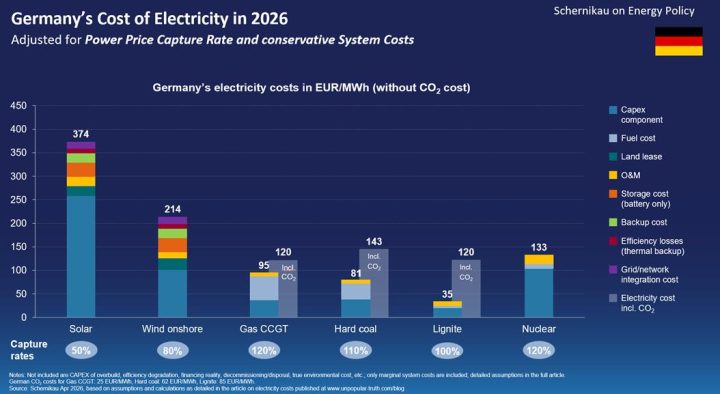
When you take into consideration total system costs, including feed-in tariffs wind and solar become far more expensive. If you could count on them 24/7 your arguments would be correct but you can't. The system is required to provide constant power. That means for at least 12 hours a day solar is useless so alternatives have to be provided. Same with wind. But you know that you simply ignore it. Then there is the multiple high voltage lines (1 to each generator) that costs. Then there is the amount that is paid out annually for power that isn't being used because neither natural source can be regulated. The sun shines, or it doesn't the wind blows or it doesn't. They don't care that you don't need their output all the time. Here are the figures from Germany re: related costs. It is copied from WUWT. Say what you will about the source but the table is accurate.
In fact, in Germany, domestic lignite is the lowest cost of generating electricity with 40 EUR/MWh excl. CO2 and 120 EUR/MWh incl CO2. As you can see below, solar is and remains the most expensive. And with regards to your comment on clickbait. don't you think that their starting construction of 94.5 gw of new coal plants 2 years ago might having something to do with those rising coal figures eh? At least a couple of them will be on line now.

image-720x394.jpg
 
When you take into consideration total system costs, including feed-in tariffs wind and solar become far more expensive.

What feed in tarrifs are they paying in China?

Again. What we do here (or in Europe) is not universal.

China obviously has lower costs for renewables. And enough energy security concerns that make any cost differential worthwile. The same is true for every importer.
 
What feed in tarrifs are they paying in China?

Again. What we do here (or in Europe) is not universal.

China obviously has lower costs for renewables. And enough energy security concerns that make any cost differential worthwile. The same is true for every importer.
absolutely. Totally agree. But then why has China actually increased their construction of coal-fired facilities? Perhaps because you can use it when the wind doesn't blow. China is unique in that they control the market on rare earth minerals and they have very low mining costs with their child/slave labour. They can afford to have renewables AND carbon based systems, their lower renewable costs gives them a savings whenever the wind blows and I actually doubt that, with their requirements, they very often have electricity that isn't being used.
 
Back
Top