
why not? It will be patrolling the same water and under the same pressures and with the same potential adversaries regardless of whether it flies the Swedish or Polish flag. In the meantime, SAAB gets a financial shot in the arm and an international sale. Win/win for themWell a quick scan of the web indicates Poland expects to get the first sub by 2030…..which is interesting since the first one, which supposedly is already under construction is due to go to the Swedish Navy in 2031…..are the Swedes going to give up the first hull?

You are using an out of date browser. It may not display this or other websites correctly.
You should upgrade or use an alternative browser.
You should upgrade or use an alternative browser.
TKMS Type 212CD (Victoria class replacement megathread)
- Thread starter Spencer100
- Start date

- Reaction score
- 8,688
- Points
- 1,260
News out of Korea.
I found this part below interesting as I don't think this has been talked about in the past. I know that Germany had said that they could deliver 1 sub by 2035 and then no talk about the next 11 in terms of timelines.
"With Canada’s active submarines expected to retire around 2035, time is tight. Germany reportedly offered to reassign one of its own submarines scheduled for domestic deployment. Specifically, it proposed diverting the third of six stealthy 2,500-ton 212CD submarines it is co-developing with Norway — originally intended for German use in 2028 — to Canada."
So, would this sub in 2028 be in addition to one delivered in 2035, so we'd have 2 in the water by 2035, which is one less than what the SK's have promised or is this a sub in 2028 and then who knows when the next 11 come? Lot's of unknowns still on the German side.

 koreajoongangdaily.joins.com
I found this part below interesting as I don't think this has been talked about in the past. I know that Germany had said that they could deliver 1 sub by 2035 and then no talk about the next 11 in terms of timelines.
"With Canada’s active submarines expected to retire around 2035, time is tight. Germany reportedly offered to reassign one of its own submarines scheduled for domestic deployment. Specifically, it proposed diverting the third of six stealthy 2,500-ton 212CD submarines it is co-developing with Norway — originally intended for German use in 2028 — to Canada."
So, would this sub in 2028 be in addition to one delivered in 2035, so we'd have 2 in the water by 2035, which is one less than what the SK's have promised or is this a sub in 2028 and then who knows when the next 11 come? Lot's of unknowns still on the German side.
'Submarine war' with Germany heats up in race for Canadian contract
With Korea ultimately eliminated from Poland’s bid to upgrade its naval capabilities with the Orka submarine procurement initiative, Seoul has launched an all-out campaign to beat Germany for a 60 trillion won Canadian submarine contract.
'Submarine war' with Germany heats up in race for Canadian contract

- Reaction score
- 9,791
- Points
- 1,210
That's a bit left field. Perhaps Polish media had a better take that we all missed. But honestly looking at where Poland is, where Sweden is and what's a little to the left of them... makes complete sense to me. Industrial benifits, sub designed for the area, able to use each others ports if they need too.
Sweden and Saab selected for Poland’s new submarines - Naval News
The Swedish government's offer of Saab’s A26 submarines to Poland has been selected by the Polish government to replace the current Kilo-class submarinewww.navalnews.com
Poland going with Saab subs it seems. Interesting choice. I guess it makes sense with the Baltic connection.
- Reaction score
- 9,791
- Points
- 1,210
This can only be a good thing for us. Two bidders fighting for the contract.News out of Korea.
I found this part below interesting as I don't think this has been talked about in the past. I know that Germany had said that they could deliver 1 sub by 2035 and then no talk about the next 11 in terms of timelines.
"With Canada’s active submarines expected to retire around 2035, time is tight. Germany reportedly offered to reassign one of its own submarines scheduled for domestic deployment. Specifically, it proposed diverting the third of six stealthy 2,500-ton 212CD submarines it is co-developing with Norway — originally intended for German use in 2028 — to Canada."
So, would this sub in 2028 be in addition to one delivered in 2035, so we'd have 2 in the water by 2035, which is one less than what the SK's have promised or is this a sub in 2028 and then who knows when the next 11 come? Lot's of unknowns still on the German side.
'Submarine war' with Germany heats up in race for Canadian contract
With Korea ultimately eliminated from Poland’s bid to upgrade its naval capabilities with the Orka submarine procurement initiative, Seoul has launched an all-out campaign to beat Germany for a 60 trillion won Canadian submarine contract.
'Submarine war' with Germany heats up in race for Canadian contract

- Reaction score
- 7,007
- Points
- 1,160
Ongoing work planned for the Victoria-class to keep them going until their eventual replacements arrive...

 defence-blog.com
Canadian Victoria-class subs to get new U.S.-built bow array
Delphinus Engineering Inc., based in Newtown, Pennsylvania, has been awarded a $14.5 million contract to develop, fabricate, produce, integrate, and test a new sonar array and lift system for Canada’s Victoria-class submarines. According to a Department of War contract announcement,
defence-blog.com
- Reaction score
- 8,688
- Points
- 1,260
Wonder if this work is for our single operational submarine or will the work be done on all 4 of them, even though 2 or more most likely won't be sailing again. Wonder when they will pay off 1 or 2 of them?Ongoing work planned for the Victoria-class to keep them going until their eventual replacements arrive...
Canadian Victoria-class subs to get new U.S.-built bow array
Delphinus Engineering Inc., based in Newtown, Pennsylvania, has been awarded a $14.5 million contract to develop, fabricate, produce, integrate, and test a new sonar array and lift system for Canada’s Victoria-class submarines. According to a Department of War contract announcement,

Rainbow1910
Sr. Member
- Reaction score
- 2,484
- Points
- 810
Maritime Engineering Journal has a great issue out recently which goes into this refit extensively.Wonder if this work is for our single operational submarine or will the work be done on all 4 of them, even though 2 or more most likely won't be sailing again. Wonder when they will pay off 1 or 2 of them?
To answer your question from the PDF above:
The plan is to upgrade HMCS Windsor, Victoria, and Corner Brook during their respective docking work periods. HMCS Windsor’s implementation will serve as a pathfinder, generating valuable lessons to reduce risk and improve efficiency for subsequent installations. Beyond restoring and enhancing current capability, this program also builds domestic expertise in advanced sonar systems— laying the foundation for Canada’s future submarine fleet.
Some interesting images from the article above as well:
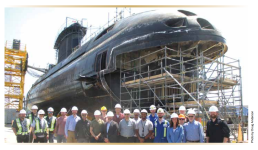
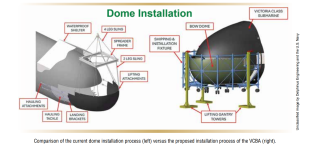
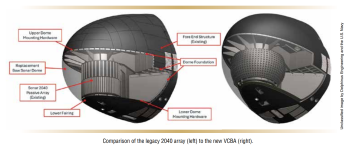
From the journal 4 Domes were fabricated: Windsor , Corner Brook, Victoria and 1 spare.Maritime Engineering Journal has a great issue out recently which goes into this refit extensively.
To answer your question from the PDF above:
Some interesting images from the article above as well:
View attachment 97024
View attachment 97025
View attachment 97026

Maxman1
Army.ca Veteran
- Reaction score
- 3,241
- Points
- 1,190
Since we only have one operational sub, do we rotate out crews on it, or is there only one full sub crew?Wonder if this work is for our single operational submarine or will the work be done on all 4 of them, even though 2 or more most likely won't be sailing again. Wonder when they will pay off 1 or 2 of them?

OldSolduer
Army.ca Relic
- Reaction score
- 22,980
- Points
- 1,260
why may I ask?Yah Chicoutimi will likely never sail again at least from what I'm hearing. Parts bin and salvage for the other submarines.
From USNI news:
Korea Submarine Update
On Wednesday, South Korean President Lee Jae Myung said the Republic of Korea Navy wants to build its planned fleet of nuclear-powered attack boats at home rather than in the U.S.Speaking to foreign reporters in Seoul, Lee affirmed comments last month from Defense Minister Ahn Gyu-back that the RoK Navy wanted to build the nuclear attack boats in Korea instead of the Korean-owned Hanwha Philly Shipyard.
Furthermore, Lee said that Seoul is specifically interested in U.S. help to acquire nuclear fuel for its fleet.
“We’re not asking for construction or tech transfer. Just approval for fuel supply,” he said.
In late October, President Donald Trump said Korean nuclear-powered attack boats would be built at Philly Shipyard, but since the announcement, Korean officials have gently suggested it would make more sense to build the submarines in Korea.
Lee does need Trump’s approval to acquire fuel to power the new class of attack boats. The 2015 Atomic Energy Peaceful Uses Agreement restricts the amount of nuclear fuel South Korea can enrich and would need U.S. permission to produce the fuel it would need for the new boats.
As USNI News reported last month, South Korea has been trying for decades to develop a nuclear-powered submarine force to counter North Korea’s emerging fleet of conventional submarines armed with nuclear ballistic missile. The RoK Navy wants attack boats that can patrol beyond the limitations of a diesel-electric propulsion system.
“Underwater operations with the fleet of diesel-electric submarines are restricted to detecting and countering the North’s SLBM [submarine-launched ballistic missile] threat,” then-President Moon Jae-in said in 2018. “On the other hand, nuclear-powered submarines will help conduct patrols for much longer periods to thwart North Korean SLBM attacks.”
Now Seoul and Washington are figuring out where the fuel will be enriched amid concerns the fuel could be used to develop a South Korean nuclear weapon.
“Some in the U.S. government seem to be a bit cautious,” Lee told reporters. “We make our position clear: We have no intention of arming ourselves with nuclear weapons. It’s realistically impossible.”

- Reaction score
- 24,849
- Points
- 1,010
We mine Uranium…just sayin…
- Reaction score
- 24,849
- Points
- 1,010
How is it “realistically impossible” for South Korea to arm themselves with nuclear weapons when North Korea did it?
GK .Dundas
Army.ca Veteran
- Reaction score
- 2,908
- Points
- 960
It's not .How is it “realistically impossible” for South Korea to arm themselves with nuclear weapons when North Korea did it?
- Reaction score
- 24,849
- Points
- 1,010
So…they have already done it?It's not .
GK .Dundas
Army.ca Veteran
- Reaction score
- 2,908
- Points
- 960
I'm not sure what their time line would be now. But back in the early thousands I saw. Figures the went from six months to a week or two.
Make of that what you will.
But they also had the delivery systems to do it.
Converted Nike Hercules and Zeus missiles.
Make of that what you will.
But they also had the delivery systems to do it.
Converted Nike Hercules and Zeus missiles.

- Reaction score
- 13,878
- Points
- 1,160
For those contemplating nukes ....

 www.telegraph.co.uk
My homeland is a godawfu mess.
Britain’s nuclear submarine fleet ‘no longer fit for purpose’
Former Navy chief calls for ‘radical’ action to revive programme after catastrophic failures
www.telegraph.co.uk
My homeland is a godawfu mess.
Likely the result of the “Peace Dividend “ following the end of the Cold War. Countries slashed their defense budgets and lost much of the skilled labour, researchers, project planers and engineers needed to run complex projects.For those contemplating nukes ....
Britain’s nuclear submarine fleet ‘no longer fit for purpose’
Former Navy chief calls for ‘radical’ action to revive programme after catastrophic failures
My homeland is a godawfu mess.
It’s not. The obstacles are political, not technical. South Korea is a major nuclear energy user, they have significant nuclear power research, and they’re a nuclear technology exporter. If South Korea chose to walk away from some existing agreements and go it alone, they could. They import uranium, but that’s more a matter of economics; they have their own poor grade deposits, but if cost effectiveness wasn’t the biggest issue I expect they could make a go of it. They also have plenty of spent fuel to work with.How is it “realistically impossible” for South Korea to arm themselves with nuclear weapons when North Korea did it?
Similar threads


- Replies
- 0
- Views
- 12K

- Replies
- 1
- Views
- 7K