• Thanks for stopping by. Logging in to a registered account will remove all generic ads. Please reach out with any questions or concerns.

Liberal Minority Government 2025 - ???

I still maintain that Carney and the LPC aren't going to risk it on a spring election.


Abacus for Jan 22-27, 2026

Vote Intention
Liberal: 43%
Conservative: 39%

Leader Impressions
Carney: +23
Poilievre: -6

Government Approval
Approve: 54%
Disapprove: 31%


Interestingly one of the few demographics that Poilievre has a positive impression (30 to 44), Carney is practically keeping pace (9% vs 10%). AB, MB and SK are doing a ton of heavy lifting for him. Liberals also appear to have largely recovered for the 18-29 range.
 
Last edited:
I'm firmly team Gripen.

Team ITAR did you say?

Imagine…”DSCA has announced that Congress has not approved Canada’s request to procure a fleet of ITAR-controlled Saab JA-39 fighter jets.”

And this means the only deal he’s interested in with us, the only one he sees as a ‘win’, is where he walks away with more and we walk away with less, rather than one where we trade more freely, innovate more freely, and we each make the most of our respective advantages.

Dmitri Peskov is pleased with such a collaborative description. 😉

Interestingly one of the few demographics that Poilievre has a positive impression (30 to 44), Carney is practically keeping pace (9% vs 10%). AB, MB and SK are doing a ton of heavy lifting for him. Liberals also appear to have largely recovered for the 18-29 range.

Still time to give them something to think about at the next CPC policy conference when limited abortion legislation via private member bills makes the list of policies to discuss.
 
Only one data point, but survey says: trade over human rights OK as priority dealing with China (for first time since tracking).
Whatever could have caused that start of a shift late last year? 🤷‍♂️
1769703335761.png
 
On Team Blue, Nanos has an interesting short- and long-term tracking of the party's fortunes over different leaders since Harper available (released before the leadership ratification vote). Full report attached, but here's some highlights ....
1769860647914.png1769860519014.png
1769860602362.png
... as well as the loooooooong term party popularity tracking since Harper & Co.:
1769860734025.png
 

Attachments

Team ITAR did you say?

Imagine…”DSCA has announced that Congress has not approved Canada’s request to procure a fleet of ITAR-controlled Saab JA-39 fighter jets.”
Moves like this is how you get point rated criteria to knock off points if the equipment includes ITAR listed components. The intent makes sense, the execution is terrible and way over reaching (ie down to common fasteners, o-rings etc).

It also means that non-Amercian companies will deliberately stop selecting American products for their weapon systems because they don't want to be hamstrung by a foreign government, so limits the export market for defence firms..
 
Team ITAR did you say?

Imagine…”DSCA has announced that Congress has not approved Canada’s request to procure a fleet of ITAR-controlled Saab JA-39 fighter jets.”
One defence to this I've seen a few times is the idea we can just make those parts ourselves.
 
On Team Blue, Nanos has an interesting short- and long-term tracking of the party's fortunes over different leaders since Harper available (released before the leadership ratification vote). Full report attached, but here's some highlights ....
View attachment 98218View attachment 98216
View attachment 98217
... as well as the loooooooong term party popularity tracking since Harper & Co.:
View attachment 98219
I had almost forgotten how close things were before Jack Layton passed away. I still believe that if he had won his battle with cancer that he would of won the election.
 
I had almost forgotten how close things were before Jack Layton passed away. I still believe that if he had won his battle with cancer that he would of won the election.
I think the NDP would do a lot better if they got back to their farmer/labourer roots. Paying people fairly for the work they do and treating them fairly when you get good/bad times goes a long way towards a lot of the social justice issues they get sidetracked with now.

Both the NDP and CPC are still crazy about identity politics; it's nice that Carney seems to be dragging the LPC away from that and focusing on getting things done. People complaining about the pace of it are drastically underestimating the level of effort involved and the complexity of it, especially when you get into international relations, complex procurements etc.
 
Both the NDP and CPC are still crazy about identity politics; it's nice that Carney seems to be dragging the LPC away from that and focusing on getting things done. People complaining about the pace of it are drastically underestimating the level of effort involved and the complexity of it, especially when you get into international relations, complex procurements etc.
Carney is playing a longer game it seems. That takes time. The CPC and supporters are in “he hasn’t done anything” mode because they are stuck in election cycle policy making as opposed to long term thinking.

It’s refreshing to see a more long term approach.
 
Carney is playing a longer game it seems. That takes time. The CPC and supporters are in “he hasn’t done anything” mode because they are stuck in election cycle policy making as opposed to long term thinking.

It’s refreshing to see a more long term approach.
12 agreements signed internationally that will likely start fielding results by year end. If we see continued economic growth despite a US trade war, it will play well for him.
 
The reflexive anti-Carney/Liberal crowd seems to view this "strategic partnership" as an indication that Canada is totally abandoning our existing relationship with the US and leaping into bed with the CCP instead.

I personally see it as Canada strategically entering trade relationships with a variety of countries on an issue by issue basis where it serves Canada's needs. I take this view from things PM Carney said in his Davos speech.


In fact the PM has specifically stated that there is no intention of seeking a free trade deal with China

"Why isnt Carney getting trade deals?"

Gets trade deal with world's second largest economy which will disportionately help Western Canadians

"Not like that!"
 
"Why isnt Carney getting trade deals?"

Gets trade deal with world's second largest economy which will disportionately help Western Canadians

"Not like that!"
It's like size ratio of when you’ll swim in water with dead bodies. You wouldn't swim in a pool with deal animals in it, but you will in a lake.

In the case of China we're willing to ignore the security risks, human abuse, and threats to our own citizens for the greater good(aka financial benefits).

It's perfectly understandable when you drop the concern for human rights nonsense.
 
It's like size ratio of when you’ll swim in water with dead bodies. You wouldn't swim in a pool with deal animals in it, but you will in a lake.

In the case of China we're willing to ignore the security risks, human abuse, and threats to our own citizens for the greater good(aka financial benefits).

It's perfectly understandable when you drop the concern for human rights nonsense.
I mean we do it for Saudi and others sooo not really unprecedented
 
Tonda MacCharles of the Red Star.


Quoted in full

Mark Carney and Stephen Harper are both ‘the smartest guy in the room’ — and that’s not all they have in common​

The former Conservative prime minister is now one of the people whose advice the current Liberal prime minister seeks, Tonda MacCharles writes.
Jan. 31, 2026
6 min read
Save
Gift this article


(167)

Harper Carney Tonda.JPG

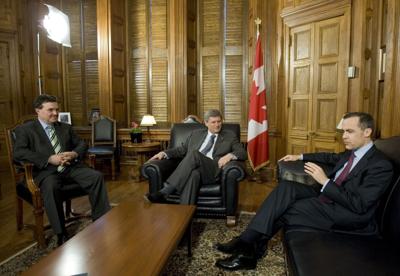
Finance Minister Jim Flaherty and Prime Minister Stephen Harper chat with incoming Bank of Canada governor Mark Carney on Parliament hill in Ottawa on Jan. 31, 2008.
Tom Hanson/The Canadian Press file photo


Tonda-MacCharles
By Tonda MacCharlesOttawa Bureau Chief

OTTAWA — At times it is uncanny.
It’s not just that Prime Minister Mark Carney’s tight-ship governing style is an abrupt break from that of his Liberal predecessor, Justin Trudeau.
It’s that it is remarkably reminiscent of another modern prime minister’s — namely his Conservative predecessor, Stephen Harper.
Mark Carney’s Rolodex is a trove of some of the most powerful political, business and media leaders in the world. Among them: Nigel Wright, Harper’s former chief of staff and later Onyx’s top executive in London, whose death last fall Carney marked with a heartfelt respectful tribute; and former interim Conservative leader Rona Ambrose and Harper-era cabinet minister Lisa Raitt, who now both hold in senior roles at Canadian banks.


So it should be no surprise Carney’s contacts also include Harper.
Harper is the prime minister who not only once named Carney to run Canada’s central bank, but is now one of the people Carney frequently reaches out to as he navigates the challenges of governing Canada at a chaotic time.
Sources, whom the Star has agreed not to identify in order to freely discuss the relationship, tell the Star the two have spoken regularly since Carney became prime minister.
Harper has publicly referred to one of those conversations. Carney has not. To what extent Harper’s private advice influences Carney is known only to them.
The two will appear together next week on Parliament Hill, when an official portrait of the former prime minister is unveiled in a long-standing tradition to celebrate political leadership and peaceful government transitions.
Their similarities — in personal and governing styles — are striking. Differences, however, are also coming into view.
‘The smartest guy in the room’
Carney and Harper are each seen by those who deal closely with them as the “smartest guy in the room,” and as acting like it. Neither suffers fools easily.


Both have had testy relations with bureaucrats, and high expectations for the civil service to deliver on their political agendas.
They have the same habit of quoting themselves — “As I said …” — a verbal tell that also serves to remind others of their prescience: They saw x or y — whatever political event or trend that is unfolding — long before others did.
For both, the lure of the job seems to have been the power to make decisions and to act, and an impatience with the formalities is apparent. Each man is a policy wonk, with little apparent love for the performative part of the job. The campaigning, travelling on election buses and planes to pitch their message, kissing babies and dealing with media are all just the price of getting to make those decisions.
A difference on caucus management is apparent. Harper formalized a structure for caucus feedback, with ministers required to address backbenchers’ concerns before going to a cabinet committee with a bill for approval, according to Conservative sources. Carney, according to Liberal sources, listens to his MPs’ concerns in weekly caucus meetings — and, unlike Trudeau, does not send out ministers to make regional announcements that come as news to local MPs.
Still, just as Harper’s MPs rarely spoke out against him, neither do Carney’s.
Both men spent years thinking about what it would be like to be prime minister. In minority Parliaments, neither is afraid of governing as if they had a majority.
They welcomed floor-crossers to boost their ranks. Both seek opposition support for legislation on a case-by-case basis instead of trying to form a governing coalition to pass an agenda. Leading minority governments, they invoked winning election mandates as reason enough for the opposition to support them.


Neither balked at spending political capital to achieve their goals: Harper made the unexpected move to declare Quebecers a nation within a united Canada, and to issue a formal apology to Indigenous residential school survivors. Carney has turned back Trudeau-era climate policies and swiftly moved to ramp up Canada’s defence spending.
Both men have only rarely admitted they were wrong. Carney acknowledged the Donald Trump era has accelerated economic disruptions faster than he had predicted. Harper ultimately walked back his aversion to deficits as the global financial crisis unfolded in the midst of the 2008 election campaign, and later borrowed heavily to manage the economic fallout.
Both men wield a sharp sense of humour, a trait that could be a superpower but which neither really uses to his best advantage.
Harper — caricatured by comedians as aloof and cold — used to make self-deprecating jokes about coming from a family of accountants and going into politics because he had the most charisma. In private, his humour was more edgy. But while he privately nailed imitations of politicians like Jean Chrétien, he rarely displayed his talent for mimicry in public.
Carney’s sense of humour is more playful but also comes with a bite, as Finance Minister François-Philippe Champagne can attest. “What kind of shop are you running!” he once said to Champagne in front of reporters.
But where Harper had a poker face, Carney’s facial reactions have given rise to numerous Instagram memes.


Hot and cold with the media
Then there is their all-too-familiar hot and cold relationship with the media.
Carney and Harper both adopted a command-and-control style for leaks. Harper tried to ban his advisers and ministers from talking to media, while Carney has, to a lesser extent, clamped down on chatty MPs and ministers.
Yet both cultivated good relations with journalists before they got into the Prime Minister’s Office. As a young Reform MP, Harper was a willing interviewee and smooth backroom pundit. When Carney was at Canada’s central bank, he developed relationships with influential (and mostly male) journalists in Ottawa, a trend it appears continued when he was at the Bank of England.
Once in the top job, however, Carney and Harper quickly grew impatient with media. “When we have something to announce, we’ll announce it,” Harper would say. Carney frequently bristles at questions, particularly those that focus on his integrity or perceived conflicts of interest, or his conversations with U.S. President Donald Trump; he has snapped at reporters, “It’s not newsworthy,” “It’s a detail,” “Who cares?” and “It’s a boring question.”
Harper and Carney use even the same slogans: “Canada’s new government” and “Canada is an energy superpower.” They both love a good “strategy” or “action plan” to brand their governing efforts.
The late Jim Flaherty was an important figure in the political careers of both men.
As Harper’s finance minister, Flaherty brought a much-needed everyman flourish to Harper’s economic agenda — and is believed to have persuaded Harper to appoint Carney as governor of the Bank of Canada in 2008.


Carney and Flaherty had both played hockey at Ivy League schools and they got along well. Flaherty was somewhat leery of his cabinet colleagues, once griping they didn’t read anything, whereas he read everything because he didn’t want to get caught out. Carney reads voraciously, and has scolded his ministers and top officials who don’t.
Harper had a temper that was sometimes on display — he once angrily kicked over a chair at a political convention — while Carney’s was well-known in during his term as governor of the Bank of England, where one newspaper headlined his “volcanic” temper.


The same and yet different
For all their similarities, however, significant differences remain.
The two come from similarly modest, middle-class backgrounds, and identify as Westerners. Harper grew up in the Toronto neighbourhood of Leaside but moved to Alberta as a young man and calls Calgary home. Carney, born in Fort Smith in the Northwest Territories, grew up in Edmonton. Yet Carney quickly ascended to the circles of the global elite in a way Harper did not, attending Harvard and Oxford universities, earning a PhD in economics, and working for the investment bank Goldman Sachs in London, Tokyo and Toronto. Harper completed a master’s degree in economics and quickly got into politics — where his critics would later challenge his claim to be an economist.
One source who knows both men well believes Carney displays a higher level of self-confidence and tolerance for political risk because he had vastly more experience at a global level before becoming prime minister than Harper ever had.
Harper would never have made a speech like Carney’s in Davos without mapping out all the ways it could go wrong, the source said, whereas Carney likely did not expect that some like U.K. Prime Minister Keir Starmer would publicly differ with him — and, more importantly, likely does not care.

But Harper was also more attuned to domestic political sentiment than Carney is, the insider said. Harper would never have given the Plains of Abraham speech that Carney delivered the day after coming back from Davos, which met with widespread disapproval in Quebec.


For all their current simpatico, there was a moment of tension in Harper and Carney’s relationship during last spring’s election campaign when, in support of Conservative Leader Pierre Poilievre, Harper publicly questioned Carney’s claim to having steered Canada’s response to the global financial crisis of 2008. Harper credited the heavy lifting to their mutual friend, his finance minister Jim Flaherty.

Carney’s campaign responded wryly, noting that Harper had once approached Carney — not Poilievre — to be his finance minister.
What does it all add up to? Is Carney the most conservative prime minister the Liberal party has ever elected? Some Liberals and some Conservatives think so.

But next week, when Carney attends Harper’s portrait unveiling, he will honour the political contributions of Canada’s last Conservative prime minister, the man who certainly set Carney on his own path to power.

 
Tonda MacCharles of the Red Star.


Quoted in full

Mark Carney and Stephen Harper are both ‘the smartest guy in the room’ — and that’s not all they have in common​

The former Conservative prime minister is now one of the people whose advice the current Liberal prime minister seeks, Tonda MacCharles writes.
Jan. 31, 2026
6 min read
Save
Gift this article


(167)

Harper Carney Tonda.JPG

Finance Minister Jim Flaherty and Prime Minister Stephen Harper chat with incoming Bank of Canada governor Mark Carney on Parliament hill in Ottawa on Jan. 31, 2008.
Tom Hanson/The Canadian Press file photo


Tonda-MacCharles
By Tonda MacCharlesOttawa Bureau Chief

OTTAWA — At times it is uncanny.
It’s not just that Prime Minister Mark Carney’s tight-ship governing style is an abrupt break from that of his Liberal predecessor, Justin Trudeau.
It’s that it is remarkably reminiscent of another modern prime minister’s — namely his Conservative predecessor, Stephen Harper.
Mark Carney’s Rolodex is a trove of some of the most powerful political, business and media leaders in the world. Among them: Nigel Wright, Harper’s former chief of staff and later Onyx’s top executive in London, whose death last fall Carney marked with a heartfelt respectful tribute; and former interim Conservative leader Rona Ambrose and Harper-era cabinet minister Lisa Raitt, who now both hold in senior roles at Canadian banks.


So it should be no surprise Carney’s contacts also include Harper.
Harper is the prime minister who not only once named Carney to run Canada’s central bank, but is now one of the people Carney frequently reaches out to as he navigates the challenges of governing Canada at a chaotic time.
Sources, whom the Star has agreed not to identify in order to freely discuss the relationship, tell the Star the two have spoken regularly since Carney became prime minister.
Harper has publicly referred to one of those conversations. Carney has not. To what extent Harper’s private advice influences Carney is known only to them.
The two will appear together next week on Parliament Hill, when an official portrait of the former prime minister is unveiled in a long-standing tradition to celebrate political leadership and peaceful government transitions.
Their similarities — in personal and governing styles — are striking. Differences, however, are also coming into view.
‘The smartest guy in the room’
Carney and Harper are each seen by those who deal closely with them as the “smartest guy in the room,” and as acting like it. Neither suffers fools easily.


Both have had testy relations with bureaucrats, and high expectations for the civil service to deliver on their political agendas.
They have the same habit of quoting themselves — “As I said …” — a verbal tell that also serves to remind others of their prescience: They saw x or y — whatever political event or trend that is unfolding — long before others did.
For both, the lure of the job seems to have been the power to make decisions and to act, and an impatience with the formalities is apparent. Each man is a policy wonk, with little apparent love for the performative part of the job. The campaigning, travelling on election buses and planes to pitch their message, kissing babies and dealing with media are all just the price of getting to make those decisions.
A difference on caucus management is apparent. Harper formalized a structure for caucus feedback, with ministers required to address backbenchers’ concerns before going to a cabinet committee with a bill for approval, according to Conservative sources. Carney, according to Liberal sources, listens to his MPs’ concerns in weekly caucus meetings — and, unlike Trudeau, does not send out ministers to make regional announcements that come as news to local MPs.
Still, just as Harper’s MPs rarely spoke out against him, neither do Carney’s.
Both men spent years thinking about what it would be like to be prime minister. In minority Parliaments, neither is afraid of governing as if they had a majority.
They welcomed floor-crossers to boost their ranks. Both seek opposition support for legislation on a case-by-case basis instead of trying to form a governing coalition to pass an agenda. Leading minority governments, they invoked winning election mandates as reason enough for the opposition to support them.


Neither balked at spending political capital to achieve their goals: Harper made the unexpected move to declare Quebecers a nation within a united Canada, and to issue a formal apology to Indigenous residential school survivors. Carney has turned back Trudeau-era climate policies and swiftly moved to ramp up Canada’s defence spending.
Both men have only rarely admitted they were wrong. Carney acknowledged the Donald Trump era has accelerated economic disruptions faster than he had predicted. Harper ultimately walked back his aversion to deficits as the global financial crisis unfolded in the midst of the 2008 election campaign, and later borrowed heavily to manage the economic fallout.
Both men wield a sharp sense of humour, a trait that could be a superpower but which neither really uses to his best advantage.
Harper — caricatured by comedians as aloof and cold — used to make self-deprecating jokes about coming from a family of accountants and going into politics because he had the most charisma. In private, his humour was more edgy. But while he privately nailed imitations of politicians like Jean Chrétien, he rarely displayed his talent for mimicry in public.
Carney’s sense of humour is more playful but also comes with a bite, as Finance Minister François-Philippe Champagne can attest. “What kind of shop are you running!” he once said to Champagne in front of reporters.
But where Harper had a poker face, Carney’s facial reactions have given rise to numerous Instagram memes.


Hot and cold with the media
Then there is their all-too-familiar hot and cold relationship with the media.
Carney and Harper both adopted a command-and-control style for leaks. Harper tried to ban his advisers and ministers from talking to media, while Carney has, to a lesser extent, clamped down on chatty MPs and ministers.
Yet both cultivated good relations with journalists before they got into the Prime Minister’s Office. As a young Reform MP, Harper was a willing interviewee and smooth backroom pundit. When Carney was at Canada’s central bank, he developed relationships with influential (and mostly male) journalists in Ottawa, a trend it appears continued when he was at the Bank of England.
Once in the top job, however, Carney and Harper quickly grew impatient with media. “When we have something to announce, we’ll announce it,” Harper would say. Carney frequently bristles at questions, particularly those that focus on his integrity or perceived conflicts of interest, or his conversations with U.S. President Donald Trump; he has snapped at reporters, “It’s not newsworthy,” “It’s a detail,” “Who cares?” and “It’s a boring question.”
Harper and Carney use even the same slogans: “Canada’s new government” and “Canada is an energy superpower.” They both love a good “strategy” or “action plan” to brand their governing efforts.
The late Jim Flaherty was an important figure in the political careers of both men.
As Harper’s finance minister, Flaherty brought a much-needed everyman flourish to Harper’s economic agenda — and is believed to have persuaded Harper to appoint Carney as governor of the Bank of Canada in 2008.


Carney and Flaherty had both played hockey at Ivy League schools and they got along well. Flaherty was somewhat leery of his cabinet colleagues, once griping they didn’t read anything, whereas he read everything because he didn’t want to get caught out. Carney reads voraciously, and has scolded his ministers and top officials who don’t.
Harper had a temper that was sometimes on display — he once angrily kicked over a chair at a political convention — while Carney’s was well-known in during his term as governor of the Bank of England, where one newspaper headlined his “volcanic” temper.


The same and yet different
For all their similarities, however, significant differences remain.
The two come from similarly modest, middle-class backgrounds, and identify as Westerners. Harper grew up in the Toronto neighbourhood of Leaside but moved to Alberta as a young man and calls Calgary home. Carney, born in Fort Smith in the Northwest Territories, grew up in Edmonton. Yet Carney quickly ascended to the circles of the global elite in a way Harper did not, attending Harvard and Oxford universities, earning a PhD in economics, and working for the investment bank Goldman Sachs in London, Tokyo and Toronto. Harper completed a master’s degree in economics and quickly got into politics — where his critics would later challenge his claim to be an economist.
One source who knows both men well believes Carney displays a higher level of self-confidence and tolerance for political risk because he had vastly more experience at a global level before becoming prime minister than Harper ever had.
Harper would never have made a speech like Carney’s in Davos without mapping out all the ways it could go wrong, the source said, whereas Carney likely did not expect that some like U.K. Prime Minister Keir Starmer would publicly differ with him — and, more importantly, likely does not care.

But Harper was also more attuned to domestic political sentiment than Carney is, the insider said. Harper would never have given the Plains of Abraham speech that Carney delivered the day after coming back from Davos, which met with widespread disapproval in Quebec.


For all their current simpatico, there was a moment of tension in Harper and Carney’s relationship during last spring’s election campaign when, in support of Conservative Leader Pierre Poilievre, Harper publicly questioned Carney’s claim to having steered Canada’s response to the global financial crisis of 2008. Harper credited the heavy lifting to their mutual friend, his finance minister Jim Flaherty.

Carney’s campaign responded wryly, noting that Harper had once approached Carney — not Poilievre — to be his finance minister.
What does it all add up to? Is Carney the most conservative prime minister the Liberal party has ever elected? Some Liberals and some Conservatives think so.

But next week, when Carney attends Harper’s portrait unveiling, he will honour the political contributions of Canada’s last Conservative prime minister, the man who certainly set Carney on his own path to power.

Some people on the right won’t be happy with Harper being associated with his inner circle.
 
Tonda MacCharles of the Red Star.


Quoted in full

Mark Carney and Stephen Harper are both ‘the smartest guy in the room’ — and that’s not all they have in common​

The former Conservative prime minister is now one of the people whose advice the current Liberal prime minister seeks, Tonda MacCharles writes.
Jan. 31, 2026
6 min read
Save
Gift this article


(167)

Harper Carney Tonda.JPG

Finance Minister Jim Flaherty and Prime Minister Stephen Harper chat with incoming Bank of Canada governor Mark Carney on Parliament hill in Ottawa on Jan. 31, 2008.
Tom Hanson/The Canadian Press file photo


Tonda-MacCharles
By Tonda MacCharlesOttawa Bureau Chief

OTTAWA — At times it is uncanny.
It’s not just that Prime Minister Mark Carney’s tight-ship governing style is an abrupt break from that of his Liberal predecessor, Justin Trudeau.
It’s that it is remarkably reminiscent of another modern prime minister’s — namely his Conservative predecessor, Stephen Harper.
Mark Carney’s Rolodex is a trove of some of the most powerful political, business and media leaders in the world. Among them: Nigel Wright, Harper’s former chief of staff and later Onyx’s top executive in London, whose death last fall Carney marked with a heartfelt respectful tribute; and former interim Conservative leader Rona Ambrose and Harper-era cabinet minister Lisa Raitt, who now both hold in senior roles at Canadian banks.


So it should be no surprise Carney’s contacts also include Harper.
Harper is the prime minister who not only once named Carney to run Canada’s central bank, but is now one of the people Carney frequently reaches out to as he navigates the challenges of governing Canada at a chaotic time.
Sources, whom the Star has agreed not to identify in order to freely discuss the relationship, tell the Star the two have spoken regularly since Carney became prime minister.
Harper has publicly referred to one of those conversations. Carney has not. To what extent Harper’s private advice influences Carney is known only to them.
The two will appear together next week on Parliament Hill, when an official portrait of the former prime minister is unveiled in a long-standing tradition to celebrate political leadership and peaceful government transitions.
Their similarities — in personal and governing styles — are striking. Differences, however, are also coming into view.
‘The smartest guy in the room’
Carney and Harper are each seen by those who deal closely with them as the “smartest guy in the room,” and as acting like it. Neither suffers fools easily.


Both have had testy relations with bureaucrats, and high expectations for the civil service to deliver on their political agendas.
They have the same habit of quoting themselves — “As I said …” — a verbal tell that also serves to remind others of their prescience: They saw x or y — whatever political event or trend that is unfolding — long before others did.
For both, the lure of the job seems to have been the power to make decisions and to act, and an impatience with the formalities is apparent. Each man is a policy wonk, with little apparent love for the performative part of the job. The campaigning, travelling on election buses and planes to pitch their message, kissing babies and dealing with media are all just the price of getting to make those decisions.
A difference on caucus management is apparent. Harper formalized a structure for caucus feedback, with ministers required to address backbenchers’ concerns before going to a cabinet committee with a bill for approval, according to Conservative sources. Carney, according to Liberal sources, listens to his MPs’ concerns in weekly caucus meetings — and, unlike Trudeau, does not send out ministers to make regional announcements that come as news to local MPs.
Still, just as Harper’s MPs rarely spoke out against him, neither do Carney’s.
Both men spent years thinking about what it would be like to be prime minister. In minority Parliaments, neither is afraid of governing as if they had a majority.
They welcomed floor-crossers to boost their ranks. Both seek opposition support for legislation on a case-by-case basis instead of trying to form a governing coalition to pass an agenda. Leading minority governments, they invoked winning election mandates as reason enough for the opposition to support them.


Neither balked at spending political capital to achieve their goals: Harper made the unexpected move to declare Quebecers a nation within a united Canada, and to issue a formal apology to Indigenous residential school survivors. Carney has turned back Trudeau-era climate policies and swiftly moved to ramp up Canada’s defence spending.
Both men have only rarely admitted they were wrong. Carney acknowledged the Donald Trump era has accelerated economic disruptions faster than he had predicted. Harper ultimately walked back his aversion to deficits as the global financial crisis unfolded in the midst of the 2008 election campaign, and later borrowed heavily to manage the economic fallout.
Both men wield a sharp sense of humour, a trait that could be a superpower but which neither really uses to his best advantage.
Harper — caricatured by comedians as aloof and cold — used to make self-deprecating jokes about coming from a family of accountants and going into politics because he had the most charisma. In private, his humour was more edgy. But while he privately nailed imitations of politicians like Jean Chrétien, he rarely displayed his talent for mimicry in public.
Carney’s sense of humour is more playful but also comes with a bite, as Finance Minister François-Philippe Champagne can attest. “What kind of shop are you running!” he once said to Champagne in front of reporters.
But where Harper had a poker face, Carney’s facial reactions have given rise to numerous Instagram memes.


Hot and cold with the media
Then there is their all-too-familiar hot and cold relationship with the media.
Carney and Harper both adopted a command-and-control style for leaks. Harper tried to ban his advisers and ministers from talking to media, while Carney has, to a lesser extent, clamped down on chatty MPs and ministers.
Yet both cultivated good relations with journalists before they got into the Prime Minister’s Office. As a young Reform MP, Harper was a willing interviewee and smooth backroom pundit. When Carney was at Canada’s central bank, he developed relationships with influential (and mostly male) journalists in Ottawa, a trend it appears continued when he was at the Bank of England.
Once in the top job, however, Carney and Harper quickly grew impatient with media. “When we have something to announce, we’ll announce it,” Harper would say. Carney frequently bristles at questions, particularly those that focus on his integrity or perceived conflicts of interest, or his conversations with U.S. President Donald Trump; he has snapped at reporters, “It’s not newsworthy,” “It’s a detail,” “Who cares?” and “It’s a boring question.”
Harper and Carney use even the same slogans: “Canada’s new government” and “Canada is an energy superpower.” They both love a good “strategy” or “action plan” to brand their governing efforts.
The late Jim Flaherty was an important figure in the political careers of both men.
As Harper’s finance minister, Flaherty brought a much-needed everyman flourish to Harper’s economic agenda — and is believed to have persuaded Harper to appoint Carney as governor of the Bank of Canada in 2008.


Carney and Flaherty had both played hockey at Ivy League schools and they got along well. Flaherty was somewhat leery of his cabinet colleagues, once griping they didn’t read anything, whereas he read everything because he didn’t want to get caught out. Carney reads voraciously, and has scolded his ministers and top officials who don’t.
Harper had a temper that was sometimes on display — he once angrily kicked over a chair at a political convention — while Carney’s was well-known in during his term as governor of the Bank of England, where one newspaper headlined his “volcanic” temper.


The same and yet different
For all their similarities, however, significant differences remain.
The two come from similarly modest, middle-class backgrounds, and identify as Westerners. Harper grew up in the Toronto neighbourhood of Leaside but moved to Alberta as a young man and calls Calgary home. Carney, born in Fort Smith in the Northwest Territories, grew up in Edmonton. Yet Carney quickly ascended to the circles of the global elite in a way Harper did not, attending Harvard and Oxford universities, earning a PhD in economics, and working for the investment bank Goldman Sachs in London, Tokyo and Toronto. Harper completed a master’s degree in economics and quickly got into politics — where his critics would later challenge his claim to be an economist.
One source who knows both men well believes Carney displays a higher level of self-confidence and tolerance for political risk because he had vastly more experience at a global level before becoming prime minister than Harper ever had.
Harper would never have made a speech like Carney’s in Davos without mapping out all the ways it could go wrong, the source said, whereas Carney likely did not expect that some like U.K. Prime Minister Keir Starmer would publicly differ with him — and, more importantly, likely does not care.

But Harper was also more attuned to domestic political sentiment than Carney is, the insider said. Harper would never have given the Plains of Abraham speech that Carney delivered the day after coming back from Davos, which met with widespread disapproval in Quebec.


For all their current simpatico, there was a moment of tension in Harper and Carney’s relationship during last spring’s election campaign when, in support of Conservative Leader Pierre Poilievre, Harper publicly questioned Carney’s claim to having steered Canada’s response to the global financial crisis of 2008. Harper credited the heavy lifting to their mutual friend, his finance minister Jim Flaherty.

Carney’s campaign responded wryly, noting that Harper had once approached Carney — not Poilievre — to be his finance minister.
What does it all add up to? Is Carney the most conservative prime minister the Liberal party has ever elected? Some Liberals and some Conservatives think so.

But next week, when Carney attends Harper’s portrait unveiling, he will honour the political contributions of Canada’s last Conservative prime minister, the man who certainly set Carney on his own path to power.
Its seems that Carney watched what worked for Harper and is using it himself.
 
Back
Top