• Thanks for stopping by. Logging in to a registered account will remove all generic ads. Please reach out with any questions or concerns.

Canada moves to 2% GDP end of FY25/26 - PMMC

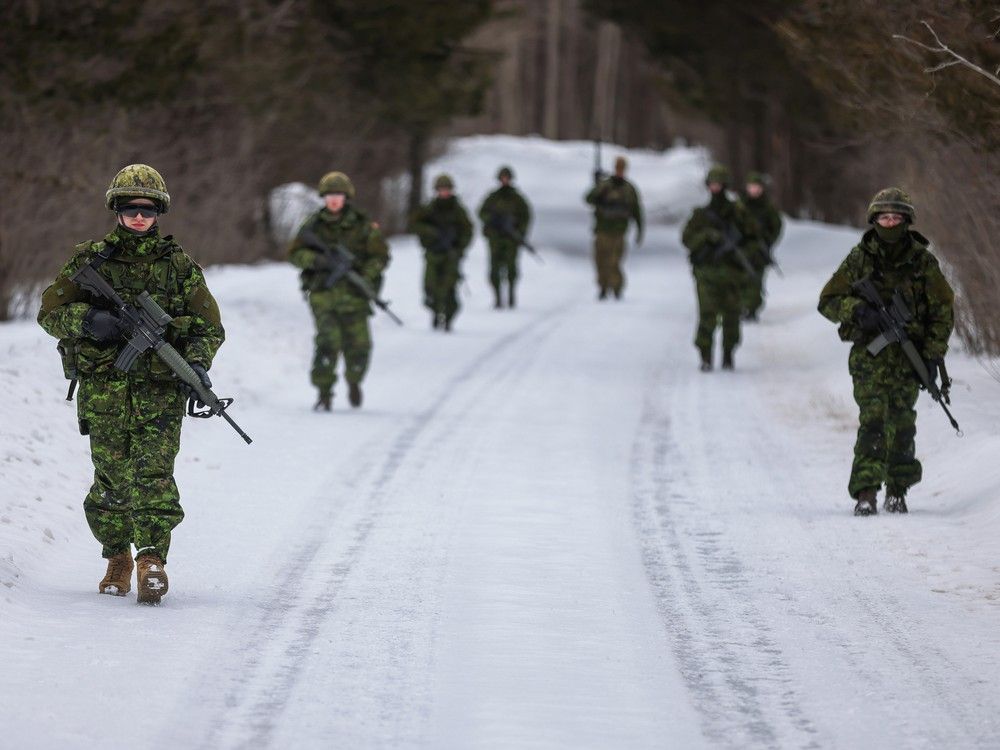
I think the politically viable solution in Canada would be return the RCMP back to its 1870s roots, which would put it back into the frame of paramilitary forces like the Royal Irish Constabulary, the Gendarmerie and the Carabinieri. A lot of policing and a little bit of military capability.

And an auxiliary force of civilians, possibly leveraging the Rangers and their structure.

And with that I would think we would have the back foot planted.

And we could focus on the rapier.
 
I agree with your points. And I have overstated the aggressor for requirements. As you say, and the IRA and others have consistently demonstrated, a small cell of half a dozen or so can generate the core elements for a Batoche/Oka type of force. Beyond the people supporting the cause there are estimated to be 70,000 individuals in Canada involved in organized gangs. Apparently Hell's Angels alone have about a thousand in 30 or 40 chapters.


....

AI helps me out - 500 Irishmen following Martin McGuinness and Gerry Adams

Estimates for the number of core, active members of the Provisional Irish Republican Army (IRA) during the Troubles (roughly 1969–1998) vary, but generally suggest a relatively small hard-core group of volunteers within a larger, fluctuating organization.
  • Peak Active Strength: At the height of the conflict in the early 1970s, estimates of the "active" or core membership range from 1,500 (according to CAIN/Martin Melaugh) to several thousand, with some estimates citing up to 1,200 in Belfast alone in 1971.
  • Later Years (Cell Structure): After reorganizing into smaller, more secure "cell" structures in the late 1970s, the number of active, full-time volunteers is believed to have reduced to a core group of approximately 500 to 800.
  • Total Volunteers: While the core, active, and armed members were relatively few, some estimates suggest that as many as 8,000 to 10,000 individuals may have passed through the ranks of the Provisional IRA over the course of the 30-year conflict, including active volunteers, support staff, and those in prison
Tying down up to 300,000 Brits over 30 years and disrupting the lives and economy of 2,000,000 people locally and 55,000,000 back on the Mainland.

During the Troubles (1969–2007), over 300,000 British military personnel served in Northern Ireland as part of Operation Banner, with troop levels peaking at approximately 21,000 to 27,000 in the 1970s. They worked alongside the Royal Ulster Constabulary (RUC), which had over 10,000 officers during the conflict's height.
Wikipedia +3
Key Facts on Security Forces:
  • Operation Banner: The longest continuous deployment in British military history, starting in 1969 and ending in July 2007.
  • Peak Strength: In 1972, the height of the Troubles, there were 21,000 British troops stationed there. Other estimates place the total military personnel (including local regiments) as high as 27,000.
  • Total Serving: More than 300,000 soldiers served in Northern Ireland during the 38-year campaign.
  • Police (RUC): The Royal Ulster Constabulary maintained a force of around 10,000+ officers.
  • Casualties: 1,441 military personnel died during the operation (722 in paramilitary attacks).
  • UDR: The locally recruited Ulster Defence Regiment (UDR) was also part of the security effort.
    Reddit +6
At the height of the conflict, the combined strength of the British Army, UDR, and RUC meant a very heavy security presence on the streets to manage riots, checkpoints, and counter-insurgency operations

....

But I am glad to be assured that this can never happen in Canada. 😉

Yabbut…

The conditions in Canada - and the US for that matter - are not, nor ever have been, similar to Ireland (or any other equivalent global trouble spot) in a way that would spark and sustain such a profoundly destructive terrorist conflict.

Thank goodness.

Suggest you go back to smoking the pipe without the screen in the bottom old chap ;)
 
Yabbut…

The conditions in Canada - and the US for that matter - are not, nor ever have been, similar to Ireland (or any other equivalent global trouble spot) in a way that would spark and sustain such a profoundly destructive terrorist conflict.

Thank goodness.

Suggest you go back to smoking the pipe without the screen in the bottom old chap ;)

We shall disagree. Canada's own history suggests another interpretation.
 
Militarization of our police forces is not likely to be supported in this day and age.

Is making a part of the RCMP like the French Gendarmerie or the Italian Carabineiri really so bad?

I think the public is more concerned if the whole RCMP ends up with the mandate and aesthetics of ICE. Even the organization named above don't roll like that.
 
Is making a part of the RCMP like the French Gendarmerie or the Italian Carabineiri really so bad?

I think the public is more concerned if the whole RCMP ends up with the mandate and aesthetics of ICE. Even the organization named above don't roll like that.
A better approach might be creating a 'net new' organization instead of having the RMCP move into some/all of that new role. That way is keep the public perception that there is still a distinct line between the police and the military.

The French NG is like over 100k in strength. That's a significant number, roughly 35-40% the size of the 'proper' French Armed Forces. If we use the potential future baseline of 84k of the CAF, we'd be looking at a new force of about 34k.
 
A better approach might be creating a 'net new' organization instead of having the RMCP move into some/all of that new role. That way is keep the public perception that there is still a distinct line between the police and the military.

The French NG is like over 100k in strength. That's a significant number, roughly 35-40% the size of the 'proper' French Armed Forces. If we use the potential future baseline of 84k of the CAF, we'd be looking at a new force of about 34k.
I really don't think it matters if it is a militarized police service or a civilianized miliary service. You use - or create - a body to fulfill an identified need then empower and equipment them to do it. It could be the RCMP, a Gendarmerie or the Raging Grannies. The bottom line reality in Canada is its existence, and everything they are expected to do, has to be Constitutionally compliant, unless people are willing to throw out that bathwater in name of security.

Adapting existing structures to new roles is often more than someone saying 'make it so'. Sure, put missiles on a CG ice breaker, but don't be surprised when the civilian crew balks at being shot at. Same with the Rangers. How many would stay signed up if the role of their fancy new rifles is to kill people?

The romantic and historic role of the RCMP simply can't be replicated in the present day. The NWMP were an armed and uniformed all-of-government presence in the emerging west. Society will not accept that today.

I believe the Atomic Energy Commission or whoever they’re called have their own armed tactical security forces at their facilities. So that’s one place the CAF don’t have to worry about being dragged into.
Ontario Power Generation has armed security at its nuclear sites as does privately-owned Bruce Nuclear.
 
Is making a part of the RCMP like the French Gendarmerie or the Italian Carabineiri really so bad?

I think the public is more concerned if the whole RCMP ends up with the mandate and aesthetics of ICE. Even the organization named above don't roll like that.
I didn’t say it was. One way or another.

I just think that given the public’s perception of policing as a whole that any attempts to bring it closer to anything military will not be viewed positively. Heck our MPs have demilitarized themselves almost.

I think the RCMP a needs to focus more and expand on the Federal space and should get out of municipal and provincial policing altogether.
 
“Militarization” of police is already pretty controversial. A new organization between police, military and “home guard” will have to thread a narrow needle.

Maybe the Canadian Rangers should be expanded to southern and more urban areas with an expanded mandate and training for emergencies. That might be an organization that can thread that needle. I’ll admit it isn’t something I’ve spent a lot of time thinking about, but I can see it as a draw for those who want to serve but don’t want to go into the military or policing.
 
I dunno where you live. But here in Ontario, I have seen municipalities absolutely get addicted to development fees to the point that they somehow wreck housing affordability and still cause substantial sprawl. If those development charges were 100% banked in reserve funds, I'd buy that there's no subsidy. But nope, lots of it ends up in general revenue subsidizing current ratepayers. They are all avoiding substantial municipal tax increases through development charges.

As to your argument that the growth ponzi scheme is a myth, the fantastic thing is that we can look at the GTA and see it in action since the suburban 905 and more urban (relatively) 416 are not in the same municipal tax jurisdiction. 905 tax rates are skyrocketing. 416 tax rates are some of the lowest in the province. And the 416 delivers substantially better public services too. Toronto has the largest transit system, largest and most used library system and the largest parks and rec system, not just in the country. But competitive in North America. What Oakville give you in return for five figure property tax bills? That differential actually gets worse for the 905 every year. Especially in places like Mississauga which are running out of land to develop. When there's no cross-subsidy, those taxes go up real fast. This is from 2020:

greater-toronto-property-tax-rates.jpg


As an Ottawa resident these days, inside the Greenbelt, I wish this city had never amalgamated. The services I get for what I pay in property taxes are poor value. I would agree with your point that suburbs can be low cost. That's if and only if suburban residents keep their service levels low. But that almost never happens. Especially not in Canada. Folks move to the suburbs and then insist they should have almost the same level of transit, rec services, snow clearing, etc they used to have in the city. That entitlement inevitably leads to subsidization. It's fantastic for 416 residents that their transit system doesn't have to cover the 905 or they'd have shitty services too.

Not a taxation SME.

But, readers may, or may not, find study by The Fraser Institute from 2004 of interest.

Perhaps still relevant today. Or, perhaps not.

Share the Wealth: Who Pays for Government Across Ontario?


Greater Toronto Area (GTA) taxpayers pay out almost $24 billion
more in taxes than they receive in government spending—a net
tax burden equal to 11 percent of the GTA economy

Most of this burden falls on the suburbs around Toronto, where
the average household pays the equivalent of more than $17,000
in extra taxes

Halton Region and York Region households—urban areas just
west and north of Toronto—pay the most: up to $26,000 more
in tax than in government services received. By comparison,
Toronto households pay almost $9,500 in extra taxes.

A minority of 9 Ontario counties are subsidizing the other 40.
Twenty-one counties pay less tax than they receive in govern-
ment services, with most found in the eastern and northern
regions. Five counties effectively have most or all of their per-
sonal income taxes refunded in the form of an equivalent dollar
value of services.

The average Ontario household bears a net tax burden of over
$4,500 to pay for transfers to other provinces through federal
government taxation and spending programs

The degree of regional net tax burden and its associated subsidy
outflow rises with income—richer communities are generally
subsidizing poorer communities

Subsidy outflows also rise with population density, contrary to
anti-development advocates’ beliefs, showing that suburbia is
paying more than its proportional share of government costs
 
But, readers may, or may not, find study by The Fraser Institute from 2004 of interest.

Perhaps still relevant today. Or, perhaps not.

From more than 20 years ago. Definitely not relevant. Or at least not as relevant as the actual tax rates that I posted.
 
I really don't think it matters if it is a militarized police service or a civilianized miliary service. You use - or create - a body to fulfill an identified need then empower and equipment them to do it. It could be the RCMP, a Gendarmerie or the Raging Grannies. The bottom line reality in Canada is its existence, and everything they are expected to do, has to be Constitutionally compliant, unless people are willing to throw out that bathwater in name of security.

Adapting existing structures to new roles is often more than someone saying 'make it so'. Sure, put missiles on a CG ice breaker, but don't be surprised when the civilian crew balks at being shot at. Same with the Rangers. How many would stay signed up if the role of their fancy new rifles is to kill people?

The romantic and historic role of the RCMP simply can't be replicated in the present day. The NWMP were an armed and uniformed all-of-government presence in the emerging west. Society will not accept that today.


Ontario Power Generation has armed security at its nuclear sites as does privately-owned Bruce Nuclear.


I agree with everything you say. If you will stipulate that we are facing concerted efforts on the civil-military boundary how do you suggest we stop that becomomg an exploitable seam?

Frankly it makes no odds to me if the green uniforms start making arrests, or red uniforms start firing autocannons or if it requires a new red-green outfit with its own special engagement rules.

I just want to know that the gray zone is covered.
 
I agree with everything you say. If you will stipulate that we are facing concerted efforts on the civil-military boundary how do you suggest we stop that becomomg an exploitable seam?

Frankly it makes no odds to me if the green uniforms start making arrests, or red uniforms start firing autocannons or if it requires a new red-green outfit with its own special engagement rules.

I just want to know that the gray zone is covered.
Except, that's not how any of it works in the real world.

Voters care about green uniforms enforcing laws, particularly if they are riding in green trucks/APCs while doing it.

Jen Gerson of The Line perfectly summed up my thoughts on a few posters on here with this little quote:

This is the end, here, folks. This is what you get when Conservative Debate Club Syndrome reaches its inevitable state of terminal decay.

Look, I have often quipped in private that if you want to get a Liberal to talk, you flatter them; if you want to get a Conservative to spill, you fight with them. And to be honest, I rather love this about Conservatives — they love a good tussle. But what we’re seeing right here is the shadow side of that character trait; the tendency to treat actual governance like an endless college dorm room bull session. Debate night is great. Power requires responsibility. You can’t foist a boundless stream of thought experiments and notional debates and political stunts on a population without risking real consequences.

Because a bar brawl that goes badly is just good fun, but there are real risks to poor governance.

The article quoted: Jen Gerson: Sure, put all of the questions on the ballot. Why not? What could go wrong?

The theory that it doesn't matter who makes the arrest is great debate night fodder, but in the real world, it matters a lot.

If we need guards for critical infrastructure, the GoC needs to articulate the need, and create the force to do the task. It will likely not resemble the old "Home Guard" of WWII, nor the NWMP. It will need to be a force that meets today's needs in a manner acceptable to today's voters.

Lastly, I highly recommend subscribing to The Line as they cover a lot of interesting topics at a reasonable subscription cost.
 
I agree with everything you say. If you will stipulate that we are facing concerted efforts on the civil-military boundary how do you suggest we stop that becomomg an exploitable seam?

Frankly it makes no odds to me if the green uniforms start making arrests, or red uniforms start firing autocannons or if it requires a new red-green outfit with its own special engagement rules.

I just want to know that the gray zone is covered.
I would first have to be convinced there is a problem. Adopting tech from the US or elsewhere that requires some form of dedicated security, a la F-35s is an issue that needs to be addressed, but limited to where the tech will be. Is there a CF base that currently has the gate down on a regular basis?

It's one thing to say that certain weapons or authorities are needed on domestic soil, but it's another to make it legal. If you give somebody a gun and a role, it is assumed they have the ability to exercise it under the appropriate circumstances. I'm not sure the military's concept of unlimited liability applies on domestic soil.

Where is this "exploitable seam" that cannot be addressed by current resources properly funded? CSIS, CSE, Immigration, federal law enforcement?
 
  • Like
Reactions: ytz
It doesn't take a large army of people to guide the hand. One Eisenhower will do.

This is not a new field of study.

You mean the guy that warned about the exponential growth of a military-industrial complex then…led the country during a time of exponential growth of a military-industrial complex? 🤔

The EU is just upset it has been told to defend itself better and rely less on US leading the way in the war over their space. "Buy European" just smacks of them taking their ball and going home. Ok then.

Or maybe it’s upset that the country that it hosted for decades having a foreign military presence under the auspices of mutual defence now is expected to still let that country use the continent for forward staging its forces for employment elsewhere but no longer being assured the defence it was pledged.

I believe the Atomic Energy Commission or whoever they’re called have their own armed tactical security forces at their facilities. So that’s one place the CAF don’t have to worry about being dragged into.

Not AECL. Bruce Power and OPG have their own security forces.

When I see the acronyms like "DOTMLPF" it reminds me of Ian Hope's article in the 2001-2 in The Army Doctrine and Training Bulletin which puts forward the proposition that "doctrine" is a comprehensive concept that includes cognitive, procedural, organizational, material, and moral components. (See attached document - excuse the highlighting).

Better than Canada’s ‘PRICIE’…

When I see acronyms like "DOTMLPF" it reminds me that we are, sadly, probably still training our leaders to be corporate automatons as opposed to knowledgeable, gifted, outside the box strategic thinkers and leaders.

So in your prior service, you never used acronyms as aids in doing your job? 🤷🏻‍♂️
 
Back
Top