I am constantly accused, justifiably, of crossing lines and screwing up silos. But things are moving so fast and solutions are crossing domains at such a pace that I honestly can't make up my mind which particular silo or silos need to be fed the new information.
This article is one of those. It is particularly dense.
1. The Arleigh Burkes will be around for a long while to come
2. They have a history of being constantly upgraded and used as test platforms for the fleet, often by bolting on novel solutions.
3. The USN, like everyone else, is looking for a CUAS solution and they are pretty agnostic about what that looks like.
4. They are trialling anything that might work and giving it a shot.
5. They are looking for new launch systems and they seem to be working across domains for platform independent solutions.
6. They are currently trialling what appears to be a new hot launch system on the Carl M. Levin
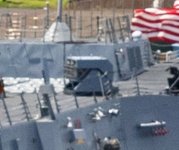
The suggestion is that it might be related to this concept
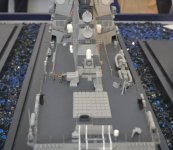
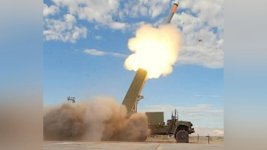
Between the CIWS and the Mk41s are a pair of launchers. They appear to be mini versions of this, the Mk70 PDS system:
Personal inferences and suppositions -
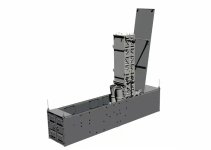
The Mk70 incorporates an array of launch tubes and exhaust stacks that can be pivoted from the horizontal for transport and storage to the vertical for launch. In the horizontal position the launch tubes lay on top of the exhaust stacks. In the vertical, on launch the exhaust is vented safely upwards.
One thing that strikes me is: Why bother?
Why bother putting a separate elevating mechanism in each container? Why not just treat each container as a pod and install a single elevating system on the launch platform and reload the elevator horizontally and elevate the entire container to the vertical and launch directly from the container. The exhaust stacks could still be incorporated within the "disposable/reusable' container but you wouldn't be wasting mass, volume, money and complexity on separate motors to elevate the launch tubes.
But back to the issue at hand - and it is related to my "Why Bother?" question.
The launcher displayed being reloaded in the model by hand horizontally, and in the vertical launch position appears to have taken the basic "launch tube / exhaust stack" package of the Mk 70 and not just miniaturized it but inverted it. In the horizontal mode the exhaust stacks lay on top and the launch tubes are on the bottom. Presumably this makes no difference to the exhaust management but it makes hand bombing reloads into the launch tubes easier.
It is also notable that the launcher on the Levin has a rotating platform. If you are launching vertically why do you need a rotating platform? Once you pop up into vertical flight it is simple to fall off onto any bearing. You don't need to train a vertical launcher.
My thoughts. There is an advantage to being able to rotate the launcher in the horizontal position to facilitate loading rounds by hand, especially if the ship is moving in three dimensions. The launcher can be rotated inboard to the safest alignment for a crew to load.
It can then be rotated to the position that creates the most free deck space and further, if that is not the same as the optimum launch configuration then the launcher can be rotated to ensure the exhaust is vented to a safe zone.
Another possibility is that the launcher could also accomodate cold launches and trained, inclined launches to increase the variety of munitions it can handle.
All pure supposition on my part but it does seem to align with the direction of travel of the article.
....
"In February, DIU put out
a call for containerized drone launcher designs that could be employed at sea or on land."
....
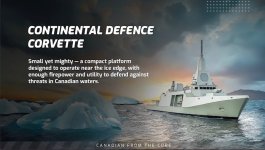
I chose to put this here because it seemed to me that this is the type of system that might influence an open concept like the CDC even though the launcher itself could just as easily be applied to the RCDs, the AOPVs or even OSVs and USVs.
Or, for that matter, trucks, railcars and asphalt installations.




 )
)