• Thanks for stopping by. Logging in to a registered account will remove all generic ads. Please reach out with any questions or concerns.

80% Solutions

Kirkhill

Puggled and Wabbit Scot.
Subscriber
Donor
Reaction score
13,910
Points
1,160

Ukraine is showing the West its focus on "perfect" weapons is flawed.
A drone radar firm says ready-now solutions beat perfect ones later.
Officials say weapons must be affordable, available, and adaptable — not flawless.

....
 
Why Ukrainian drones are so cheap


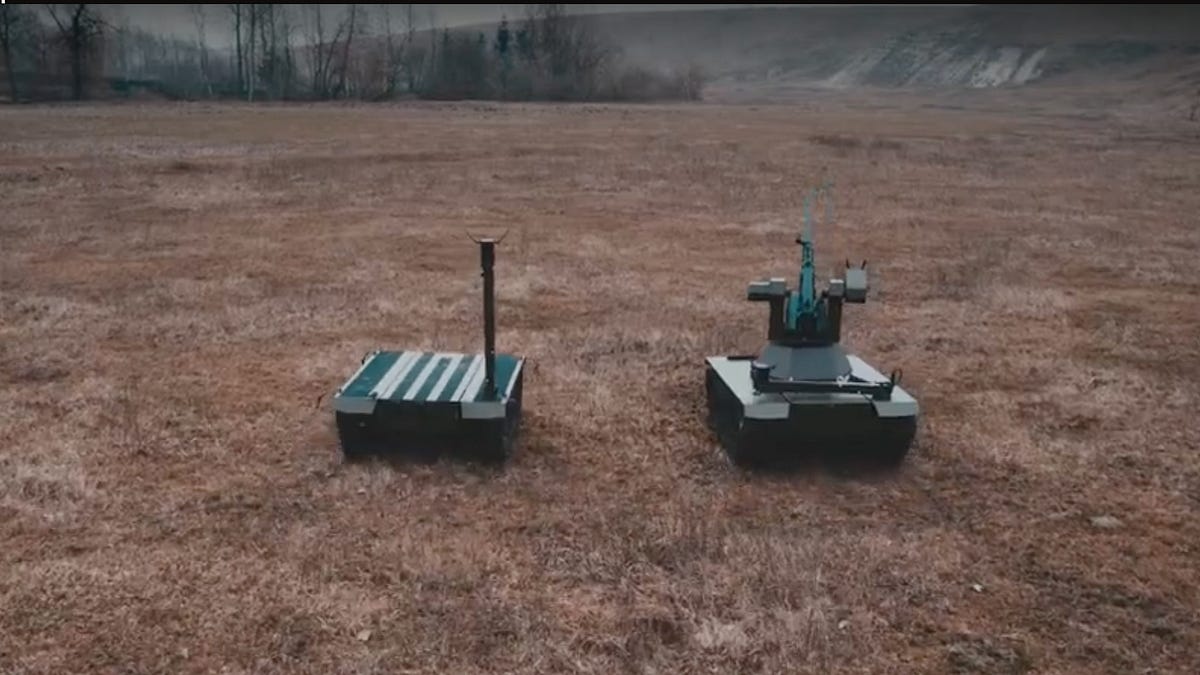
Ukrainian $30,000 UGV


Aussie equivalent carrying capacity at $400,000


why are ukrainian ugvs so cheap compared to western ones and what western ones compete on price +13

Ukrainian Unmanned Ground Vehicles (UGVs) are significantly cheaper than Western counterparts—often costing $10,000–$20,000 compared to hundreds of thousands for Western systems—due to a focus on attritable (disposable) design,, rapid prototyping, and utilizing commercial off-the-shelf (COTS) components rather than expensive, specialized military-grade hardware.

While Western systems prioritize longevity, high-end armor, and multifunctionality, Ukrainian UGVs are built for immediate, high-volume combat use.

Why Ukrainian UGVs are Cheaper

"Good Enough" Engineering: Ukrainian developers focus on rapid, functional designs rather than perfection, often producing new iterations in months.

COTS Components: Instead of bespoke, expensive sensors, they use commercially available Chinese or Western components, significantly lowering costs.

Attritable Design: Because UGV life expectancy on the front line is often only a week, low cost is prioritized over durability, notes Viktor Dolgopiatov of Burevii.

War-Driven Innovation & Scale: The Brave1 ecosystem enables rapid production, aiming for high-volume, low-cost solutions, rather than expensive, complex platforms.

Low Labor Costs: Manufacturing wages are significantly lower in Ukraine than in Western countries.

Cost Comparison:

Ukraine vs. WestUkrainian UGV (e.g., Zmiy): ~$20,000 for a demining platform.
Western UGV (e.g., Small Engineering Robot): ~$400,000 or more, notes a Ukrainian commander.

Long-Range Strike Drone: ~$200,000 in Ukraine vs. $5–10 million from Western contractors.

Western UGVs Competing on Price

While most Western systems are "exquisite wares" designed for longevity, a few companies are shifting toward more affordable or scalable solutions:

Milrem Robotics (Estonia) - THeMIS: Although more expensive than Ukrainian options, THeMIS is widely used by over 15 NATO nations and focuses on modularity, allowing it to be adapted for cheaper configurations.

Clearpath Robotics (Canada) - Husky/Jackal: These are popular in research and R&D but offer robust, smaller-scale platforms that are cheaper than large armored UGVs.

Roboteam (Israel/Canada) - Probot/PackBot: These are often smaller,, packable, or modular, providing lower-cost alternatives to larger, heavy-combat systems.

Textron Systems (USA) - Ripsaw 3: Following recent competition developments, the U.S. Army is emphasizing a more affordable "Robotic Combat Vehicle".

The main constraint for Western platforms is that they are "underwhelming" on the front line compared to cheaper, mass-produced drones that can be lost in high numbers without significant financial loss.

 
how much does a ukrainian ugv cost +9

The cost of a Ukrainian Unmanned Ground Vehicle (UGV) typically ranges from $5,000 to $50,000, with most mid-range models used for logistics or combat falling between $12,000 and $35,000.

Ukrainian systems are significantly more affordable than Western counterparts, which often cost upwards of $100,000 to $400,000 per unit.

Typical Costs by Model & Type

UGV CategoryApproximate Cost (USD)ExamplesBudget /

Basic $2,000 – $8,000

Small resupply or "disposable" unitsLogistics / Medevac $11,000 – $30,000
TerMIT ($12k–$30k),
NUMO ($11k),
Murakha ($29k)

Specialized Combat $35,000 – $50,000
Odyssey ($35k),
DevDroid with machine gun ($50k)

Heavy / Multi-role $97,000+
Protector combat variant

Key Cost Drivers

Weaponry: Adding remote-controlled turrets or heavy machine guns (like a Browning) can increase the base price by $20,000.
Modifications: Field-specific modifications, such as adding Starlink for remote control or extra signal repeaters, can add $750 to $2,500 per unit.
Economies of Scale: Startups and volunteer organizations like Brave1 leverage civilian components and 3D printing to keep costs at roughly 1/10th of NATO-equivalent hardware.

....

Fascinating just how cheap the comms link that makes all of this possible is.

Those small, disposable units in the 11-30k range can carry a 500 kg payload up to 60 km.

It can be paired with the Dev Droid Wolly, a $10,000 AI RWS that can mount 12.7 HMGs and 40mm GMGs, and presumably the 30x113 M230 LF . The turret costs $5000 and the Control Panel another $5000. When the UGV and turret are destroyed the Control Panel can be reused.


Why Ukrainian drones are so cheap


Ukrainian $30,000 UGV


Aussie equivalent carrying capacity at $400,000


why are ukrainian ugvs so cheap compared to western ones and what western ones compete on price +13

Ukrainian Unmanned Ground Vehicles (UGVs) are significantly cheaper than Western counterparts—often costing $10,000–$20,000 compared to hundreds of thousands for Western systems—due to a focus on attritable (disposable) design,, rapid prototyping, and utilizing commercial off-the-shelf (COTS) components rather than expensive, specialized military-grade hardware.

While Western systems prioritize longevity, high-end armor, and multifunctionality, Ukrainian UGVs are built for immediate, high-volume combat use.

Why Ukrainian UGVs are Cheaper

"Good Enough" Engineering: Ukrainian developers focus on rapid, functional designs rather than perfection, often producing new iterations in months.

COTS Components: Instead of bespoke, expensive sensors, they use commercially available Chinese or Western components, significantly lowering costs.

Attritable Design: Because UGV life expectancy on the front line is often only a week, low cost is prioritized over durability, notes Viktor Dolgopiatov of Burevii.

War-Driven Innovation & Scale: The Brave1 ecosystem enables rapid production, aiming for high-volume, low-cost solutions, rather than expensive, complex platforms.

Low Labor Costs: Manufacturing wages are significantly lower in Ukraine than in Western countries.

Cost Comparison:

Ukraine vs. WestUkrainian UGV (e.g., Zmiy): ~$20,000 for a demining platform.
Western UGV (e.g., Small Engineering Robot): ~$400,000 or more, notes a Ukrainian commander.

Long-Range Strike Drone: ~$200,000 in Ukraine vs. $5–10 million from Western contractors.

Western UGVs Competing on Price

While most Western systems are "exquisite wares" designed for longevity, a few companies are shifting toward more affordable or scalable solutions:

Milrem Robotics (Estonia) - THeMIS: Although more expensive than Ukrainian options, THeMIS is widely used by over 15 NATO nations and focuses on modularity, allowing it to be adapted for cheaper configurations.

Clearpath Robotics (Canada) - Husky/Jackal: These are popular in research and R&D but offer robust, smaller-scale platforms that are cheaper than large armored UGVs.

Roboteam (Israel/Canada) - Probot/PackBot: These are often smaller,, packable, or modular, providing lower-cost alternatives to larger, heavy-combat systems.

Textron Systems (USA) - Ripsaw 3: Following recent competition developments, the U.S. Army is emphasizing a more affordable "Robotic Combat Vehicle".

The main constraint for Western platforms is that they are "underwhelming" on the front line compared to cheaper, mass-produced drones that can be lost in high numbers without significant financial loss.

A lot of the interesting part here is that the price difference seems to come from different design and procurement priorities, not simply cheaper manufacturing. Ukrainian developers are increasingly building UGVs around specific frontline tasks, rapid iteration, and scalable production. Brave1, for example, currently lists more than 200 UGV manufacturers in its ecosystem and has been supporting rapid development and testing.


The really interesting question is whether Western defense companies can adopt the same “good enough, scalable, replaceable” philosophy while still meeting their own reliability and certification requirements. That could have a major effect on the future cost of ground robotics.


And I agree that this is a fascinating area to follow because battlefield technology is changing so quickly.


https://currentphasemoon.netlify.app/
 
Back
Top