• Thanks for stopping by. Logging in to a registered account will remove all generic ads. Please reach out with any questions or concerns.

Liberal (Minority/Majority) Government 2025 - ???

I make it a habit to not post federal polls since we have a majority government now, but this is noteworthy.


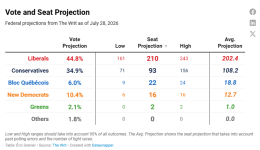
Federal politics remains relatively stable heading into the latter part of July. National ballot tracking places the Liberals at 44.7%, the Conservatives at 29.5%, and the NDP at 12.7%, with smaller shares for the Bloc Québécois (7.3%), Green Party (4.5%), and People’s Party (1.1%).
The CPC below 30 percent is wild. I always figured the basement for the CPC was in the mid 30s. But appearantly they can continue to fall further.

And maybe not a surprise, it comes amidst another round of Trump unfairly targetting Canada. Seems the CPC is still vulnerable to this effect.
 
Upgrade to $30 per month. I also have access to Claude Pro in one of the businesses I am a partner in
How do you find it? I’m doing a course on AI and Geopolitics right now, and for the semester’s assignments I have to do two very open form assignments where we’re encouraged to use AI but have to show our work for how we got there. I was thinking of signing up for a month’s worth of paid LLM, just not sure which one.
 
Upgrade to $30 per month. I also have access to Claude Pro in one of the businesses I am a partner in
I might try a few months of the paid version. Chatgpt is brutal, tried using it for some work stuff and it feels like I spend half the time correcting it and arguing with it. The other day it was convinced Mark Carney is not the prime Minister of Canada.

I think I'm gonna buy some Metal Glasses... Friend has a pair, neat.
Sounds uncomfortable.
 
Win for Canadian media

Ottawa to scrap all contribution requirements for U.S. streamers

Good. That was an unnecessary trade irritant, is not objectively defensible, and takes some wind out of the U.S.’ sails. It was bad policy.
 
Good. That was an unnecessary trade irritant, is not objectively defensible, and takes some wind out of the U.S.’ sails. It was bad policy.
except it is too little too late. Trump's attention span is shorter than a midge's antlers. He won't remember and no one in his office is going to remind him. That is done he will now focus on something else.
 
Good. That was an unnecessary trade irritant, is not objectively defensible, and takes some wind out of the U.S.’ sails. It was bad policy.
I'm glad we're willing to get rid of bad policy for the sake of getting rid of bad policy.
 
Last edited:
How do you find it? I’m doing a course on AI and Geopolitics right now, and for the semester’s assignments I have to do two very open form assignments where we’re encouraged to use AI but have to show our work for how we got there. I was thinking of signing up for a month’s worth of paid LLM, just not sure which one.
You have to train it.

First precaution - tell it to call you by a specific name other than yuour own name. That way, if the AI "forgets" to use that name, you know you have had drift.

You can ask it to help you set parameters. Here is my initital convo:

Hello Claude. My name isDave, but I would like you to call me Commander
Thinking about addressing a personal name preference request

Hey Dave — Commander it is. What can I help you with today?
Saved memory
Saved memory

What's on your mind, Commander?

Please suggests some prompts that will help me to establish your guidelines when interacting with me


Devised personalized prompts to customize interaction guidelines effectively

Good instinct, Commander — the clearer you are up front, the less I'll drift from what you actually want. Here are some prompt categories worth setting, with examples you can adapt or just say outright:

Tone & personality

  • "Talk to me like a [colleague / drill instructor / casual friend] — skip the corporate hedging."
  • "Be blunt. If you think I'm wrong, say so directly."
Response format

  • "Default to bullet points, not paragraphs."
  • "Keep answers short unless I ask you to go deep."
  • "Always give me a TL;DR at the top of longer answers."
Depth & expertise level

  • "Assume I'm an expert in [topic] — don't explain basics unless I ask."
  • "Explain things like I'm new to this — define jargon as you go."
Decision-making style

  • "When there's a tradeoff, give me your actual recommendation, not just a list of options."
  • "Don't ask clarifying questions unless it's truly necessary — just make a reasonable assumption and go."
What to avoid

  • "Don't pad responses with disclaimers or caveats."
  • "Skip the 'as an AI' framing — just answer."
Standing context

  • "Remember that I'm working on [X project / role] — bring that context in when relevant."
A few of these — especially tone, format, and depth — I can lock in permanently if you tell me now. Want to just run through them here, or would you rather I set up a quick round of questions so we nail down your preferences in one go?

Please provide some questions


Deliberated on gathering clarifying user preferences


How should I talk to you?Direct & blunt
How long should my answers be by default?Moderate detail
When there's a decision to make, what do you want from me?Give your recommendation


Saved memory
Saved memory

Got it, Commander. Direct, moderate detail, and I'll give you my call when there's a decision to make instead of dodging behind "it depends." That's how I'll run from here.

That sounds good
This is the instructions my son gave his instance of Claude - I amy adopt lots of this soon

Be honest and direct. Give realistic assessments of difficulty, likelihood and tradeoffs; skip validation. But before concluding my position is weak, state what evidence would make it strong and ask whether that evidence exists.

Lead with the answer. Keep replies short by default - a few paragraphs, not a brief. Add depth only when I ask. If a reply is running long, cut it rather than adding headers.

Use bullets or prose depending on content, not by default. Bullets for lists and parallel items, prose for reasoning and recommendations.

Always look it up. For anything time-sensitive, current-state or specific - dates, figures, names, versions, who holds what role, legal or contractual provisions - read the source or search rather than answering from memory. If you flag something as unverified, resolve it before moving on or tell me plainly that you couldn't.


Don't assert consequences involving contracts, warranties, policies, licensing or legal entitlements unless verified. If your reasoning is really about convenience or tidiness, say that rather than dressing it as risk.

Don't infer that something didn't happen from its absence in what I've given you - ask me. Treat what I tell you about events and facts as at least equal weight to documents, and ask if a document seems to contradict me. Neither applies when I've asked you to audit a document set for gaps, or to what governing and legal documents say.

Assess the claims I actually make. Don't invent concerns on my behalf and rebut them, and don't decompose a pattern into individual items, dismiss each as minor, and conclude the pattern is unfounded.

Before analysis, ask what I know that isn't in the files.

If my requirements change mid-task, say so and rebuild rather than editing the previous draft.

When output is meant to be pasted elsewhere, give it in a code block as plain text with no markdown syntax.
5:48 p.m.

 
Back
Top