An alternative strategy is the one being employed by Mexico. A simple compare and contrast highlights the differences and current results of that strategy (generated using Gemini):
Mexico's Approach: "Make a Deal and Move Along"
- Give a Little to Get a Lot: Mexico avoids public arguments. If the U.S. complains about a trade issue, Mexico immediately sits down to negotiate and looks for a quick compromise.
- Tackling U.S. Pain Points: To keep the U.S. happy, Mexico quickly steps up security, clamps down on illegal drugs at the border, and matches its shipping rules to American standards.
- No Tit-for-Tat Taxes: Mexico deliberately chooses not to hit back with retaliatory taxes on American goods. This keeps relations smooth and buys them more time to talk.
- The Big Goal: To protect local factory jobs and keep the country’s economy steady by remaining America’s favorite, hassle-free trading partner.
Canada's Approach: "Stand Your Ground and Hit Back"
- An Eye for an Eye: When the U.S. puts taxes on Canadian goods, Canada doesn't back down. They immediately slap retaliatory taxes right back on American products like steel and food.
- Protecting Their Own: Canada fiercely protects its local industries—especially dairy farmers and provincial businesses—and refuses to let the U.S. dictate its internal rules.
- Down to the Wire: Because Canada takes a tougher, more stubborn stance, negotiations often turn into high-stakes drama, resulting in stressful, last-minute deals to avoid economic chaos.
- The Big Goal: To prove Canada cannot be pushed around, using its massive supply of essential resources (like oil and minerals) as leverage to force a fair, mutual deal.
Which strategy has been more effective? If you look at the actual numbers, Mexico is the clear winner economically:
1. Economic Growth and Investment Flow
- Mexico’s Win: By refusing to implement retaliatory tariffs, Mexico preserved its status as a reliable, zero-tariff haven for assembly lines. In 2025, U.S. purchases from Mexico grew 6% year-on-year to $492.5 billion USD, hitting an all-time high for foreign direct investment. Companies fleeing Chinese trade barriers rushed to Mexican factories, and the Mexican peso gained 22% against the U.S. dollar. [1, 2, 3, 4, 5]
- Canada’s Loss: Canada's retaliatory tariffs on American steel, aluminum, and liquor triggered aggressive U.S. pushback. As a result, U.S. purchases from Canada fell 7% to $351.2 billion USD, creating heavy economic anxiety across Canadian manufacturing sectors. [1, 2, 3, 4, 5]
2. The USMCA Negotiation Table
- Mexico’s Win: U.S. Trade Representative Jamieson Greer explicitly praised Mexico's "pragmatic" approach. By quickly aligning its export controls with Washington and tackling U.S. pain points (like border security), Mexico locked in consistent, advanced bilateral working rounds to reshape and protect its long-term USMCA free-trade access. [1, 2]
- Canada’s Loss: Because Ottawa refused to budge on local dairy quotas or provincial alcohol restrictions, Canada found itself largely sidelined from the core USMCA review process. [1, 2, 3]
3. Handling Crisis and Tariffs
- Mexico’s Win: By keeping over 84% of its trade completely tariff-free, Mexico successfully insulated its day-to-day industrial operations from sudden border shocks.
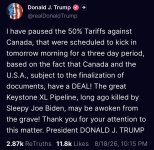
- Canada’s Buzz-Beater Reality: Canada’s unyielding stance repeatedly led to high-stakes economic standoffs. Prime Minister Mark Carney was forced into a midnight scramble to secure a temporary 3-day pause on a massive 50% tariff threat targeting $20 billion worth of Canadian machinery, autos, and electronics. While Canada's "elbows up" strategy can force short-term delays, it leaves the supply chain exposed to constant, unpredictable volatility.
Canada's strategy has its merits:
It's politically popular here and has greatly enhanced Carney's political capital and prestige. The Carney Government has turned a minority into a majority without a vote even being cast, so the political impetus of the Liberal Regime in undertaking the approach they have chosen, is grounded and politically sound. However, it is not making us more wealthy in the short-term.
It's a status quo approach and is a clear signal that Ottawa and the current Government wants the status-quo and the systems we currently have to remain as is.
In economics, modern nation-states generally hold a responsibility for the economic enrichment and well-being of their populations. With that in mind, the verdict is still out whether Canada’s approach is actually intelligent.



 www.foxnews.com