• Thanks for stopping by. Logging in to a registered account will remove all generic ads. Please reach out with any questions or concerns.

CAN-USA Tariff Strife (split from various pol threads)

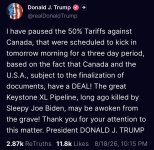
IMG_9219.jpeg

Little of what he says piques my curiosity anymore because so little of it means anything, but the fact that he focuses on Keystone XL is curious. Canada started giving thumbs up on our part (South Bow), and it’s been awaiting American approval for their end of it for a while. I’m wondering if if a move-forward on Keystone has been floated as something the U.S. gets to claim as a win out of this to let other things move forward? It just seems out of place that that’s what he emphasizes.

I have no real hope for anything meaningful come Friday save the usual market manipulation, but I do wonder how the game’s being played from our side.
 
Letting Trump declare victory by doing something we want him to do and have been waiting for him to do is 2D checkers not 4D chess, but I'll take it.
The fact that before all this crap began that the only reason that we had a 50+/- billion trade surplus with the US was because of the 4million bpd of oil they imported from us and now their Genius President is crowing about wanting to expand their oil imports from us by another 20% is just the icing on the cake.
 
The fact that before all this crap began that the only reason that we had a 50+/- billion trade surplus with the US was because of the 4million bpd of oil they imported from us and now their Genius President is crowing about wanting to expand their oil imports from us by another 20% is just the icing on the cake.
I await with bated breath. Hoping we didnt capitulate anything major. Once the capitulating becomes habit, the vultures wont stop.
 
Nowhere did I suggest that this is the most appropriate strategy. I merely posted one of the viable COAs for information.

I would love to see some other coherent strategies, but I fear that neither the Government nor the Opposition have articulated one, to say nothing of the commentariat (which includes this site).

An alternative strategy is the one being employed by Mexico. A simple compare and contrast highlights the differences and current results of that strategy (generated using Gemini):

Mexico's Approach: "Make a Deal and Move Along"
  • Give a Little to Get a Lot: Mexico avoids public arguments. If the U.S. complains about a trade issue, Mexico immediately sits down to negotiate and looks for a quick compromise.
  • Tackling U.S. Pain Points: To keep the U.S. happy, Mexico quickly steps up security, clamps down on illegal drugs at the border, and matches its shipping rules to American standards.
  • No Tit-for-Tat Taxes: Mexico deliberately chooses not to hit back with retaliatory taxes on American goods. This keeps relations smooth and buys them more time to talk.
  • The Big Goal: To protect local factory jobs and keep the country’s economy steady by remaining America’s favorite, hassle-free trading partner.
Canada's Approach: "Stand Your Ground and Hit Back"
  • An Eye for an Eye: When the U.S. puts taxes on Canadian goods, Canada doesn't back down. They immediately slap retaliatory taxes right back on American products like steel and food.
  • Protecting Their Own: Canada fiercely protects its local industries—especially dairy farmers and provincial businesses—and refuses to let the U.S. dictate its internal rules.
  • Down to the Wire: Because Canada takes a tougher, more stubborn stance, negotiations often turn into high-stakes drama, resulting in stressful, last-minute deals to avoid economic chaos.
  • The Big Goal: To prove Canada cannot be pushed around, using its massive supply of essential resources (like oil and minerals) as leverage to force a fair, mutual deal.

Which strategy has been more effective? If you look at the actual numbers, Mexico is the clear winner economically:

1. Economic Growth and Investment Flow
  • Mexico’s Win: By refusing to implement retaliatory tariffs, Mexico preserved its status as a reliable, zero-tariff haven for assembly lines. In 2025, U.S. purchases from Mexico grew 6% year-on-year to $492.5 billion USD, hitting an all-time high for foreign direct investment. Companies fleeing Chinese trade barriers rushed to Mexican factories, and the Mexican peso gained 22% against the U.S. dollar. [1, 2, 3, 4, 5]
  • Canada’s Loss: Canada's retaliatory tariffs on American steel, aluminum, and liquor triggered aggressive U.S. pushback. As a result, U.S. purchases from Canada fell 7% to $351.2 billion USD, creating heavy economic anxiety across Canadian manufacturing sectors. [1, 2, 3, 4, 5]
2. The USMCA Negotiation Table
  • Mexico’s Win: U.S. Trade Representative Jamieson Greer explicitly praised Mexico's "pragmatic" approach. By quickly aligning its export controls with Washington and tackling U.S. pain points (like border security), Mexico locked in consistent, advanced bilateral working rounds to reshape and protect its long-term USMCA free-trade access. [1, 2]
  • Canada’s Loss: Because Ottawa refused to budge on local dairy quotas or provincial alcohol restrictions, Canada found itself largely sidelined from the core USMCA review process. [1, 2, 3]
3. Handling Crisis and Tariffs
  • Mexico’s Win: By keeping over 84% of its trade completely tariff-free, Mexico successfully insulated its day-to-day industrial operations from sudden border shocks.
  • Canada’s Buzz-Beater Reality: Canada’s unyielding stance repeatedly led to high-stakes economic standoffs. Prime Minister Mark Carney was forced into a midnight scramble to secure a temporary 3-day pause on a massive 50% tariff threat targeting $20 billion worth of Canadian machinery, autos, and electronics. While Canada's "elbows up" strategy can force short-term delays, it leaves the supply chain exposed to constant, unpredictable volatility.


Canada's strategy has its merits:

It's politically popular here and has greatly enhanced Carney's political capital and prestige. The Carney Government has turned a minority into a majority without a vote even being cast, so the political impetus of the Liberal Regime in undertaking the approach they have chosen, is grounded and politically sound. However, it is not making us more wealthy in the short-term.

It's a status quo approach and is a clear signal that Ottawa and the current Government wants the status-quo and the systems we currently have to remain as is.

In economics, modern nation-states generally hold a responsibility for the economic enrichment and well-being of their populations. With that in mind, the verdict is still out whether Canada’s approach is actually intelligent.

 
An alternative strategy is the one being employed by Mexico. A simple compare and contrast highlights the differences and current results of that strategy (generated using Gemini):

Mexico's Approach: "Make a Deal and Move Along"
  • Give a Little to Get a Lot: Mexico avoids public arguments. If the U.S. complains about a trade issue, Mexico immediately sits down to negotiate and looks for a quick compromise.
  • Tackling U.S. Pain Points: To keep the U.S. happy, Mexico quickly steps up security, clamps down on illegal drugs at the border, and matches its shipping rules to American standards.
  • No Tit-for-Tat Taxes: Mexico deliberately chooses not to hit back with retaliatory taxes on American goods. This keeps relations smooth and buys them more time to talk.
  • The Big Goal: To protect local factory jobs and keep the country’s economy steady by remaining America’s favorite, hassle-free trading partner.
Canada's Approach: "Stand Your Ground and Hit Back"
  • An Eye for an Eye: When the U.S. puts taxes on Canadian goods, Canada doesn't back down. They immediately slap retaliatory taxes right back on American products like steel and food.
  • Protecting Their Own: Canada fiercely protects its local industries—especially dairy farmers and provincial businesses—and refuses to let the U.S. dictate its internal rules.
  • Down to the Wire: Because Canada takes a tougher, more stubborn stance, negotiations often turn into high-stakes drama, resulting in stressful, last-minute deals to avoid economic chaos.
  • The Big Goal: To prove Canada cannot be pushed around, using its massive supply of essential resources (like oil and minerals) as leverage to force a fair, mutual deal.

Which strategy has been more effective? If you look at the actual numbers, Mexico is the clear winner economically:

1. Economic Growth and Investment Flow
  • Mexico’s Win: By refusing to implement retaliatory tariffs, Mexico preserved its status as a reliable, zero-tariff haven for assembly lines. In 2025, U.S. purchases from Mexico grew 6% year-on-year to $492.5 billion USD, hitting an all-time high for foreign direct investment. Companies fleeing Chinese trade barriers rushed to Mexican factories, and the Mexican peso gained 22% against the U.S. dollar. [1, 2, 3, 4, 5]
  • Canada’s Loss: Canada's retaliatory tariffs on American steel, aluminum, and liquor triggered aggressive U.S. pushback. As a result, U.S. purchases from Canada fell 7% to $351.2 billion USD, creating heavy economic anxiety across Canadian manufacturing sectors. [1, 2, 3, 4, 5]
2. The USMCA Negotiation Table
  • Mexico’s Win: U.S. Trade Representative Jamieson Greer explicitly praised Mexico's "pragmatic" approach. By quickly aligning its export controls with Washington and tackling U.S. pain points (like border security), Mexico locked in consistent, advanced bilateral working rounds to reshape and protect its long-term USMCA free-trade access. [1, 2]
  • Canada’s Loss: Because Ottawa refused to budge on local dairy quotas or provincial alcohol restrictions, Canada found itself largely sidelined from the core USMCA review process. [1, 2, 3]
3. Handling Crisis and Tariffs
  • Mexico’s Win: By keeping over 84% of its trade completely tariff-free, Mexico successfully insulated its day-to-day industrial operations from sudden border shocks.
  • Canada’s Buzz-Beater Reality: Canada’s unyielding stance repeatedly led to high-stakes economic standoffs. Prime Minister Mark Carney was forced into a midnight scramble to secure a temporary 3-day pause on a massive 50% tariff threat targeting $20 billion worth of Canadian machinery, autos, and electronics. While Canada's "elbows up" strategy can force short-term delays, it leaves the supply chain exposed to constant, unpredictable volatility.


Canada's strategy has its merits:

It's politically popular here and has greatly enhanced Carney's political capital and prestige. The Carney Government has turned a minority into a majority without a vote even being cast, so the political impetus of the Liberal Regime in undertaking the approach they have chosen, is grounded and politically sound. However, it is not making us more wealthy in the short-term.

It's a status quo approach and is a clear signal that Ottawa and the current Government wants the status-quo and the systems we currently have to remain as is.

In economics, modern nation-states generally hold a responsibility for the economic enrichment and well-being of their populations. With that in mind, the verdict is still out whether Canada’s approach is actually intelligent.
The Mexicans can't 'hit back' because they 'fail' on so many levels.

Fentanyl
- when Trump put his first set of Tariffs against us (Canada and Mexico) this was his justification. He didn't have a leg to stand on with us and accordingly we said 'what the f*ck'. Mexico said nothing because they had zero ability to counter that argument because the numbers/facts weren't on their side​
Trade Surplus
- when back out Oil imports from us, the US has a trade surplus with Canada. We buy more from them than any other country in the world. That is not the case with the Mexicans. Back out their oil exports to the US and they still have a massive surplus with the Americans. Because of this, its in their best interest to keep their mouth shut and not upset the apple cart. Its in our interest to loudly inform the Americans that if we don't buy your goods and continue to be your number 1 export market its your citizens/workers that are going to suffer.​
 
An alternative strategy is the one being employed by Mexico. A simple compare and contrast highlights the differences and current results of that strategy (generated using Gemini):

Mexico's Approach: "Make a Deal and Move Along"
  • Give a Little to Get a Lot: Mexico avoids public arguments. If the U.S. complains about a trade issue, Mexico immediately sits down to negotiate and looks for a quick compromise.
  • Tackling U.S. Pain Points: To keep the U.S. happy, Mexico quickly steps up security, clamps down on illegal drugs at the border, and matches its shipping rules to American standards.
  • No Tit-for-Tat Taxes: Mexico deliberately chooses not to hit back with retaliatory taxes on American goods. This keeps relations smooth and buys them more time to talk.
  • The Big Goal: To protect local factory jobs and keep the country’s economy steady by remaining America’s favorite, hassle-free trading partner.
Canada's Approach: "Stand Your Ground and Hit Back"
  • An Eye for an Eye: When the U.S. puts taxes on Canadian goods, Canada doesn't back down. They immediately slap retaliatory taxes right back on American products like steel and food.
  • Protecting Their Own: Canada fiercely protects its local industries—especially dairy farmers and provincial businesses—and refuses to let the U.S. dictate its internal rules.
  • Down to the Wire: Because Canada takes a tougher, more stubborn stance, negotiations often turn into high-stakes drama, resulting in stressful, last-minute deals to avoid economic chaos.
  • The Big Goal: To prove Canada cannot be pushed around, using its massive supply of essential resources (like oil and minerals) as leverage to force a fair, mutual deal.

Which strategy has been more effective? If you look at the actual numbers, Mexico is the clear winner economically:

1. Economic Growth and Investment Flow
  • Mexico’s Win: By refusing to implement retaliatory tariffs, Mexico preserved its status as a reliable, zero-tariff haven for assembly lines. In 2025, U.S. purchases from Mexico grew 6% year-on-year to $492.5 billion USD, hitting an all-time high for foreign direct investment. Companies fleeing Chinese trade barriers rushed to Mexican factories, and the Mexican peso gained 22% against the U.S. dollar. [1, 2, 3, 4, 5]
  • Canada’s Loss: Canada's retaliatory tariffs on American steel, aluminum, and liquor triggered aggressive U.S. pushback. As a result, U.S. purchases from Canada fell 7% to $351.2 billion USD, creating heavy economic anxiety across Canadian manufacturing sectors. [1, 2, 3, 4, 5]
2. The USMCA Negotiation Table
  • Mexico’s Win: U.S. Trade Representative Jamieson Greer explicitly praised Mexico's "pragmatic" approach. By quickly aligning its export controls with Washington and tackling U.S. pain points (like border security), Mexico locked in consistent, advanced bilateral working rounds to reshape and protect its long-term USMCA free-trade access. [1, 2]
  • Canada’s Loss: Because Ottawa refused to budge on local dairy quotas or provincial alcohol restrictions, Canada found itself largely sidelined from the core USMCA review process. [1, 2, 3]
3. Handling Crisis and Tariffs
  • Mexico’s Win: By keeping over 84% of its trade completely tariff-free, Mexico successfully insulated its day-to-day industrial operations from sudden border shocks.
  • Canada’s Buzz-Beater Reality: Canada’s unyielding stance repeatedly led to high-stakes economic standoffs. Prime Minister Mark Carney was forced into a midnight scramble to secure a temporary 3-day pause on a massive 50% tariff threat targeting $20 billion worth of Canadian machinery, autos, and electronics. While Canada's "elbows up" strategy can force short-term delays, it leaves the supply chain exposed to constant, unpredictable volatility.


Canada's strategy has its merits:

It's politically popular here and has greatly enhanced Carney's political capital and prestige. The Carney Government has turned a minority into a majority without a vote even being cast, so the political impetus of the Liberal Regime in undertaking the approach they have chosen, is grounded and politically sound. However, it is not making us more wealthy in the short-term.

It's a status quo approach and is a clear signal that Ottawa and the current Government wants the status-quo and the systems we currently have to remain as is.

In economics, modern nation-states generally hold a responsibility for the economic enrichment and well-being of their populations. With that in mind, the verdict is still out whether Canada’s approach is actually intelligent.


Canada and the USA are children of the same parent.

I am convinced our conduct of this whole situation is based on jealousy of American economic and cultural success; and the real thread that binds this country together which is anti Americanism.

Nothing will win you political popularity quite like giving the finger to Uncle Sam.


Canada and the USA are children of the same parent.

I am convinced our conduct of this whole situation is based on jealousy of American economic and cultural success; and the real thread that binds this country together which is anti Americanism.

Nothing will win you political popularity quite like giving the finger to Uncle Sam.


I'm more pro Canadian than anti american. But why is there this feeling out there? To me its this; it's our proximity to the United States that no other nation in the world faces. The 24/7, 365-day tsunami of American culture washing across the border has led many Canadians to discount our own cultural touchstones.

When was the last time you heard Canadians enthusiastically talking about a Canadian movie? Or saw the CBC heavily promote a standout U Sports athlete? I'd wager it's about as rare as hen's teeth. Yet when a Canadian athlete excels in the NCAA, the coverage is everywhere. The same applies to Canadian major junior hockey players who transfer to American colleges. Some people who barely acknowledge the WHL, OHL, or QMJHL suddenly become invested because that player is now skating for a school in Iowa or Michigan.

The NHL has become a thoroughly American-run league, and I doubt many of the executives in New York would lose sleep if more Canadian franchises moved south of the border. It's long past time for Canadians to support our own institutions, leagues, artists, and athletes. Doing so, however, requires effort, commitment, and money. Too often, our decision-makers choose the easy option and lean on the United States instead.

That tendency extends well beyond sports and entertainment. It shows up in our infrastructure, manufacturing base, technology sector, and broader economy. Why do you think Canada finds itself in the position it does today with the current U.S. administration? For decades, we've become comfortable relying on American markets, American capital, and American cultural influence rather than investing in our own capabilities.

Perhaps if we had more confidence in ourselves and greater pride in Canadian achievements, we wouldn't be so quick to dismiss our own culture. We might pay more attention to the CFL, CEBL, CPL, Northern Super League, Canadian films, and Canadian artists instead of constantly looking south for validation.

Ultimately, supporting Canadian culture and institutions requires choices. It means directing at least some of those limited entertainment dollars toward Canadian leagues, performers, and creators. That may mean choosing local over imported, Canadian over American. If we truly believe we're facing a moment that demands greater national resilience, then supporting our own cultural and economic ecosystem is one place to start.
 
Canada and the USA are children of the same parent.

I am convinced our conduct of this whole situation is based on jealousy of American economic and cultural success; and the real thread that binds this country together which is anti Americanism.

Nothing will win you political popularity quite like giving the finger to Uncle Sam.


Fair points.
 
Back
Top