• Thanks for stopping by. Logging in to a registered account will remove all generic ads. Please reach out with any questions or concerns.

TKMS Type 212CD (Victoria class replacement megathread)

I think for others on the forum to follow, who have not researched nor monitored this over the years, I will take a step back next, and post some information I learned some time back (years back actually) in regards to SSN submarine Arctic transits, together with more recent speculation on the web in regards to the Canadian Patrol Submarine project.

First some history:

Its common knownedge that SSNs have transited the Arctic waters, and even visited the North Pole area.

For example, purportedly in August 1960, the SSN USS Seadragon (SSN-584), a Skate class nuclear attack submarine entered the Parry Channel at Lancaster Sound on August 15, 1960, and completed the deep-archipelago passage out to the Beaufort Sea (via Viscount Melville Sound and McClure Strait) on August 21, 1960. This was not the first Arctic transit but argueably the first mostly following the North West Passage.
  • Eastern Entry (Lancaster Sound / Baffin Bay boundary): ~74° 15′ N, 80° 00′ W (where Baffin Bay funnels westward into the sound between Devon Island Baffin Island)
  • Western Exit (McClure Strait / Beaufort Sea boundary): ~74° 30′ N, 122° 00′ W (where the strait opens out past Banks Island into the western polar basin).
The total Underwater Time for the Passage: Exactly 6 days (approx. 144 hours) of continuous under-ice navigation to clear the restricted straits of the Canadian Arctic. That is about 1,035 km (559 nautical miles). That is an average speed of 3.9 knots.

But 6 days ? At that slow speed?? I was immediately VERY supicous.

Transit at 6 knots, and 559nm is only a fraction of the Arctic.

That does not include passage through the ice by Bering Sea, so I don't consider such even close to being partly representative. Further, I noted that August is a favourable time of year for such a passage, with major portions of channels like the Parry Channel are often open enough for surface travel, or choked only with looser, fractured multi-year and seasonal ice. Having typed that, mid-to-later September is even more favourable for such a passage.

Still, calculating further, if considering navigating underwater from the western McClure Strait exit (~74° 30′ N, 122° 00′ W) to open water south of the Bering Sea icefields, requires following deeper underwater channels across the Beaufort and Chukchi shelves, to avoid shallow shoals and to avoid potential deep ice keels that might reach to the ocean floor. That increases the necessary transit distance.

Following an under-ice track that arcs westward across the deep Beaufort basin, passes north of the Chukchi shelf break, threads the Bering Strait, and continues south into the open Bering Sea past the seasonal ice edge (~61° N, 171° W) results in a total Navigable Track Distance of approximately 1,435 nautical miles (about 2,658 kilometers) for only that portion.

So if I add this up - - the underwater distance from Eastern Entry (Lancaster Sound / Baffin Bay boundary): ~74° 15′ N, 80° 00′ W (where Baffin Bay funnels westward into the sound between Devon Island and Baffin Island) to Open water south of the Bering Strait ice pack , positioned safely south of the seasonal winter/spring ice edge in the Bering Sea (-61°N, 171°W), I come to a number of around 1,994nm (around 3,693 km).

So - for the moment (only) lets go with that number of 1,994nm (around 3,693 km) for straight (no detour) transit - and even that is (IMHO) likely too short an estimate re:distance.

Next if I look at the RCN RFI for the Canadian Patrol Submarine Project (such as HLMR #3 ), which specified:
----
Ability to operate discretely without external support for minimum transits of 7000nm (2x 3500nm) at 8kts, and a minimum of 21 days of continuous dived operations while on station. Capable of no less than 60 days self-sustained operation.
---

The 21-days does not state the submarine's dived operations speed underwater. Lets assume (and this could be wrong) of 21-days of continuous dived at 3-knots, and also for comparison, look at a more ambitious (speculative?) 4 knots assumption for 21-days continuous dived under water duration.

21 days at 3 knots is 21 days x 24hr/day x 3knots = 1,512 nm (if at 3 knots) or 2,016 nm (at 4 knots). Given the distance is about 1,994 nm from open Bering Sea south of the seasonal ice edge to the Lancaster Sound / Baffin Bay boundary approximate ice edge, it is clear to me a Type-212CD likely can not safely (safely being the "operative word") traverse the full distance in 21 days based on the RCN requirement. Its too 'tight' with little to no margin.

But is 21 days the right number for the Type-212CD continous under water endurance?

Open unclassified press (purportedly originating from TKMS) for the Type-212CD claims 41-days underwater transit, which is assessed by many to be under water duration (noting that the RCN RFI HLMR (requirement) is a 60 day deployment for both above and underwater together). This is a purported improvement over the much older Type-212A which purportedly has the capability of 21-days submerged. So calculating from 41-days: 41 days x 24hrs/day x 3 knots = 2,952 nm. That exceeds the 1,994 nm arguably needed for Arctic transit - if and only if the 41-days is accurate. Is 41-days submerged on AIP accurate? And also if the 1,994 nm is accurate. Is that accurate? I don't know. I am rather skeptical to say it mildly.

Again thou, given I am skeptical there, as such a transit in my mind, that assumes a straight uneventful transit, and from my reading books such as "Nautilus 90-north" (USS Nautilus Arctic transit) suggests to me that multiple underwater efforts can be needed to get past blocking ice.

Such deviations in course may be necessary and hence a straight forward transit is credibly not possible and not likely assured, even if 41 days continuous underwater on an AIP system is possible. Of course, that pessimistic assumption of mine may also be invalid, as today with Synthetic Aperture Radar satellites (which Canada has), and with global warming, perhaps more favourable under ice transit routes can be determined and passed to the submarine before it submerges to attempt transit, and a more direct route under ice can be found with occasional locations to surface (or come to periscope depth) and run diesel engines with AIP temporary switched off.

Still even only one Arctic AIP replenishment system prepositioned in the Arctic, would change AIP equipped submarine Arctic operations from an no-detour Arctic transit (that I believe is still risky for an AIP equipped submarine), to a route that is not only a mostly an assured Arctic transit, but also one where margin exists for a further Arctic patrol.

Obviously more than one Arctic replenishment location would provide more risk free Arctic presence assurance, but I suspect even one such Arctic AIP replenishment location would in and of itself be a major challenge to the RCN to procure, implement, and maintain. One need read no further than the major skepticism in posts on this forum in regards to mobile AIP reactant replenishment, to appreciate the level of skepticism that exists - and the level of difficulty.

Still - to survive tomorrows wars, thinking and planning for the future as much as practical is essential. I can't understate that. To me that means using current contracts (such as the RCN/TKMS Type-212CD contract) to assess, and as much as possible, if assessed credible, to specify and plan for Arctic AIP replenishment.

And yes, the manpower issues/shortages in the RCN today is IMHO a major impediment, which suggests to me, that more use of civilian contractors, in conducting such investigations, assessments, planning, and where appropriate, helping in implementations, is and will be needed by the RCN.
 
Some trivia re: the North West Passage.

I found some data, speculating on the percentage of the North West Passage covered with ice. I was surprised at the data for the month of September over the years. Looking at September for some years from 2016 to 2025 — September being typically the month with the least amount of ice — there appears to me to be a clear long-term trend toward less ice.

For some of the years I found data for September:

2016 - 25.7% ice-covered; 74.3% ice-free
2017 - 22.6% ice-covered; 77.4% ice-free
.
.
2022 - 10.3% ice-covered; 89.7% ice-free
2023 - 5.7% ice-covered; 94.3% ice-free
2024 - 2.3% ice-covered; 97.7% ice-free

Again, I emphasize this is September only, when ice coverage is generally at or near its annual minimum.

Sep-2024 was a record year in terms of how much of the northern North West Passage was ice-free. I did not find year 2025 data.

If Sep-2024 ice conditions were to persist in later years, then in September I speculate a Canadian patrol submarine with AIP could potentially transit from West to East Coast if it started the North West Passage part of its voyage with 100% reactants — ie, use diesel from Esquimalt toward the Bering Sea, then potentially switch to AIP and operate under ice only where necessary. Once past the Bering Strait, there would likely be many areas where it could snorkel and switch back to diesel, minimizing AIP reactant consumption where there is no ice. Note this is for a transit — not for a sustained Arctic patrol.

This is for the yearly month of September, though — other months won't be as kind. I see this as "trivia" — interesting to think about, but not something to yet plan on for nominal operations.
 
Some trivia re: the North West Passage.

I found some data, speculating on the percentage of the North West Passage covered with ice. I was surprised at the data for the month of September over the years. Looking at September for some years from 2016 to 2025 — September being typically the month with the least amount of ice — there appears to me to be a clear long-term trend toward less ice.

For some of the years I found data for September:

2016 - 25.7% ice-covered; 74.3% ice-free
2017 - 22.6% ice-covered; 77.4% ice-free
.
.
2022 - 10.3% ice-covered; 89.7% ice-free
2023 - 5.7% ice-covered; 94.3% ice-free
2024 - 2.3% ice-covered; 97.7% ice-free

Again, I emphasize this is September only, when ice coverage is generally at or near its annual minimum.

Sep-2024 was a record year in terms of how much of the northern North West Passage was ice-free. I did not find year 2025 data.

If Sep-2024 ice conditions were to persist in later years, then in September I speculate a Canadian patrol submarine with AIP could potentially transit from West to East Coast if it started the North West Passage part of its voyage with 100% reactants — ie, use diesel from Esquimalt toward the Bering Sea, then potentially switch to AIP and operate under ice only where necessary. Once past the Bering Strait, there would likely be many areas where it could snorkel and switch back to diesel, minimizing AIP reactant consumption where there is no ice. Note this is for a transit — not for a sustained Arctic patrol.

This is for the yearly month of September, though — other months won't be as kind. I see this as "trivia" — interesting to think about, but not something to yet plan on for nominal operations.
Yes the Arctic is warming, I think I read that somewhere.

Interesting trivia, but the percentages do not tell us whether the Northwest Passage itself was navigable by a submarine. “97.7 percent ice free” across a large reporting region can still leave concentrated ice in the narrow straits and choke points that determine whether a particular route is open. Ice location, concentration, thickness, movement and the presence of multi year ice matter far more than the regional average. A submarine would also need reliable places to surface or snorkel, safe water beneath the ice and sufficient under keel clearance through shallow and poorly surveyed areas.

In an unusually favourable September, an AIP equipped submarine might conceivably make much of the passage on diesel and batteries, using AIP only for short periods where ice prevented snorkeling. That is broadly consistent with the RFI’s language about operating predominantly in navigable waters and making occasional short under ice passages between ice free areas. However, it would still depend on the actual ice picture, weather, hydrography, reactant capacity and the submarine’s approved operating limits. Much of which we don't know.

So yes, it is an interesting possibility, but it does not demonstrate that a future Canadian Patrol submarine could routinely transit the Northwest Passage under ice, nor does it justify designing normal operations around the exceptional September 2024 minimum. The sensible assumption remains that Arctic transits would be seasonal, carefully planned and routed through navigable water, with under ice operation limited wherever possible.
 
Yes the Arctic is warming, I think I read that somewhere.

Interesting trivia, but the percentages do not tell us whether the Northwest Passage itself was navigable by a submarine. “97.7 percent ice free” across a large reporting region can still leave concentrated ice in the narrow straits and choke points that determine whether a particular route is open. Ice location, concentration, thickness, movement and the presence of multi year ice matter far more than the regional average. A submarine would also need reliable places to surface or snorkel, safe water beneath the ice and sufficient under keel clearance through shallow and poorly surveyed areas.

In an unusually favourable September, an AIP equipped submarine might conceivably make much of the passage on diesel and batteries, using AIP only for short periods where ice prevented snorkeling. That is broadly consistent with the RFI’s language about operating predominantly in navigable waters and making occasional short under ice passages between ice free areas. However, it would still depend on the actual ice picture, weather, hydrography, reactant capacity and the submarine’s approved operating limits. Much of which we don't know.

So yes, it is an interesting possibility, but it does not demonstrate that a future Canadian Patrol submarine could routinely transit the Northwest Passage under ice, nor does it justify designing normal operations around the exceptional September 2024 minimum. The sensible assumption remains that Arctic transits would be seasonal, carefully planned and routed through navigable water, with under ice operation limited wherever possible.
So ,
1788290076991.png
 
I think for others on the forum to follow, who have not researched nor monitored this over the years, I will take a step back next, and post some information I learned some time back (years back actually) in regards to SSN submarine Arctic transits, together with more recent speculation on the web in regards to the Canadian Patrol Submarine project.

First some history:

Its common knownedge that SSNs have transited the Arctic waters, and even visited the North Pole area.

For example, purportedly in August 1960, the SSN USS Seadragon (SSN-584), a Skate class nuclear attack submarine entered the Parry Channel at Lancaster Sound on August 15, 1960, and completed the deep-archipelago passage out to the Beaufort Sea (via Viscount Melville Sound and McClure Strait) on August 21, 1960. This was not the first Arctic transit but argueably the first mostly following the North West Passage.
  • Eastern Entry (Lancaster Sound / Baffin Bay boundary): ~74° 15′ N, 80° 00′ W (where Baffin Bay funnels westward into the sound between Devon Island Baffin Island)
  • Western Exit (McClure Strait / Beaufort Sea boundary): ~74° 30′ N, 122° 00′ W (where the strait opens out past Banks Island into the western polar basin).
The total Underwater Time for the Passage: Exactly 6 days (approx. 144 hours) of continuous under-ice navigation to clear the restricted straits of the Canadian Arctic. That is about 1,035 km (559 nautical miles). That is an average speed of 3.9 knots.

But 6 days ? At that slow speed?? I was immediately VERY supicous.

Transit at 6 knots, and 559nm is only a fraction of the Arctic.

That does not include passage through the ice by Bering Sea, so I don't consider such even close to being partly representative. Further, I noted that August is a favourable time of year for such a passage, with major portions of channels like the Parry Channel are often open enough for surface travel, or choked only with looser, fractured multi-year and seasonal ice. Having typed that, mid-to-later September is even more favourable for such a passage.

Still, calculating further, if considering navigating underwater from the western McClure Strait exit (~74° 30′ N, 122° 00′ W) to open water south of the Bering Sea icefields, requires following deeper underwater channels across the Beaufort and Chukchi shelves, to avoid shallow shoals and to avoid potential deep ice keels that might reach to the ocean floor. That increases the necessary transit distance.

Following an under-ice track that arcs westward across the deep Beaufort basin, passes north of the Chukchi shelf break, threads the Bering Strait, and continues south into the open Bering Sea past the seasonal ice edge (~61° N, 171° W) results in a total Navigable Track Distance of approximately 1,435 nautical miles (about 2,658 kilometers) for only that portion.

So if I add this up - - the underwater distance from Eastern Entry (Lancaster Sound / Baffin Bay boundary): ~74° 15′ N, 80° 00′ W (where Baffin Bay funnels westward into the sound between Devon Island and Baffin Island) to Open water south of the Bering Strait ice pack , positioned safely south of the seasonal winter/spring ice edge in the Bering Sea (-61°N, 171°W), I come to a number of around 1,994nm (around 3,693 km).

So - for the moment (only) lets go with that number of 1,994nm (around 3,693 km) for straight (no detour) transit - and even that is (IMHO) likely too short an estimate re:distance.

Next if I look at the RCN RFI for the Canadian Patrol Submarine Project (such as HLMR #3 ), which specified:
----
Ability to operate discretely without external support for minimum transits of 7000nm (2x 3500nm) at 8kts, and a minimum of 21 days of continuous dived operations while on station. Capable of no less than 60 days self-sustained operation.
---

The 21-days does not state the submarine's dived operations speed underwater. Lets assume (and this could be wrong) of 21-days of continuous dived at 3-knots, and also for comparison, look at a more ambitious (speculative?) 4 knots assumption for 21-days continuous dived under water duration.

21 days at 3 knots is 21 days x 24hr/day x 3knots = 1,512 nm (if at 3 knots) or 2,016 nm (at 4 knots). Given the distance is about 1,994 nm from open Bering Sea south of the seasonal ice edge to the Lancaster Sound / Baffin Bay boundary approximate ice edge, it is clear to me a Type-212CD likely can not safely (safely being the "operative word") traverse the full distance in 21 days based on the RCN requirement. Its too 'tight' with little to no margin.

But is 21 days the right number for the Type-212CD continous under water endurance?

Open unclassified press (purportedly originating from TKMS) for the Type-212CD claims 41-days underwater transit, which is assessed by many to be under water duration (noting that the RCN RFI HLMR (requirement) is a 60 day deployment for both above and underwater together). This is a purported improvement over the much older Type-212A which purportedly has the capability of 21-days submerged. So calculating from 41-days: 41 days x 24hrs/day x 3 knots = 2,952 nm. That exceeds the 1,994 nm arguably needed for Arctic transit - if and only if the 41-days is accurate. Is 41-days submerged on AIP accurate? And also if the 1,994 nm is accurate. Is that accurate? I don't know. I am rather skeptical to say it mildly.

Again thou, given I am skeptical there, as such a transit in my mind, that assumes a straight uneventful transit, and from my reading books such as "Nautilus 90-north" (USS Nautilus Arctic transit) suggests to me that multiple underwater efforts can be needed to get past blocking ice.

Such deviations in course may be necessary and hence a straight forward transit is credibly not possible and not likely assured, even if 41 days continuous underwater on an AIP system is possible. Of course, that pessimistic assumption of mine may also be invalid, as today with Synthetic Aperture Radar satellites (which Canada has), and with global warming, perhaps more favourable under ice transit routes can be determined and passed to the submarine before it submerges to attempt transit, and a more direct route under ice can be found with occasional locations to surface (or come to periscope depth) and run diesel engines with AIP temporary switched off.

Still even only one Arctic AIP replenishment system prepositioned in the Arctic, would change AIP equipped submarine Arctic operations from an no-detour Arctic transit (that I believe is still risky for an AIP equipped submarine), to a route that is not only a mostly an assured Arctic transit, but also one where margin exists for a further Arctic patrol.

Obviously more than one Arctic replenishment location would provide more risk free Arctic presence assurance, but I suspect even one such Arctic AIP replenishment location would in and of itself be a major challenge to the RCN to procure, implement, and maintain. One need read no further than the major skepticism in posts on this forum in regards to mobile AIP reactant replenishment, to appreciate the level of skepticism that exists - and the level of difficulty.

Still - to survive tomorrows wars, thinking and planning for the future as much as practical is essential. I can't understate that. To me that means using current contracts (such as the RCN/TKMS Type-212CD contract) to assess, and as much as possible, if assessed credible, to specify and plan for Arctic AIP replenishment.

And yes, the manpower issues/shortages in the RCN today is IMHO a major impediment, which suggests to me, that more use of civilian contractors, in conducting such investigations, assessments, planning, and where appropriate, helping in implementations, is and will be needed by the RCN.
My hat is off to your dogged determination to prove your own assumptions and speculation. I ran them past actual submariners today, and their reaction confirmed the central problem, you can Google, read and add, but that does not turn snippets of public information and some dubious figures into credible submarine op analysis. Just as I am not a submariner, neither are you.

The 2024 Canadian Patrol Submarine Project document was a RFI and you being in procurement know that its not the final contract or even a binding RFP Its purpose was to test the market, obtain industry feedback and help Canada refine its draft of high level requirements. Those requirements could subsequently be clarified, revised or negotiated over a very long period of time before being incorporated into an actual contract, whose detailed specifications are not publicly available and probably never will be.

More importantly, even within that RFI, the 7,000 nautical mile transit, 21 days continuously dived on station and 60 day self sustained endurance figures are separate requirements from the under ice provision. The RFI explicitly states that Arctic operations would occur predominantly in navigable waters, with under ice operations limited to occasional short passages between ice free areas. It further states there was no intention to make the submarine routinely through ice capable. The document supports long, unsupported Arctic deployments. It does not establish a requirement for long distance transits beneath continuous ice.

The first error, is treating the RFI’s minimum requirement for 21 days continuously dived on station as though it were the Type 212CD’s maximum endurance and then repurposing that number as an under ice transit requirement. It is none of those things. Multiplying 21 or 41 days by an assumed constant speed does not establish a safe under ice range. AIP endurance depends upon speed, hotel load, battery management, tactical activity, reactant capacity and the reserve demanded by the commanding officer. None of those figures is publicly available in sufficient detail to calculate the Type 212CD’s actual Arctic endurance. So we really don't know.

The proposed 1,994 nautical mile route is equally speculative. It combines approximate coordinates, seasonal ice boundaries and an invented “navigable track” without the classified bathymetric, ice, sonar, intelligence and operational information used to plan an actual submarine passage. A 1960 Skate class SSN operating with the sensors, charts and ice knowledge of that era is not a speed or routing template for a modern conventional submarine. Its average speed cannot simply be projected across another hypothetical route and season.

There is also a fundamental difference between demonstrating that a submarine might possess the theoretical endurance to complete a transit and deciding that the RCN would even authorize it. The Type 212CD is not an SSN. AIP is primarily a low speed endurance system, while batteries provide the higher power required for manoeuvring. Those battery and power reserves must be protected beneath ice, where surfacing or snorkelling may be impossible. Canada will probably impose conservative limits on continuous under ice operations regardless of the submarine’s theoretical maximum endurance. That is broadly what the RFI already anticipated.

Neither does a single Arctic replenishment site make such a transit “mostly assured.” The submarine must still reach the facility, surface, enter a suitable harbour, berth safely and transfer cryogenic oxygen and hydrogen under controlled conditions. That requires dependable marine access, trained personnel, security, emergency response, maintained and certified equipment, stored reactants and reliable resupply. If ice, weather, mechanical failure or hostile action prevents access, the submarine must retain enough reserve to reach an alternative.

Future planning is necessary, but planning begins by establishing a genuine operational requirement and testing it against engineering, safety, logistics and cost. It does not begin by modifying the submarine contract around a hypothetical replenishment system derived from an RFI that expressly envisioned only occasional short under ice passages.

The sensible approach is to acquire the proven submarine, establish its actual performance with TKMS and the other operators, and develop Canadian Arctic operating limits through trials and operational experience. If the evidence later supports an Arctic reactant facility, design that facility around the submarine’s standard replenishment interfaces.

Planning for the future is prudent. Turning Google searches, draft RFI language, arbitrary routes and calculations into procurement requirements is precisely how Canada creates expensive orphan capabilities.
 
Any sense on high far north and where the Norwegians are thinking their ops will be for their TKMS’s?
 
My hat is off to your dogged determination to prove your own assumptions and speculation. I ran them past actual submariners today, and their reaction confirmed the central problem, you can Google, read and add, but that does not turn snippets of public information and some dubious figures into credible submarine op analysis. Just as I am not a submariner, neither are you.

The 2024 Canadian Patrol Submarine Project document was a RFI and you being in procurement know that its not the final contract or even a binding RFP Its purpose was to test the market, obtain industry feedback and help Canada refine its draft of high level requirements. Those requirements could subsequently be clarified, revised or negotiated over a very long period of time before being incorporated into an actual contract, whose detailed specifications are not publicly available and probably never will be.

More importantly, even within that RFI, the 7,000 nautical mile transit, 21 days continuously dived on station and 60 day self sustained endurance figures are separate requirements from the under ice provision. The RFI explicitly states that Arctic operations would occur predominantly in navigable waters, with under ice operations limited to occasional short passages between ice free areas. It further states there was no intention to make the submarine routinely through ice capable. The document supports long, unsupported Arctic deployments. It does not establish a requirement for long distance transits beneath continuous ice.

The first error, is treating the RFI’s minimum requirement for 21 days continuously dived on station as though it were the Type 212CD’s maximum endurance and then repurposing that number as an under ice transit requirement. It is none of those things. Multiplying 21 or 41 days by an assumed constant speed does not establish a safe under ice range. AIP endurance depends upon speed, hotel load, battery management, tactical activity, reactant capacity and the reserve demanded by the commanding officer. None of those figures is publicly available in sufficient detail to calculate the Type 212CD’s actual Arctic endurance. So we really don't know.

The proposed 1,994 nautical mile route is equally speculative. It combines approximate coordinates, seasonal ice boundaries and an invented “navigable track” without the classified bathymetric, ice, sonar, intelligence and operational information used to plan an actual submarine passage. A 1960 Skate class SSN operating with the sensors, charts and ice knowledge of that era is not a speed or routing template for a modern conventional submarine. Its average speed cannot simply be projected across another hypothetical route and season.

There is also a fundamental difference between demonstrating that a submarine might possess the theoretical endurance to complete a transit and deciding that the RCN would even authorize it. The Type 212CD is not an SSN. AIP is primarily a low speed endurance system, while batteries provide the higher power required for manoeuvring. Those battery and power reserves must be protected beneath ice, where surfacing or snorkelling may be impossible. Canada will probably impose conservative limits on continuous under ice operations regardless of the submarine’s theoretical maximum endurance. That is broadly what the RFI already anticipated.

Neither does a single Arctic replenishment site make such a transit “mostly assured.” The submarine must still reach the facility, surface, enter a suitable harbour, berth safely and transfer cryogenic oxygen and hydrogen under controlled conditions. That requires dependable marine access, trained personnel, security, emergency response, maintained and certified equipment, stored reactants and reliable resupply. If ice, weather, mechanical failure or hostile action prevents access, the submarine must retain enough reserve to reach an alternative.

Future planning is necessary, but planning begins by establishing a genuine operational requirement and testing it against engineering, safety, logistics and cost. It does not begin by modifying the submarine contract around a hypothetical replenishment system derived from an RFI that expressly envisioned only occasional short under ice passages.

The sensible approach is to acquire the proven submarine, establish its actual performance with TKMS and the other operators, and develop Canadian Arctic operating limits through trials and operational experience. If the evidence later supports an Arctic reactant facility, design that facility around the submarine’s standard replenishment interfaces.

Planning for the future is prudent. Turning Google searches, draft RFI language, arbitrary routes and calculations into procurement requirements is precisely how Canada creates expensive orphan capabilities.

Thankyou for your reply. I think the viability of Arctic transit and Arctic patrols by modern AIP equipped submarines needs to be debated. We are doing such and I think such is useful.

I believe your delineating notes of different aspects, are simply overstating the complexity. Canada has a very competitant and dedicated naval service, which in my view can address and solve each and every point, with the professionalism the service is known for. That is not to say such will be easy, just the opposite. Yes, it will be difficult. But this is to say that such is definitely doable.

I wish to point out, currently a Harry DeWolf-class AOPS (HMCS Robert Hampton Gray ) is transiting the Canadian Arctic—in September. It will be interesting to read their account of the September ice.

Its a Polar Class 5, which means year-round operation in medium first-year ice, which may include old-ice inclusions. A PC5 vessel is generally designed to operate in ice, with appropriate ice-navigation procedures and, depending on conditions, possibly icebreaker support.

Medium first-year ice in the PC5 classification refers to ice in the specified medium first-year-ice category. In September, however, first-year ice will have undergone substantial seasonal melt, so the actual thickness encountered can be considerably less.

While accompanying Robert Hampton Gray is CCGS George R. Pearkes, an Arctic Class 2 vessel, it should be noted that her icebreaking capability for Arctic ice is not superior to that of Robert Hampton Gray. Research this if you don't believe me.

If a Harry DeWolf-class vessel and CCGS George R. Pearkes can go through occasional patches of such ice in September (and I emphasize September), I think it is reasonable to conclude that an AIP-equipped submarine operating submerged could pass underneath such medium first year ice (if need be), using its AIP and/or its lithium batteries, and return to periscope depth or surface once clear of the occasional ice. Also statistically, in September, the ice in the North West passage is at its lowest during the year, with there being large areas of open water. I previously posted data on that.

The location of the ice can be updated by satellite using synthetic-aperture radar (SAR), of which Canada has the RADARSAT Constellation Mission, which has specifically been identified by National Defence as critical to monitoring Canada's Arctic. The ice-mapping information can be relayed to a surfaced or periscope-depth submarine to help it dynamically plan its transit. The Canadian Department of National Defence helps fund the RADARSAT Constellation. So data access to ice information is not an issue.

September transit for an AIP equipped submarine could thus be planned and implemented. And as noted elsewhere in this forum thread, the global warming trend is making this more and more viable and if global warming continues, the season suitable for transit (and ultimately patrols) will increase more and more.
 
Last edited:
You say other Type 212A and Type 214 operators may be interested. Perhaps they are, but after decades of operating fuel cell AIP submarines, not one appears to use the mobile replenishment arrangement you are advocating, not one! That does not prove it is impossible, but it should tell us something about its practicality, cost and safety. Canada should not volunteer to become the development customer simply because the technology sounds plausible on paper.

I don't think "no other navy does this" is a particularly strong argument against the concept. If such was always the case, there would never be any naval innovation.

Canada's own naval history is a good example. The RN and USN experimented with shipborne helicopters before Canada, but the major problem was making large ASW helicopters practical on small escorts — particularly recovering, securing and moving them in rough weather. Canada developed the Beartrap to solve that problem. By the mid-1960s, contemporary USN reporting described the Canadian system as something no other navy had yet managed to achieve on an escort-type vessel, and the USN subsequently studied and ultimately adapted the Canadian approach.

So Canada was not simply following an established international practice; it was solving a problem that other navies had not yet solved because Canada had a particular operational requirement.

I see containerized AIP-reactant replenishment (potentially applicable to the Arctic) in much the same way. I'm not claiming it will be easy (as I agree it will be difficult) — I'm saying "nobody else does it" does not establish that it is impractical nor that it should not be done.

Other navies may have no requirement for it because their submarines operate closer to established bases and logistics infrastructure. Canada's potential Arctic requirement is quite different: enormous distances, very limited infrastructure and the possibility of sustained operations far from conventional support facilities.

The proper question therefore in my mind isn't "Why hasn't another navy done this?" but:

"Can Canada develop a technically safe, operationally useful and economically reasonable way of doing it?"

If engineering analysis says no, fair enough. But the absence of a foreign precedent is not, by itself, an answer.
 
Any sense on high far north and where the Norwegians are thinking their ops will be for their TKMS’s?

I don't know the Norwegian plans for operations for their Type 212CD fleet. Given they have less ice (and ice of different characteristics) to deal with, I don't believe they share Canada's Arctic deployment complexity.

Nominally, I believe the Royal Norwegian Navy submarines operate out of a single, home port at Haakonsvern, which houses their maintenance infrastructure and fuel-cell (reactant) support facilities for their submarines.

As backup, I speculate Norway will rely on a truck-based industrial supply chain rather than backup fixed pier infrastructure, where such trucks can carry LOX and compressed hydrogen (in standardized commercial transport). Hence I speculate (again) that for a backup stategy Norway can bypass fixed-port limitations by utilizing such standard industrial gas trailers.

If a submarine needs to replenish its AIP systems farther north along the Norwegian coastline, trucks (with reactant embarked) could meet the submarine at selected deep-water commercial pier or secondary naval port (under the assumption a major road goes to such a port). This speculated mobile strategy could, I suspect, allow Norwegian submarines to sustain operations much higher into the North and Norwegian Seas by having higher latitude AIP reactant replenishment.

Further I speculate for survivability reasons, Germany likely may adopt a similar strategy of truck delivered reactant to 'backup ports'.

For truck based reactant delivery (which could be German and Norwegian considerations) my understanding there is evaporation when delivering reactants by that method, so delivery distances need to be relatively short.

Unfortunately, Canada's geography, mostly precludes that approach for any potential and debatable Arctic deployments.
 
Last edited:
I don't know the Norwegian plans for operations for their Type 212CD fleet. Given they have less ice (and ice of different characteristics) to deal with, I don't believe they share Canada's Arctic deployment complexity.

Nominally, I believe the Royal Norwegian Navy submarines operate out of a single, home port at Haakonsvern, which houses their maintenance infrastructure and fuel-cell (reactant) support facilities for their submarines.

As backup, I speculate Norway will rely on a truck-based industrial supply chain rather than backup fixed pier infrastructure, where such trucks can carry LOX and compressed hydrogen (in standardized commercial transport). Hence I speculate (again) that for a backup stategy Norway can bypass fixed-port limitations by utilizing such standard industrial gas trailers.

If a submarine needs to replenish its AIP systems farther north along the Norwegian coastline, trucks (with reactant embarked) could meet the submarine at selected deep-water commercial pier or secondary naval port (under the assumption a major road goes to such a port). This speculated mobile strategy could, I suspect, allow Norwegian submarines to sustain operations much higher into the North and Norwegian Seas by having higher latitude AIP reactant replenishment.

Further I speculate for survivability reasons, Germany likely may adopt a similar strategy of truck delivered reactant to 'backup ports'.

For truck based reactant delivery (which could be German and Norwegian considerations) my understanding there is evaporation when delivering reactants by that method, so delivery distances need to be relatively short.

Unfortunately, Canada's geography, mostly precludes that approach for any potential and debatable Arctic deployments.

I was thinking more along the lines of speculating if they'll be pushing their subs all the way up to Kirkenes, which I assume that they 100% will be. That's a very short sail to Murmansk. There's alot of water between their coastline up there and Svalbard.

With the Norwegians ordering 6 boats, I speculate that they'll have 1 boat up in the Kirkenes/Hammerfest and Svalbard area and possibly the other covering the Alesund/Faroe Islands and Iceland stretch. Again I speculate, but I would think that the UK would position a boat(s) in the roughly similar area, Shetlands focus?

When looking at their north/south lay of their land, with a long coastline and Svalbard hanging way out in the middle of nowhere, have to wonder if 9 boats rather than 6 boats makes more sense to them. They are really sticking out there in the north all by themselves.
 
6 boats for the Norgies means they can likely sustain 2 ish at a deployable status. They are most likely to keep their boats closer to home than we are - our boats will likely see longer transits to 'interesting' areas. Norway has lots of 'interesting areas' very close to home.

One north-ish, and one south-ish would probably be how they play their game.

The south one monitoring the entry into the North Sea.
The north one giving some eyes on the Norwegian Sea to keep an eye on things....going around the north...

The ability to surge an extra 1-2 boats out into the Norwegian Sea would be handy so getting 3-ish boats on station in a nice quiet line 60-80 miles apart each starting on the edge of the shallows NW of Bodo would be a great way to keep an eye on things moving around into towards the G-I-UK gap.

But.

What do I know?

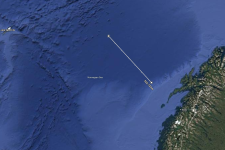
1788351664574.png
 
6 boats for the Norgies means they can likely sustain 2 ish at a deployable status. They are most likely to keep their boats closer to home than we are - our boats will likely see longer transits to 'interesting' areas. Norway has lots of 'interesting areas' very close to home.

One north-ish, and one south-ish would probably be how they play their game.

The south one monitoring the entry into the North Sea.
The north one giving some eyes on the Norwegian Sea to keep an eye on things....going around the north...

The ability to surge an extra 1-2 boats out into the Norwegian Sea would be handy so getting 3-ish boats on station in a nice quiet line 60-80 miles apart each starting on the edge of the shallows NW of Bodo would be a great way to keep an eye on things moving around into towards the G-I-UK gap.

But.

What do I know?

View attachment 102046

Should things hot up with Russia, I see Jan Mayen becoming a very busy place.
 
Back
Top