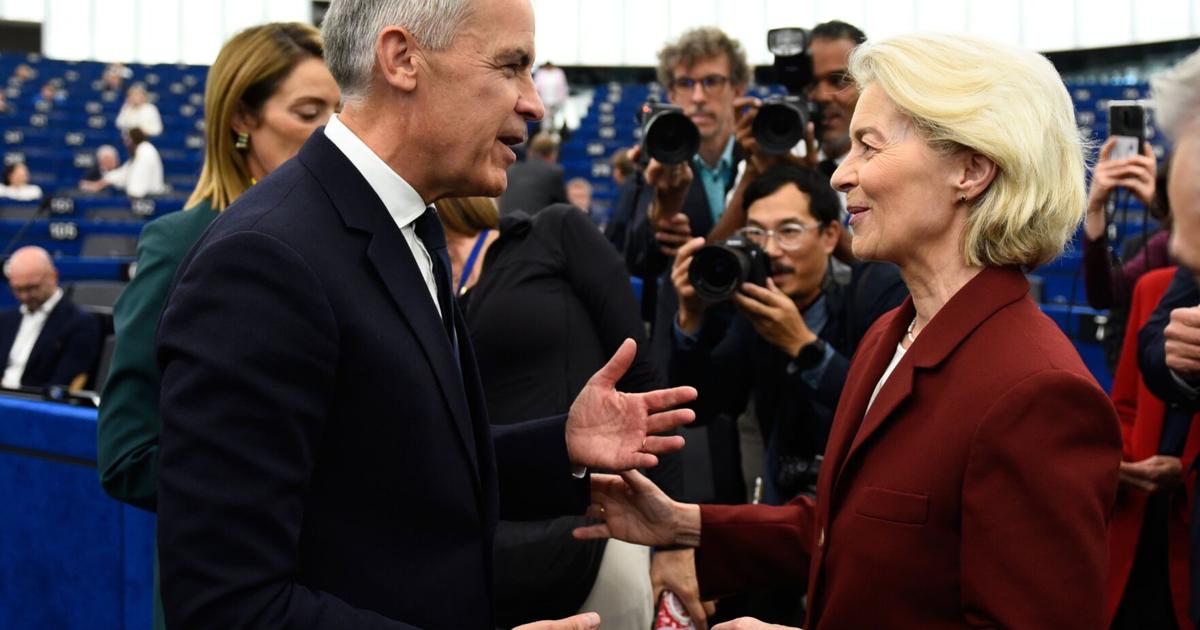
TorStar is reporting on a leaked document circulating in European diplomatic circles around the upcoming Canada - EU summit, and the sort of agreement we seem to be building towards:
The document reveals that the EU chief and Canada’s prime minister plan to launch a “Canada-EU Alliance for the Future.”

www.thestar.com
- - - - -
What a leaked Canada-EU summit document reveals about Mark Carney’s turn to Europe
The document reveals that the EU chief and Canada’s prime minister plan to launch a “Canada-EU Alliance for the Future.”
Oct. 1, 2026
By
Tonda MacCharlesOttawa Bureau Chief
OTTAWA — A newly revealed leaders’ statement pre-written for next month’s Canada-EU summit does not use “associate member” for the escalating love affair between the Carney government and the European Union.
That term,
floated by EU Commission President Ursula von der Leyen to
Prime Minister Mark Carney‘s apparent surprise two weeks ago in Strasbourg, is nowhere to be seen in the proposed declaration, labelled “as received from Canada,” that was circulated to EU ambassadors by the European secretariat in charge of talks.
Obtained by Politico’s Brussels-based reporters and
published Wednesday, the Sept. 22 document reveals that the EU chief and the Canadian prime minister plan instead to formally launch a “Canada-EU Alliance for the Future” when the summit concludes on Oct. 30.
“Alliance” was Canada’s preferred term, as reporters who covered Carney’s trip to Strasbourg and the U.K. mid-September were told then.
However, does the absence of the label “associate membership” in the European Union — a term that currently doesn’t exist in EU protocols — matter?
It won’t to many in the American administration.
They’ve been closely tracking Carney and von der Leyen’s comments with a skeptical eye, and bristling if not scoffing at Canada’s bid to distance itself from the U.S.
Now the Canada-EU statement lays out, in black and white, just how Carney is anchoring his ambitions in Europe.
It says the two leaders are preparing to announce a stronger “partnership” and it charts deeper Canada-EU co-operation on defence, on artificial intelligence — including a new Digital Trade Agreement — on energy, critical minerals, vaccines and space-based communications — all areas where Canada has historically integrated efforts with the U.S. but areas where Carney has specifically identified strategic vulnerabilities for Canada.
The proposed Canada-EU statement pledges to “identify commitments for export of Canadian critical minerals to Europe” and eyeballs the “stockpiling of critical resources to insulate from market fluctuations and geopolitical impacts.”
That’s despite discussions at the Canada-U.S. trade table about securing preferential U.S. access to Canada’s critical minerals. Remember, that was a big part of the
prime minister’s pitch to the U.S. in May, when he said Canada could help “make America great again.”
Carney touted Canada’s rich stores of potash, nickel, copper and uranium, saying Canada should be America’s most reliable supplier “to put affordable food on the table, to strengthen its national defence and meet its exploding demand to power AI.”
Now, according to the draft statement, the Canadian and EU leaders have a different plan. “We will align strategies and standards, connect industries, and focus our ambitions on sectors with greatest returns for our peoples,” reads the document, which solicited European comments by Sept. 28.
The joint Canada-EU list of strategic sectors specifies energy, critical minerals and supply chains, semiconductors, vaccines, and space-based communications “where shared resilience is becoming an imperative.”
It pledges more defence co-operation, including support for Ukraine and the defence of Arctic sovereignty, as well as stronger co-operation on crisis response, sanctions, defence industrialization and countering hybrid threats — all areas where the U.S. is unquestionably a pivotal player.
It promises stronger financial-market integration, greater co-operation on cybersecurity, closer foreign-policy alignment and joint promotion of multilateralism in pursuit of greater stability in the Indo-Pacific, as well as de-escalation and humanitarian support in the Middle East — areas where the U.S. under
President Donald Trump has been setting his own course.
It describes a plan to jointly purchase 50 De Havilland waterbombers, saying they will be ready for use in Canada and Europe in 2030 to fight wildfires.
That comes as news, however welcome, to De Havilland Canada.
Corporate affairs vice-president Neil Sweeney told the Star that the company does not yet have such a purchase order. And 50 new planes would not be ready for use by 2030, he said. The company is “sold out” to 2034, and is currently filling an order for the EU for a total of 24 planes, the first of which is to be delivered “on time” by 2028, he said. To do more, it would need to build a new production line which requires a minimum 50-aircraft order.
The firm has lobbied Ottawa to create a national firefighting fleet of 50 waterbombers, and he said it’s “not unusual” given Carney and von der Leyen’s closeness that they would make a joint proposal. At best though, the first of those planes would come off the assembly lines in 2030.
Certainly, the need for more waterbombers on both continents is great: President Donald Trump threatened tariffs to punish Canada for the wildfire smoke drifting across America that he said was choking the U.S. northeast.
The draft statement commits to starting work toward other big goals, as the two leaders aim for a deal by next year’s summit.
That to-do list is long and telling: increasing Canada’s participation in Europe’s Horizon Europe research and innovation program; recognizing professional credentials beyond the current mutual recognition of architectural qualifications; expanding opportunities for students, researchers and educators to travel to Europe through the Erasmus+ program; and aligning AI and digital regulatory frameworks through “associated country status for Canada under the Cloud and AI Development Act” (Europe’s strategy to build tech sovereignty and reduce reliance on non-EU suppliers).
Beyond that, the two sides are eyeing Canadian participation in the Galileo satellite-navigation program, more European investment in “critical Canadian resources” and a feasibility study on enhancing digital links between Europe, Canada and Asia through new subsea cable infrastructure.
Then there are some baubles: more travel for Carney and his cabinet ministers.
Carney will attend the next meeting of the European Political Community in Ireland, following on his trip to Armenia in May, when Canada became the first non-European country to participate in the twice-yearly meetings that began after Russia’s full-scale invasion of Ukraine in 2022. His ministers will also attend more European ministerial meetings.
Just as noteworthy is what the joint draft statement doesn’t do. It doesn’t commit the EU to getting 10 reluctant member states to ratify the Canada-EU free trade deal or commit Canada to abide by Brussels’ immigration, agricultural or customs regulations.
After details about Carney’s European bid were first revealed in the Wall Street Journal ahead of his Strasbourg trip, Carney outlined the broad brush strokes and rationale in the European Parliament. He promised Canadian parliamentarians would be able to debate and vote on what emerges out of all this. Canadian officials said the goal is to nail it all down by October 2027.
But so far there has been no real debate in Parliament. Canadian officials have revealed little public detail, although Carney did give the New York Times an in-depth interview on his thinking, saying that he is “much more interested in going deep with many European countries in defense because it’s complementary, because they’re not going to use the leverage against us.” That includes decoupling from Elon Musk’s Starlink.
On Tuesday, asked if Canada would align with Europe on pesticide regulations, Carney said Canadians should wait and see what comes out of this October’s meeting.
On Wednesday, the Prime Minister’s Office refused to answer questions, saying it doesn’t comment on “leaked documents or leaks.” They referred
only to his Strasbourg speech.
But Carney’s turn to Europe and his
shifting tone in public towards Trump have not gone unnoticed in Washington.
Some American officials, speaking privately since Carney’s Strasbourg speech, suggest that in trying to build new bridges — or, if you want, lay new subsea cables — to Europe, and in failing to tamp down anti-American rhetoric in Canada, Carney is helping solidify the “rupture” he says Trump started and raising questions about the future of the Canada-U.S. relationship.
One, speaking on condition they not be identified, told the Star that if Canada wants to cede sovereignty to the EU, it should be careful what it wishes for when it aligns with the Europeans given the rise of nationalist, populist right-wing forces on that continent.
Jamieson Greer, the top U.S. trade negotiator, openly mocked Carney’s concerns about economic and cultural sovereignty, after the prime minister ordered Canada’s negotiators to quit trade talks last month.
“The reality is economically, it makes sense for the Canadians to have more interaction with the US,” Greer told Bloomberg television last week. “This is where the growth is. This is where the consumption is. It’s not in Europe. It’s not elsewhere.”
Canadians, he said, have been “very clear over the past year and a half: they’re sovereign. They may want to tie up with the EU now so it raises the question of that whole kind of sovereignty shtick.”