• Thanks for stopping by. Logging in to a registered account will remove all generic ads. Please reach out with any questions or concerns.

Canada moves to 2% GDP end of FY25/26 - PMMC

The Ranger rifle got a laminated wooden stock - as some idiot seemed to believe that would be better than a composite stock -- despite composite stocks being used on bolt action sniper rifles since the 80's in all sorts of environments across the world.

Prime example of a improperly written SOR/SOW and lack of testing.
The problem isn't the fact that the stock was a laminated wooden type, it was that the stock's overall quality was poor, they were not properly sealed and thus fell apart upon use. The stocks in testing apparently faired very well and passed, but there was a drastic drop in quality control somewhere in the production versions.
 
The problem isn't the fact that the stock was a laminated wooden type, it was that the stock's overall quality was poor, they were not properly sealed and thus fell apart upon use. The stocks in testing apparently faired very well and passed, but there was a drastic drop in quality control somewhere in the production versions.

Like our boots... ;)
 
The problem isn't the fact that the stock was a laminated wooden type, it was that the stock's overall quality was poor, they were not properly sealed and thus fell apart upon use. The stocks in testing apparently faired very well and passed, but there was a drastic drop in quality control somewhere in the production versions.

I find it hard to believe a vendor would offer one product to an RFP and then deliver a lower quality product in the end.

Vendors would never use a defence contract as a cash cow. They are elbows up, patriotic Canadians after all!
 
You will end up with a lot of variants of that truck - as the OEM of the chassis isn't going to sit on a design unless there is a gov contract requiring it.
Thinking at scale is absolutely necessary and so is thinking long term.

Personally I can't see a 60k vehicle contract. I do see a continuous contract that spells out our needs but see that spread between manufacturers.

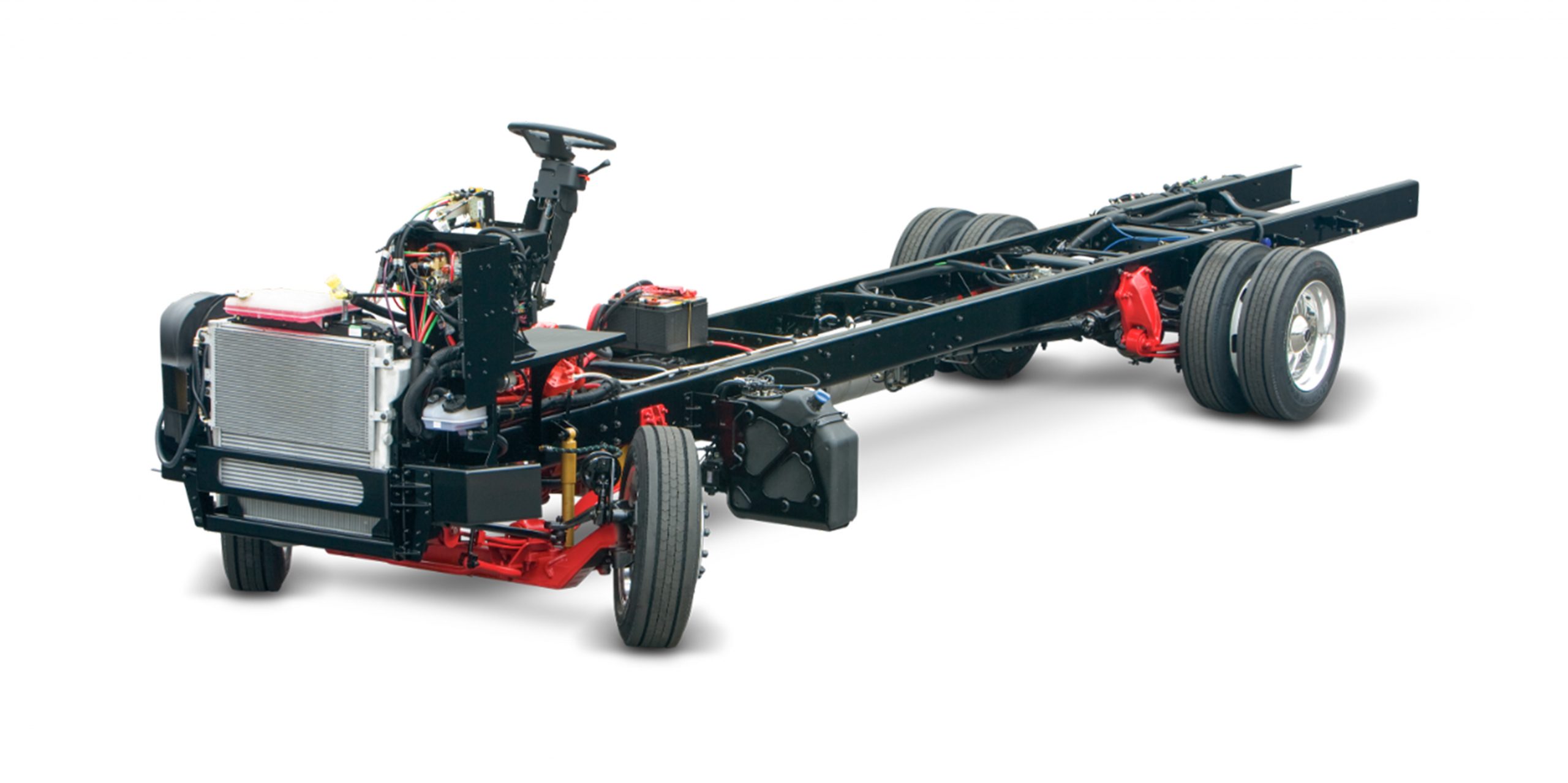
Let GM or Ford or whoever, provide their basic 550 chassis in whatever form it comes off their standard production line that year in the same way that they provide chassis to recreational vehicle manufacturers:

MC-chassis-scaled.jpg


Basically have it come with the heaviest suspension, wheels, accessory power supply and engine they make. That makes it cheap and ensures that new automotive improvements come with it over time. That should also come with a stock of parts and the statutory guarantee that chassis parts are produced for ten years as a minimum. If possible tie the manufacturer to turning out x copies per year indefinitely until there is a replacement base chassis agreed to.

The chassis is then handed over to one or two secondary manufacturer who are responsible for building the various SEVs to complete the required vehicles from unarmoured ISV-like, armoured senator-like or armoured and unarmoured logistic-type required.

The secondary manufacturers remain responsible for continuously adapting their SEV kits to conform to chassis changes which might come along from time-to-time.

Yes, that means that from time to time there will be changes to the chassis which means that you start running A1E1; A1E2 versions of vehicles arriving in the fleet which might need grouping them but that's just the way it is. The most logical grouping is a hand-me-down structure from RegF operationally deployed to RegF back home to ResF thus ensuring that the OPFOR has the most current easy to maintain version and the ResF gets the older vehs capable of low usage training but still mobilization capable.

Chassis manufacturers generally don't get fancy with changes very often - engines maybe, wheels, shocks etc are mostly generic. Considering the high level of sophistication of databases these days the ability to supply the right part for the right vehicle is very high. Parts and maintenance data undoubtedly comes directly from the manufacturer. Usage rates for parts should come automatically to the system and logistics systems ought to be able to predict and stock parts well beyond the 10 year limit and, if necessary where an essential OEM part is no longer manufactured, generate an ersatz part.

SEV kits are simple so long as the kit manufacturer is required to design its SEV kit to be capable of modifying the mounting as the OEM chassis changes over time without the need to change the basic SEV module itself. This also allows for module modifications as downstream needs change. This demands some rigour within the customer base to not demand constant SEV mods but again, mod suggestions can be held and grouped until a new "E2" model is introduced and a decision is made to upgrade existing E1 models to E2 standards. The US army runs numerous different models concurrently.

IMHO, the best structure is to have one chassis OEM (a large-scale national commercial manufacturer) and one SEV OEM (a moderate-scale single customer manufacturer) in order to simplify the basic supply system. If more than one is desired it should be based on SEVs - say one SEV manufacturer for armoured kits and another for unarmoured ones. And of course a modular RWS manufacturer for the weapon kits added to some SEVs.

$0.02

🍻
 
Thinking at scale is absolutely necessary and so is thinking long term.

Personally I can't see a 60k vehicle contract. I do see a continuous contract that spells out our needs but see that spread between manufacturers.

Let GM or Ford or whoever, provide their basic 550 chassis in whatever form it comes off their standard production line that year in the same way that they provide chassis to recreational vehicle manufacturers:

MC-chassis-scaled.jpg


Basically have it come with the heaviest suspension, wheels, accessory power supply and engine they make. That makes it cheap and ensures that new automotive improvements come with it over time. That should also come with a stock of parts and the statutory guarantee that chassis parts are produced for ten years as a minimum. If possible tie the manufacturer to turning out x copies per year indefinitely until there is a replacement base chassis agreed to.

The chassis is then handed over to one or two secondary manufacturer who are responsible for building the various SEVs to complete the required vehicles from unarmoured ISV-like, armoured senator-like or armoured and unarmoured logistic-type required.

The secondary manufacturers remain responsible for continuously adapting their SEV kits to conform to chassis changes which might come along from time-to-time.

Yes, that means that from time to time there will be changes to the chassis which means that you start running A1E1; A1E2 versions of vehicles arriving in the fleet which might need grouping them but that's just the way it is. The most logical grouping is a hand-me-down structure from RegF operationally deployed to RegF back home to ResF thus ensuring that the OPFOR has the most current easy to maintain version and the ResF gets the older vehs capable of low usage training but still mobilization capable.

Chassis manufacturers generally don't get fancy with changes very often - engines maybe, wheels, shocks etc are mostly generic. Considering the high level of sophistication of databases these days the ability to supply the right part for the right vehicle is very high. Parts and maintenance data undoubtedly comes directly from the manufacturer. Usage rates for parts should come automatically to the system and logistics systems ought to be able to predict and stock parts well beyond the 10 year limit and, if necessary where an essential OEM part is no longer manufactured, generate an ersatz part.

SEV kits are simple so long as the kit manufacturer is required to design its SEV kit to be capable of modifying the mounting as the OEM chassis changes over time without the need to change the basic SEV module itself. This also allows for module modifications as downstream needs change. This demands some rigour within the customer base to not demand constant SEV mods but again, mod suggestions can be held and grouped until a new "E2" model is introduced and a decision is made to upgrade existing E1 models to E2 standards. The US army runs numerous different models concurrently.

IMHO, the best structure is to have one chassis OEM (a large-scale national commercial manufacturer) and one SEV OEM (a moderate-scale single customer manufacturer) in order to simplify the basic supply system. If more than one is desired it should be based on SEVs - say one SEV manufacturer for armoured kits and another for unarmoured ones. And of course a modular RWS manufacturer for the weapon kits added to some SEVs.

$0.02

🍻
I look at that picture and have flashbacks to Tata trucks coming out of India when working overseas. And that's what the new owner bought...an engine attached to a frame and enough basics to steer it.

Everything else was built/jury rigged onsite by local fabricators. Some were great...and others made you question being on the road with them. But under the tinwork they were almost identical and allowed the mechanical side to be easily worked on.
 
Have you ever been in rural Canada? Moderate town during a power outage? We're not Europe, we struggle with cellular coverage outside major cities and dropping even 1000 phones onto a tower in an emergency situation where the civilian population is trying to contact family or EMS is a recipe to deny both groups use of the phones due to tower saturation.

There are tactical cellular towers that can be purchased, but they're expensive and a niche skillset to maintain. If we buying phones we need to bring our own towers which means we're only talking to ourselves. Terrain is also a significant limfac for those tactical towers if we're talking LENTUS.
The tactical cell tower can be great...however at least the ones I've seen used are limited to a relatively small area good for a command post. One of the real problems noticed in recent years is with the cell phones going to more specific frequencies for 4G and 5G networks the actual coverage area available has shrunk noticeably as the new phones don't like old 3G networks.

The work around for many now is use of mini-starlink units in pick-ups or field shacks. But getting too many of those units parked side by each also causes problems and can overload things...

I don't want to return to hardwire and phone exchanges but somedays I wonder if it wouldn't be better...
 
The tactical cell tower can be great...however at least the ones I've seen used are limited to a relatively small area good for a command post. One of the real problems noticed in recent years is with the cell phones going to more specific frequencies for 4G and 5G networks the actual coverage area available has shrunk noticeably as the new phones don't like old 3G networks.

The work around for many now is use of mini-starlink units in pick-ups or field shacks. But getting too many of those units parked side by each also causes problems and can overload things...

I don't want to return to hardwire and phone exchanges but somedays I wonder if it wouldn't be better...
I, for some reason, still have a landline and a still have an old fashion phone available, as well as cordless phones, in the event of a power outage ill still have a working phone.
I also still have two functioning ‘hurricane oil lamps’ that were my grandparents in case of prolonged power outage at night…..
 
I would agree if the purpose of the drone is terminal attack, but not so much one with an ISR etc payload. I prefer to think of all drones as consumables...at least for the micro to most of the medium classed drones

Absolutely onside with my intent.
 
Great if the goal is have one-way communications from one or a few points. Not so great if you expect any of those 25K to call a significant number of the same 25K. Group calling is limited to a handful of numbers.

One problem with cel phone use during emergencies is the towers can get overwhelmed and can't discriminate between an 'official' call and somebody checking to see if their cat is ok. This was a big problem during the '98 ice storm (that and towers going down for lack of power). Way back in the day of landlines, Bell used to be able to identify certain numbers that would always have service regardless of the 'workload' of the switching gear (emergency services had to provide them updated lists every year). I'm not aware that something similar exists for cel phones.

Not my field but aren't cell towers permanent RRBs?
 
Great if the goal is have one-way communications from one or a few points. Not so great if you expect any of those 25K to call a significant number of the same 25K. Group calling is limited to a handful of numbers.

One problem with cel phone use during emergencies is the towers can get overwhelmed and can't discriminate between an 'official' call and somebody checking to see if their cat is ok. This was a big problem during the '98 ice storm (that and towers going down for lack of power). Way back in the day of landlines, Bell used to be able to identify certain numbers that would always have service regardless of the 'workload' of the switching gear (emergency services had to provide them updated lists every year). I'm not aware that something similar exists for cel phones.

Not my field but aren't cell towers permanent RRBs? Fixed relay nodes?

I thought they operated on UHF frequencies?
 
The Senator and ISV/LUVW are entirely different beasts.

I'm not arguing against Rochel making the Senator, I'm arguing that on top of the Senator, we need a boat load of green fleet utility vehicles, and GM already makes them... Just get GM to make them here, on a small line dedicated to making vehicles for the CAF.
Seen. Agreed.

I went with GM because we already operate their vehicles, and they already have done the R&D to produce both Colorado and Silverado based military vehicles. Why pay Rochel extra to develop what GM already makes, and can assemble in Canada easily? In what world does it make sense to have Rochel covert a Colorado or Silverado into a light utility vehicle when GM already makes them?

Fair.

Nothing will... Mexico is cheaper. America didn't kill Windsor and Oshawa, Mexico did. The best we can hope for is more defense specific builds in Canada.

Agreed


I agree 100% with drones. Throw money into a R&D pile and let the small companies do what they can do. There will be waste, but there will be innovation as well.

Batting a thousand here.

My issue with doing that with vehicles is that 30 different shops using a "standard" kit will have 30 different ways of doing it. That might work for a $500 drone, but it doesn't with a $70K truck. In WWII the auto makers made trucks and other utility vehicles, because they knew what they were doing and already had decades of experience. In 2026, 80+ years on, auto makers know even more about making trucks, so let's let them do their thing.

I agree with the comments about the 30 shops. That is why I agree with using them for the drones.

In genetic terms we are looking at a mutation event. Ukraine and the terrorists are the mutagen. We need a bunch of different mutants so we can let natural selection take its course.

Wrt the Roshel situation I was thinking of down-selecting a couple from the 30.
 
Everything else was built/jury rigged onsite by local fabricators. Some were great...and others made you question being on the road with them. But under the tinwork they were almost identical and allowed the mechanical side to be easily worked on.
What's interesting too is that every once in a while I get a lot of video feeds of local small business manufacturing in India etc. There are some which show field repairs being undertaken when a heavily overloaded Jingle trucks axle or some such breaks and a couple of guys in filthy shalwar kameezzes (or the Indian equivalent) are at the side of the road using marginal tools and disassembling the differential and wheel bearings to their basic parts, bending them back into shape or replacing the busted ones and putting the whole thing together again. Like this one:


If we ever need to bolster the RCEMEs, I know where to find recruits.

:giggle:
 
What's interesting too is that every once in a while I get a lot of video feeds of local small business manufacturing in India etc. There are some which show field repairs being undertaken when a heavily overloaded Jingle trucks axle or some such breaks and a couple of guys in filthy shalwar kameezzes (or the Indian equivalent) are at the side of the road using marginal tools and disassembling the differential and wheel bearings to their basic parts, bending them back into shape or replacing the busted ones and putting the whole thing together again. Like this one:


If we ever need to bolster the RCEMEs, I know where to find recruits.

:giggle:
Actually FJAG I believe that video is actually Huntington Road in Abbotsford. Same, same.
 
What's interesting too is that every once in a while I get a lot of video feeds of local small business manufacturing in India etc. There are some which show field repairs being undertaken when a heavily overloaded Jingle trucks axle or some such breaks and a couple of guys in filthy shalwar kameezzes (or the Indian equivalent) are at the side of the road using marginal tools and disassembling the differential and wheel bearings to their basic parts, bending them back into shape or replacing the busted ones and putting the whole thing together again. Like this one:


If we ever need to bolster the RCEMEs, I know where to find recruits.

:giggle:

That's why I like Ike Steven's Bonehead Truckers channel.
 
What's interesting too is that every once in a while I get a lot of video feeds of local small business manufacturing in India etc. There are some which show field repairs being undertaken when a heavily overloaded Jingle trucks axle or some such breaks and a couple of guys in filthy shalwar kameezzes (or the Indian equivalent) are at the side of the road using marginal tools and disassembling the differential and wheel bearings to their basic parts, bending them back into shape or replacing the busted ones and putting the whole thing together again. Like this one:


If we ever need to bolster the RCEMEs, I know where to find recruits.

:giggle:
A lot of ingenuity, born of necessity. I've watched clips of entire engine rebuilds in some dusty back lot.

OHS as well as highway transport and road safety rules seem a little lighter.
 
Not my field but aren't cell towers permanent RRBs? Fixed relay nodes?

I thought they operated on UHF frequencies?
No clue. Not my area either. Phone to tower and tower to tower frequencies would have to be distinct. Some towers in the middle of nowhere might be relay only but I suspect most would be relay/downlink.
 
Back
Top