• Thanks for stopping by. Logging in to a registered account will remove all generic ads. Please reach out with any questions or concerns.

Continental Defence Corvette

Current/Previous Surface Layers

Orca Patrol Boats - 33m, 20 kts, 5 crew
Kingston MCDVs (OSV) - 55 m, 15 kts, <47 crew
HdW AOPVs - 104m, 17 kts, 65 crew plus 22 pax.
Halifax Frigates - 134m, >30 kts, 255 crew
Iroquois Destroyers - 121m, 29 kts, 280

Future Surface Layers

USVs (Various)
Orca-ish Patrol Boats
OSVs
AOPVs
CDCs
RCDs

Needless to say I am a proponent of more, faster, Kingstons with smaller required crews but able to accomodate larger passenger loads through seacan accomodations.
Kingston Class can go to sea with 36. New Pods for the class can accommodate 8 vice 6. I am looking at repurposing the PODs for AOPV's for more training bunks.
 
I think one way that people are going to adapt to UxVs is through a combination of two streams.

1 - treating UxVs as munitions - smart munitions, capable of doing more than previous generations of munitions, but still munitions.
That, I think will work for the small stuff.

2 - adding "auto-pilots" to all craft and allow them to "stand watch" under supervision.
The more rest the supervisors get the more they will come to trust the "auto-pilots"
Eventually they will not only leave the bridge, they will leave the ship.
This would work for logistics, surveillance and comms nodes.

Fighting the ship is a whole other issue.
 
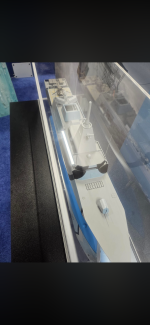
I haven’t seen any discussion on this yet. But these pics are from Seaspan’s pavilion (I didn’t take these, I believe they’re Noah’s). It’s purportedly the Seaspan pitch for the CDC program. I didn’t see much in the way of details included in the fb posting.
 

Attachments

  • IMG_3534.png
    IMG_3534.png
    1.3 MB · Views: 32
  • IMG_3535.png
    IMG_3535.png
    1.7 MB · Views: 32
  • IMG_3537.png
    IMG_3537.png
    1.4 MB · Views: 32
Looks like it's using a SPY radar as its main radar. I am not sure that meets the "made in Canada" criteria that is meant to move us away from the US for that specific ship type. I would have expected a European radar, either a SMART or a Thales NS110 type radar.
 
Looks like it's using a SPY radar as its main radar. I am not sure that meets the "made in Canada" criteria that is meant to move us away from the US for that specific ship type. I would have expected a European radar, either a SMART or a Thales NS110 type radar.
And I can just about guarantee that the flight deck depicted is too large.
 
But it doesn't lead to a hangar for the helo. If they have room in the specs displacement to make it big enough to land a Cyclone in an emergency, I can't blame them for that.
Just when does Seaspan expect that they will have the runway to start building the first of these?
 
That Seaspan model was stated to be already out of date based on Seaspans new designs (CANSEC reporting... they just wanted to have a model there to show they were working on stuff I think).

Noah is reporting that CDC is upping the VLS requirement from 16. Which means likely 24 as they go in 8 packs. So its pretty much a regular guided missile frigate at this point and we can stop pretending its a corvette.
 
Looks like it's using a SPY radar as its main radar. I am not sure that meets the "made in Canada" criteria that is meant to move us away from the US for that specific ship type. I would have expected a European radar, either a SMART or a Thales NS110 type radar.
The new Sea Giraffe 4A has fixed arrays and I believe its going on the new Finish Pohjanmaa class corvette. As does the Germans with their Hendsolt TRS 4D.

Actually the Saab had a ship design for the CDC at CANSEC as well. They used the same mast design as for the Pohjanmaa class. The Saab Lightweight Integrated Mast
Its a fully composite mast design with a SG4A and SG 1X integrated into it (along with other stuff). If Canada wants to push the boundaries that's an interesting way to go.
 
That Seaspan model was stated to be already out of date based on Seaspans new designs (CANSEC reporting... they just wanted to have a model there to show they were working on stuff I think).

Noah is reporting that CDC is upping the VLS requirement from 16. Which means likely 24 as they go in 8 packs. So its pretty much a regular guided missile frigate at this point and we can stop pretending its a corvette.
Still have this nagging feeling that we’ll somehow see the Rivers reduced to 6 and be given 12-16 of these corvette/light frigates/minifaxs. Happy to be wrong.
 
Does that increase or decrease the chances of a reduction in the number of Rivers?
I’m wondering if they’re still going to go for 20 of them at that level. I was thinking if it was something like an upgraded RN RIVER, that would be more likely. Now 🤷‍♂️
 
A lot will depend on CONOPS for those ships, which must start with some thinking about how the RCN envisage use of those vessels, and how "expendable" they see them. Twenty of them on top of 15 RCD and 12 SSK requires a lot of personnel, even if all three streams will be building up over time.

So hear me out: Personally, I think a bit in more European way than North American for them. Think about the two UK carriers: all the cabins are built up for 12 sailors, but only 8 sailors are assigned to any cabin. It's the same for all rank levels (except CO, ;) ), because the RN knows that, in wartime, they will likely have to boost the number of sailors by about 50%. Similarly, most of the continental Europe navies sail with reduced crew for their training, train mostly by day and go down to minimal watch levels at night, unless they are carrying out a specific night training exercise.That way, their manning can be lower and if and when they deploy to a full scale ex or operation, they draw extra personnel from shore or the other training vessels to fill up the ranks as required.

You could do the same for the CDC's. The RCD's would remain the front line vessels, manned near full, ready to deploy, but in peacetime, the CDC's, particularly by using a lot of automation and accepting the consequences should things go wrong, would be manned to 50-60% of their wartime expected manning, concentrating on training - mostly during the day "a la European" - and generating the maritime pictures and showing the flag. That would help in letting people have a reasonable shore/ship time ratio. Should things begin to heat up or a need for deployment/war arise, you would draw from shore personnel and reserves to fill up the rank.

I could see such increased manning working like this: Say you have ten CDC per coast, at "full" manning, that gives you five crew. I could see three of the ten CDC going immediately to full manning by using personnel from the other seven CDC's. The remaining seven CDC would then draw on personnel on shore rotation to fill back their numbers to the 50-60% level and then, fill the remaining positions with trained reservists. In such a scenario, you would basically have the reg force provide 50-60% of the wartime manning at all time - during peace - then increase it's contribution to 65-75% in wartime/time of increased tension, and the reserve contribute between 25-35 % of manning in time of increased tension.

The only thing left for something like that to work would be for the reg force to understand and agree to the fact that, at first and for a short while, there would be a lowering of standards until the reservists can work themselves up to speed.

 
Last edited:
Back
Top