- Reaction score
- 12,263
- Points
- 1,040
Yes, I consider it "more fair" (and healthier for the stability of the country) when people in a locality can choose a representative unencumbered by the preferences of people further away.


Brad Sallows said:Yes, I consider it "more fair" (and healthier for the stability of the country) when people in a locality can choose a representative unencumbered by the preferences of people further away.

It must be that you are being deliberately obtuse, given that the three London ridings together are all just one small "locality." Collectively these three ridings are a fraction of the size of any adjacent riding. Are the people of Lambton-Kent-Middlesex deprived of fairness as most of them are "encumbered by the preferences of people further away" to an extent that would be unachieved in the hypothetical three member riding that you use distance to argue against.Brad Sallows said:Yes, I consider it "more fair" (and healthier for the stability of the country) when people in a locality can choose a representative unencumbered by the preferences of people further away.
The trick is to do as Alberta did from 1905 to 1955 and limit multi-member ridings to the urban centres that could otherwise support multiple single member ridings. Distance is does not become a factor, and the citizens are directly connected to their representatives through municipal transportation systems (bus, light rail, monorail, subway).Chris Pook said:Too much distance, too many bodies, too little direct connection = too little accountability.
Brad Sallows said:Looking at a graphic of London from the 2015 election, I now see that the 2 x LPC and 1 x NDP ridings seem to be surrounded by CPC ridings. So I'm more convinced that the pocket of NDP supporters in London who can currently manage to elect a NDP representative - at least occasionally - get a fair shake from FPTP that they might never otherwise get in a multi-member riding.
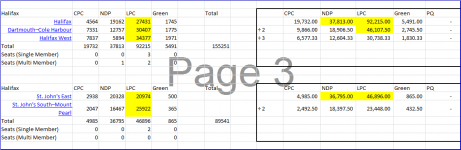
What you are feeling is called cognitive dissonance. If "locality matters" is your underlying premise against geographically small multi-member ridings, then it does not matter what surrounds the city of London when we are talking about voting results inside the city of London. Looking inside the city of London, 32% (almost 1/3) want a conservative MP but they do not get this under FPTP single representative ridings. A multi-member riding would give one conservative MP.Brad Sallows said:Looking at a graphic of London from the 2015 election, I now see that the 2 x LPC and 1 x NDP ridings seem to be surrounded by CPC ridings. ... looking at Canada-wide results in general, it is clear that "locality" matters and ...
I do not think PEI makes a good candidate for a single multi-member riding. Much of it is rural, without the benefit of public transportation to connect voters to riding offices. Further, despite the province being small, its three rural ridings are still geographically much larger than the multi-member ridings that could be created through combining existing urban ridings in large cities.jmt18325 said:Places like Nunavut could stay as 1 riding with 1 member. Places like the City of Winnipeg, or the province of PEI could be combined into single multi member ridings employing a simple formula STV system.
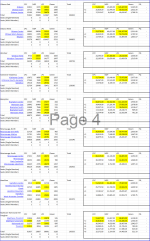
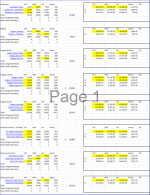
Agreed, and that means that any consideration of multi-member ridings would have to give voters the ability to select the individual MPs (ie. no party lists). Unfortunately, when working with FPTP results to model a hypothetical multi-member riding, the data just does not exist to replicate STV. It also does not let you model an independent ... Brent Rathgeber scored well enough in his riding that if other ridings provided him similar support he would have been a contender in a North Edmonton multi-member riding, but data only exists for the riding he actually ran in.Chris Pook said:Again, my opinion, "partyism" is the problem and should not be pandered to. I would sooner have more representatives, with smaller salaries, controlling the purse strings - and with no party connections.
| Liberal | Conservative | NDP | Green | BQ | ||||
163 | 112 | 44 | 1 | 11 | ||||
-21 | +13 | +7 | +0 | +1 |


At 5,660 square km, PEI is larger than Toronto's 630 square km. I would not form multi-member ridings on that island unless Charlottetown ever grows big enough to merit two MPs.jmt18325 said:I totally disagree with PEI though. I live in Dauphin - Swan River - Neepawa. There's nothing large about PEI.
MCG said:At 5,660 square km, PEI is larger than Toronto's 630 square km. I would not form multi-member ridings on that island unless Charlottetown ever grows big enough to merit two MPs.
I don't think that either of us will be around when that day comes.dapaterson said:Let me know when it's big enough to merit one.


MCG said:At 5,660 square km, PEI is larger than Toronto's 630 square km.
Chris Pook said:The problem that I have, overall, is that every system will be gamed over time. Sooner or later somebody will figure out how to take advantage of the rules for their own betterment.

Chris Pook said:I agree the payroll is too large. I don't agree that we don't need more MPs. The "job" should be a duty not a reward. And it shouldn't be a vocation or even an avocation. I don't want anybody there that wants to be there.