Would they be expected to fight that deep? And presumably if yes, the adversary would be of the same weight or lighter?
How are they going to get through the close area, considering the mass persistent surveillance and strike that is available today?
When thinking about how Division Cav fits into the battlefield framework of deep, close, and rear, perhaps its useful to not consider any of them as purely isolated from one another.
The Deep for example has a gray zone where it transitions to the close area. In some doctrine references this could be seen as the Division Security Area.
This transition zone is where the forward line of own troops resides for both the Division and its subordinate Bdes.
It’s also where the various emerging control features are located. Items such as the FLOR (Forward Line Own Robotics), IHL (Intelligence Handover Line between the Div assets and the Bde assets) and FLOS (Forward Line Own Sensors). Its also the area where the fires support coordination measures exist.
The Div CAV could exist in a Division Security Area which is inside and up to the Fire Support Coordination Line (FSCL) but forward of the Bde Coordinated Fires Lines. This space would be where the Div CAV would be trying to push back the opposing forces own FLOS and FLOR.
While any manned ground vehicles belonging to the Div CAV are highly unlikely to be pushed past this transition zone (or the FSCL) into the rest of the Division Deep Area, if resourced with the necessary stand in sensors its feasible that the Div CAV would be pushing unmanned UAS into the Division Deep cued by other stand off sensors. Basically, this would see the unmanned systems being pushed across the FSCL to enable the Division Recce-Strike Fires Complex targeting inside the Division Deep.
Note however this concept is NOT explicitly laid out in the Canadian Army or RCAC doctrine yet but its in line with the open source doctrine evolution happening in other peer armies.
Looking at doctrine helps. US defines doctrine defines deep operations as
"tactical actions against enemy forces, typically out of direct contact with friendly forces, intended to shape future close operations and protect rear operations. At the operational level, deep operations isolate current battles and influence the timing, location, and enemy forces involved in future battles. At the tactical level, deep operations set favorable conditions for close combat and subsequent engagements." [FM 3-0]. The UK defines it similarly as those "
conducted at long range and often over a protracted timescale, against an adversary’s forces or resources not currently engaged in the close battle." [AFM:WT 1] For what it's worth, our own Land Ops defines it the same, as we are unoriginal and just ripped it off the Brits.
I can't see many situations where you would put the deep area along the FLOT as, for battlespace framework, doing so limits your ability to fight "out of contact" or "at long range" against the enemy. Perhaps, in a specific context where forces are separated and the Division has the opportunity to get a security force far enough forward to establish a cover or guard task. The Brits are trying to build off this concept with the Deep Recce-Strike concept, but I'm not completely sold on it.
Let's go from theory to practice.
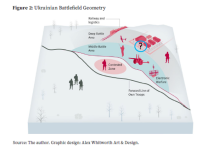
Watling paints an interesting picture of the battlespace in Ukraine (he also notes that the Deep Area could not be consistently defined by senior UK offices, meaning the concept is far from definitive). The concepts of Middle and Deep Battle can be be parallel to Western concepts of Deep and Extended Deep areas.
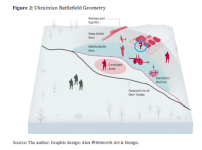
Note I've added a question mark. How is an element going to get into close engagements in that space, making it past the mass persistent surveillance and strike along the "0 Line" (FEBA) ahead of the FLOT. Then make it through the contested zone and fight (and be sustained) in the "Middle" or "Deep" Battle areas depicted above?
Now Ukraine is not necessarily how future conflicts will unfold as context is everything, but lets look at two other Divisional conflicts - Gulf War and Iraq War. Neither of these wars featured the requirement to get a land element in deep (save the 101st doing air mobile insertions) but rather saw sharp, powerful thrusts by tank/infantry teams.
To bring this back this back to my original question. Is the cavalry concept designed to fight "in the deep" for the Division - if so,
how does it defeat or avoid this phenomenon, which is probably here to stay? Or does it operate uncrewed systems to fight "in the deep" - if so, why are we talking about fighting mounted in 50 ton armoured vehicles? Finally, how does this integrate with the 1 Cdn Div concept of fighting the deep, specifically with 1 Cdn Arty Bde standing up?
Perhaps the concept needs to shift away from a narrative of "fighting in the deep" and position itself as the Division's security element, one of the few (if not only) elements outside of a CMBG that can be tasked with the full suite of security tasks (screen, guard, cover). If so, I think the conversation on structure, number of units, and equipment changes somewhat.