The RN has issued a Request for Information (RFI) notice to industry for what it calls a future Long Range Anti-Submarine Warfare Weapon (LRAW). Here we consider the options and what the implications would be if this weapon is brought into service. Testing the market In simple terms, LRAW can be...

www.navylookout.com
On Sep 2, 1944 Lt(JG) George H.W. Bush took off in one of the 45 aircraft carried aboard the 15,100 tonne (full load) USS San Jacinto, a light carrier converted from a light cruiser hull. She was home to 1549 men.
He was flying a Grumman TBM-1C Avenger to bomb a Japanese radio station. He was shot down.
His aircraft was shot up on the run in and his engine was in flames. He had two crew with him. They were both killed on the run in.
He pressed home the attack and broke free to open water. He spent 4 hours in a raft until picked up by a submarine.
That single mission cost the US the bombs, an aircraft, two aviators and almost lost the US a President.
It also required the presence of a submarine in the area to pick up survivors putting more equipment and more lives at risk.
.....
The Grumman TBM-1C Avenger was a Torpedo Bomber. Its Maximum Take Off Weight was 7047 kg.
Its range was 1456 km at a cruise speed of 346 km/h. That suggests a time of flight of 252 minutes or 4 hours and 12 minutes.
In its bomb bay it could carry one Bliss-Leavitt Mk13 torpedo.
The Bliss-Leavitt weighed 1005 kg and had a range of 5.8 km at 61.6 km/h suggesting a time to target of 5.6 minutes or so.
The delivered payload was 273 kg of Torpex.
....
15,100 tonnes of ship.
1549 crew
45 aircraft
273 kg of Torpex
Assuming a flight time of 4 hours and 12 minutes total and a range of 1456 km, and assuming the intention was not to go Kamikaze but to return to the San Jacinto, then that suggests an attack radius of about half of that allowance. For allowances I am going to call it at 40% That results in a distance of about 582 km and a time to release point of 50 minutes. Add in the 6 km in the water and the 6 minute running time.
The result is that the San Jacinto could prosecute targets at 588 km distance in 56 minutes and deliver 273 kg of Torpex to the target.
And it had 45 "attritable" systems to do the prosecution.
....
Present Day.
ASROC option.
A torpedo launched by rocket directly from a ship.
The torpedo in question is the Mk 46 lightweight homing torpedo.
It delivers 43.9 kg charge instead of a 273 kg charge.
It flies 9.7 km from the ship in less than one minute.
It swims 11 km through the water in about 9 minutes.
The skipper of the launch vessel can prosecute targets at 20 km distance in 10 minutes and deliver 44 kg of Torpex-equivalent to the target.
...
Another version of the torpedo, the Mk 54, can be launched directly from tubes on a frigate to 11 km in 9 minutes. Or it can be carried on a helicopter like the Sea King, Cyclone or Seahawk. Or it can be launched from a P8 operating at high altitude by means of a special kit, HAAWC.
The all increase the range at which the payload can be delivered but the payload is still only 44 kg.
That is only 15% of the payload that Lt Bush was able to put on target in 1944.
....
To get to the payloads that George could deliver we have to look at the heavy weight torpedos carried on submarines these days: the Mk 48 ADCAP.
The ADCAP delivers a payload of 293 kg. 7% more than the Bliss-Leavitt of 1944 and 567% more than can be delivered by the Mk 46 or the Mk 54.
That torpedo has a range of about 30 km and a time to target of 10 to 15 minutes (making allowances for published data only).
But that torpedo weighs 1676 kg
The Mk 46 weighs 230 kg
The Mk 54 weighs 276 kg
1676 kg is a beast to handle compared to even 276 kg.
But could you get 1676 kg to fly?
With a big enough engine.
....
The Tomahawk missile launches from the same submarines and the same tubes as the Mk 48 torpedo. It also launches from the wings of aircraft, the Mk 41 VLS and the Mk 70 PDS systems on board ships and trucks.
The Tomahawk weighs 1300 kg and delivers 120 kg of explosive to targets up to 1600 km away in about 90 minutes to 2 hours.
It does so with the assistance of a 300 kg rocket booster which brings the weight of the entire package up to 1600 kg or roughly the same weight of a Mk 48 ADCAP at 1676 kg.
The Tomahawk has tiny wee wings and a jet engine that produces thrust in the range of 400 to 700 lbf.
If only we could strap wings and a jet engine on a Mk 48, and maybe a rocket booster.
....
JDAM.
The Joint Direct Attack Munition has been around since 1999. It was a Gulf War 1 star.
It takes a typical dumb bomb and straps a new head and tail on to it. The new tail moves. It could adjust the direction of the bomb's travel in flight. And the new head piece told it where to go.
This system could be strapped on to Mks 81, 82, 83 and 84 bombs : 250 lb, 500 lb, 1000 lb and 2000 lb. 2000 lb is 925 kg. Still a bit lighter than a 1944 Bliss Leavitt at 1005 kg and a fair bit lighter than a Mk 48 at 1300 kg (without the rocket booster). But heading in the right direction.
This kit changes the dumb bombs into guided projectiles with Circular Error Probables in the 5 to 30 m vicinity. Hits were a lot more likely.
Of course if all you want to do is get a homing torpedo somewhere within 30 km of a moving target perhaps that level of accuracy isn't that important to you.
What is of more importance is that those JDAM kits flew the bombs 24 km from their launch point. But that launch point had to be high in the sky.
....
JDAM-ER
JDAM Extended Range
In 2006 Boeing and the Aussies strapped some pop-out wings on to a JDAM.
It increased the range from 24 km to 74 km.
But it still relied on gravity and had to be launched from a great height.
It went into production in 2015.
....
Digression
The Small Diameter Bomb (GBU-39)
The Small Diameter Bomb is a reduced size JDAM-ER, a refined version of the 250 lb Mk 81 JDAM.
It doesn't do much damage, which in many cases is a good thing, but it flies 74 km just like its big brothers and sisters.
It went into service in 2006
....
GL-SDB
Ground Launched - SDB
Soon after the JDAM-ER went into production in 2015 Boeing took its GBU-39, complete with wings and went to Norway and strapped it to the top of a M30 rocket that had been rendered surplus to requirement by the Cluster Munitions treaty.
The result was the M30 took the SDB/JDAM-ER to a great height where its wings popped out and allowed the smart head piece, the manoeuvering tail unit and the pop out wings to fly it to its target with the same 5-30 m CEP expected of its relatives.
The combined round, M30-SDB, had a range in excess of 150 km, and it wasn't restricted to a ballistic trajectory. It could circle targets and attack from the rear.
Some were delivered to Ukraine but the Russians were unsporting and started jamming the GPS signals that the head pieces on the SDBs and JDAMs relied on for targeting precision. But that problem is being or has been addressed.
....
So now we have the means to take any payload, up to 2000 lb or 900 kg, strap a kit on it and punt it into the atmosphere by jet, or rocket, or other means, and have it hit targets within 5-30 m CEP at ranges in excess of 75 km.
The only difference between that device and the Tomahawk is the jet engine.
....
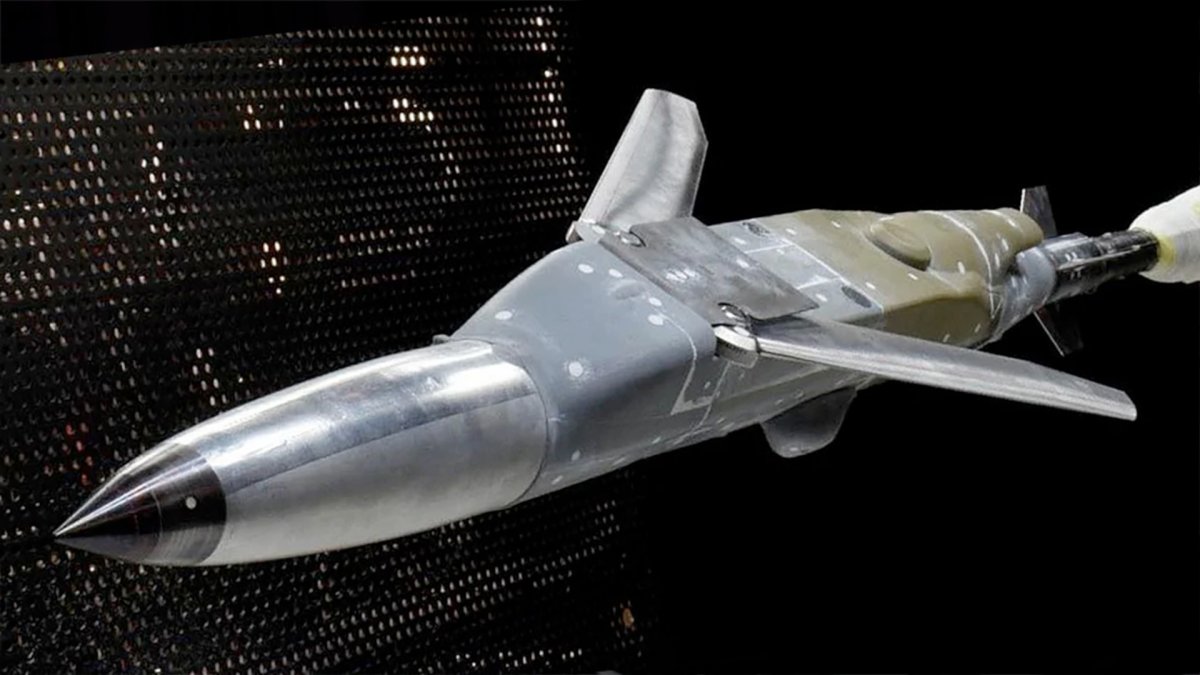
P-JDAM (or JDAM-LR)
Powered-JDAM
The Tomahawk is a 1300 kg aircraft that flies at Mach 0.8 or so by virtue of its Williams turbo fan jet engine which seems to operate in the 400 to 700 lbf of thrust range.
P-JDAM aims to strap a similarly sized engine on to JDAM-ERs and get them to fly distances comparable to the Tomahawk. The initial target is on the order of 600 km. More than the 75 km of the JDAM-ER but less than the 1600 km of the conventional Tomahawk although about the same as the Maritime Strike version of the Tomahawk.
....
Kratos makes target drones. It has been doing it for decades. They are very popular, very effective and very cheap. They are also jet powered.
Currently it has three models making the news: Firejet, Mako and Valkyrie as well a new Low Cost Cruise Missile, the Ragnarok.
Firejet - weighs 145 kg at launch, including a 32 kg payload of any sort, to about 950 km in 75 minutes or so. It uses a 162 lbf jet engine.
Mako - weighs 932 kg at launch, including 523 kg of payload, to 1200 km in about 3 hours. It uses a 1000 lbf jet engine.
Valkyrie - weighs 2722 kg at launch, including 545 kg of payload, to 5600 km in about 7 hours. It uses a 2000 lbf jet engine.
Kratos and GE have hooked up to start building, and marketing, Kratos type disposable jet engines.
Their first offering is the GEK-800, 800 lbf. Enough to power a Tomahawk size aircraft.
Their next project is a GEK-1600, 1600 lbf. Almost enough to power a Valkyrie.
Using Kratos's production practices and designs Kratos has created the Ragnarok as a Low Cost Cruise Missile competitor.
Ragnarok - weighs 79 kg, including a 36 kg payload, and has a projected range of over 500 NM or about 920 km. It is believed that it is a candidate for the 800 lbf thrust GEK-800.
....
Tomahawk sells for about 4 MUSD.
Ragnarok is intended to sell for under 150,000 USD
4 MUSD will get you the 5600 km, 2722 kg Valkyrie.
....
Getting back to the business of lifting a 1676 kg Mk 48 torpedo, and delivering it and its payload over useful distances.
Valkyrie is the heaviest lifter of these offerings. But it only has a design lift of 545 kg. And the requirement it 1676 kg.
Now of the Valkyrie's MTOW at launch about 12 to 1300 kg is fuel.
545 kg of payload plus 1250 kg of fuel gives useful load of 1795 kg
A wee bit more than the 1676 kg of the Mk 48.
But only a bit over 100 kg of fuel.
If it takes 1250 kg of fuel to fly 5600 km then how far can you fly on 120 kg?
About 500 km?
Is that miltarily useful? Delivering a 30 km torpedo with a 293 kg load of high explosive to a target 250 km away (allowing for re-use) in about 20 minutes?
...
Keep in mind that Valkyrie, Mako and Firejet use no fuel on launch. Nor do they use runways. They are launched from inclined ramps that can be mounted on trailers a pick-up truck can pull.
Firejet is punted up the ramp pneumatically.
Valkyrie and Mako, like Tomahawk, are launched by rockets. RATO or Rocket Assisted Take Off.
....
The USMC is betting on the MQ-58B to accompany its F-3Bs as spear carriers.
It has asked for one significant design change.
It wants a landing carriage added.
The base model Valkyrie lands by parachute on air bags.
That may not be the best option for operations at sea.
Better that the returning aircraft fly its way on to the deck for positive capture, if there is enough runway room. As on an LHA, or LHD or a RN carrier.
It looks as if they are sticking with the RATO launch which, being runway independent, would marry up with the rest of their VTOL fleet, fixed and rotary wings.
....
So bringing this back to the RN Admiral's ask, the ability to deliver heavy weight torpedoes over long distances in short times.
I think it is reasonable to suggest that all the pieces of the puzzle are on hand to be able to sort that out in the near future.
....
And drawing from WW2 again, I can see something like the expedient Hurricat solution being resurrected for both ships and shore stations. Only without the poor bugger of a pilot worrying about getting his feet wet.

en.wikipedia.org
Powered JDAMs could attack targets on land and sea, deploy naval mines, or even act as decoys, over long ranges.

www.twz.com
....
PS: A Valkyrie variant could also lift a Tomahawk or half a dozen Mk 54s.