• Thanks for stopping by. Logging in to a registered account will remove all generic ads. Please reach out with any questions or concerns.

Public service employment has grown by 31 per cent

Legally per the various CA, they can't do it that way. They must decide which activities are no longer going to be done, or which sections reduced in size, and then delete boxes, not people. IE, you have a policy section of 20 personnel working on 5 different files, and you need to eliminate 10 positions. If everyone is working on files equally, and you are either going to stop progress on some files, or extend the timelines to complete the files, all 20 individuals get a notice they are affected, and the manager hopes people voluntarily retire/resign. If individual positions are assigned work on individual files, and certain files are being stopped, then those positions working on those specific files are given notices. Here, the manager may hope that someone working on a non-affected file want to take early retirement, or the resignation deal, and swaps with an affected employee, the position is still eliminated.

It is a pretty complex process that has a plethora of possibilities.
What they seem to be actually doing as a starting point is going for attrition and early retirements, not backfilling jobs, and letting managers make noise about it if they need that position.

That can work, providing management actually is tracking what the impact is of people leaving a position, and doesn't protect their own sacred cows, which is a bit all over the place.

Remember one particular technical expert putting in their retirement notice about 18 months in advance, knowing they had about 30+ years of SME on an operationally critical role, with no backup to replace them, so that someone could get tagged for knowledge transfer and slowly take over that file. What actually happened is nothing, until about 6 weeks after they retired, and a ship needed approval for something that they were the SME for and someone outside the immediate CoC realised the position was vacant and what that actually meant. It was one of those positions where if you need to talk to them, you are calling them on a sat phone on a long weekend to see if you can sail Monday, so was a pretty big deal.

Someone else took over the file, and the previous incumbent came back as a casual worker for a while, trained someone else to formally take over the job etc, so it eventually got sorted out, but was a bit of a shitshow.

That's an expertise that was required to support day to day peacetime operations, and we have lots of one off SMEs that specialize in things relating to actual combat survivability that we aren't replacing, so we'll be pretty SOL if we wait to find out that we lost a support capability when the shooting has actually started.

I'm sure it'll be fine though; some of those sacred cows will have delivered tracking dashboards identifying it as a risk and deprioritized it as we'll never actually go to war, so it's fine.
 
Probably not a bad idea.... but sounds kind of futile nonetheless


Several law firms in Ottawa say they’re getting an influx of calls from federal workers looking to learn what their options are and how to negotiate or push back against the cuts.

Malini Vijaykumar, a partner at Nelligan Law, says unionized employees need to go through their unions to file grievances or complaints on their behalf.

But she says she has also seen an increase in inquiries from non-unionized executives and employees in human resources who are navigating the changes.

A government program and spending review is looking to eliminate about 40,000 public service jobs by 2029, from a peak of 368,000 positions in 2024.

That includes 1,000 executive positions over the next two years.

 
Probably not a bad idea.... but sounds kind of futile nonetheless


Several law firms in Ottawa say they’re getting an influx of calls from federal workers looking to learn what their options are and how to negotiate or push back against the cuts.

Malini Vijaykumar, a partner at Nelligan Law, says unionized employees need to go through their unions to file grievances or complaints on their behalf.

But she says she has also seen an increase in inquiries from non-unionized executives and employees in human resources who are navigating the changes.

A government program and spending review is looking to eliminate about 40,000 public service jobs by 2029, from a peak of 368,000 positions in 2024.

That includes 1,000 executive positions over the next two years.

My brother was a non unionized employee of a crown corporation. Thanks to his lawyer he got a significant increase in the severance he was offered. Which was considered a fair offer but he was able to add an additional 5 months of salary. Nothing futile about that even after paying the law firm he came out ahead on that front.
 
My brother was a non unionized employee of a crown corporation. Thanks to his lawyer he got a significant increase in the severance he was offered. Which was considered a fair offer but he was able to add an additional 5 months of salary. Nothing futile about that even after paying the law firm he came out ahead on that front.

I stand corrected.

Well done!


, and for the unionized people it's because their union reps can frequently be useless.

Out of curiosity, what does their Collective Agreement say about Employment Security?
 
In what way? There is no guarantee of employment security.

The federal way.

The muni way our CA guaranteed Employment Security was after six years of service.

Was simply curious what the federal CA(s) have to say about Employment Security.

Thank you for your reply.
 
I elected not to get OSS when I turned 65 in May, so they started sending me checks and we notified them that we did not want them. They said it could take a long time to "stop the cheques" Come Jan 6th which the date we can "Escalate our issue" We did so, now we have a T4 slip that we just sent back to CRA and with copies of the cheques and said "We have not cashed them or want them". We also sent letters to the Pension office to fix their shit. When you have to ask your clients to be nice to frontline staff at the beginning of every call, then maybe the problem is you and not your clients. What a clusterf*ck.
 
I elected not to get OSS when I turned 65 in May, so they started sending me checks and we notified them that we did not want them. They said it could take a long time to "stop the cheques" Come Jan 6th which the date we can "Escalate our issue" We did so, now we have a T4 slip that we just sent back to CRA and with copies of the cheques and said "We have not cashed them or want them". We also sent letters to the Pension office to fix their shit. When you have to ask your clients to be nice to frontline staff at the beginning of every call, then maybe the problem is you and not your clients. What a clusterf*ck.
OAS? If so that is massive eff up on their part.
 

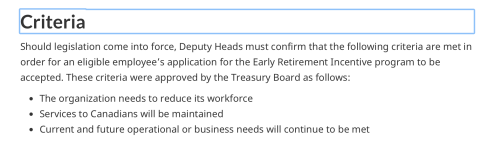
Public servants to learn about job cuts in January​


Hopefully, this will not apply to any of our readers.

However, anyone who does find themselves in that unfortunate situation, if they wish to remain public servants, might consider non-federal PS.

Only way in, with the one I was familiar with, is application as an External / Open Canidate , ie off the street.

The job calls are - extremely - limited.

Hiring is based on Relative Ability Process.

Our employer also has an Equity, Diversity and Inclusion ( EDI ) hiring process.

If you pass that, and are willing to accept any job they offer you, it opens a huge number of Internal / Closed postings the public will never see.

Promotion is Senior Qualified Process, and are basically "no-fail" promotions to the PS job you really want, if qualified.

Relative Ability Process only applies to a small number of union positions, for Internal ie Permanent employees.

Accommodation of Permanently Partially Disabled ( PPD ) members. They bypass the Senior Qualified Process,

A permanent employee who has become incapable of fully performing their regular duties because of injury, occupational disease, advancing years or disability may be given preference for any available vacant permanent position for which they are considered able to perform.
 
Here's a viable career option no one ever acknowledges ;)

David Sovka: Why quiet quitting is better than starting a new career​

Starting a new career requires you to pretend you have a lot more enthusiasm than aspirin and scotch provides, and also to lie theatrically on a newly made-up résumé.

Today, strategic human resource professionals have to be on the lookout for employees who engage in a relatively new workplace trend called “quiet quitting.”

This is when employees only do the minimum requirements of their jobs, without working unpaid overtime or going above and beyond like we all did in the 1990s. Remember the 1990s, when AI was just a made-up threat in science-fiction movies, not a real threat to people’s jobs and the economy? I’M JUST ASKING QUESTIONS.

Practitioners of quiet quitting say they are setting boundaries to prevent burnout and combat “hustle culture,” which is the belief that relentless work, long hours and prioritizing professional achievement is worth it, despite all evidence to the contrary.

Sometimes it’s described as “acting your wage,” and sometimes as “acting like dirty commies,” depending on your perspective.

I would like to recommend quiet quitting over starting a new career, which requires you to pretend you have a lot more enthusiasm than aspirin and scotch provides, and also to lie theatrically on a newly made-up résumé.

I have been quiet quitting for years. This comes out in various ways, such as giggling when my manager says: “I want you to own your projects,” and never walking all the way to the staff washroom when Colin’s office plant is right there, looking thirsty.

 
Here's a viable career option no one ever acknowledges ;)

David Sovka: Why quiet quitting is better than starting a new career​

Starting a new career requires you to pretend you have a lot more enthusiasm than aspirin and scotch provides, and also to lie theatrically on a newly made-up résumé.

Today, strategic human resource professionals have to be on the lookout for employees who engage in a relatively new workplace trend called “quiet quitting.”

This is when employees only do the minimum requirements of their jobs, without working unpaid overtime or going above and beyond like we all did in the 1990s. Remember the 1990s, when AI was just a made-up threat in science-fiction movies, not a real threat to people’s jobs and the economy? I’M JUST ASKING QUESTIONS.

Practitioners of quiet quitting say they are setting boundaries to prevent burnout and combat “hustle culture,” which is the belief that relentless work, long hours and prioritizing professional achievement is worth it, despite all evidence to the contrary.

Sometimes it’s described as “acting your wage,” and sometimes as “acting like dirty commies,” depending on your perspective.

I would like to recommend quiet quitting over starting a new career, which requires you to pretend you have a lot more enthusiasm than aspirin and scotch provides, and also to lie theatrically on a newly made-up résumé.

I have been quiet quitting for years. This comes out in various ways, such as giggling when my manager says: “I want you to own your projects,” and never walking all the way to the staff washroom when Colin’s office plant is right there, looking thirsty.


I don't see the issue. If employers want more, then pay more.
 
Here's a viable career option no one ever acknowledges ;)

David Sovka: Why quiet quitting is better than starting a new career​

Starting a new career requires you to pretend you have a lot more enthusiasm than aspirin and scotch provides, and also to lie theatrically on a newly made-up résumé.

Today, strategic human resource professionals have to be on the lookout for employees who engage in a relatively new workplace trend called “quiet quitting.”

This is when employees only do the minimum requirements of their jobs, without working unpaid overtime or going above and beyond like we all did in the 1990s. Remember the 1990s, when AI was just a made-up threat in science-fiction movies, not a real threat to people’s jobs and the economy? I’M JUST ASKING QUESTIONS.

Practitioners of quiet quitting say they are setting boundaries to prevent burnout and combat “hustle culture,” which is the belief that relentless work, long hours and prioritizing professional achievement is worth it, despite all evidence to the contrary.

Sometimes it’s described as “acting your wage,” and sometimes as “acting like dirty commies,” depending on your perspective.

I would like to recommend quiet quitting over starting a new career, which requires you to pretend you have a lot more enthusiasm than aspirin and scotch provides, and also to lie theatrically on a newly made-up résumé.

I have been quiet quitting for years. This comes out in various ways, such as giggling when my manager says: “I want you to own your projects,” and never walking all the way to the staff washroom when Colin’s office plant is right there, looking thirsty.

Boeing did a review of all past employees who had retired from the company. I may not have the ages exactly right but I believe I am close. Those that retired with a full pension at age 65 were the most likely to be dead by 67 1/2. Those that retired at 50 or searched out another career at 50 were most likely to die at 87 and there was a direct correlation for the years in between. 64 lived to 69 etc.
 
Boeing did a review of all past employees who had retired from the company. I may not have the ages exactly right but I believe I am close. Those that retired with a full pension at age 65 were the most likely to be dead by 67 1/2. Those that retired at 50 or searched out another career at 50 were most likely to die at 87 and there was a direct correlation for the years in between. 64 lived to 69 etc.
Blue collar kills, it is the main reason why ‘women live longer than men’.

The amount of people I have known in the trades who have died of cancer or are dying of it and some don’t live the ‘hard’ lifestyle speaks for itself. These aren’t even that old guys, 50s, 60s, early 70s.
 
Boeing did a review of all past employees who had retired from the company. I may not have the ages exactly right but I believe I am close. Those that retired with a full pension at age 65 were the most likely to be dead by 67 1/2. Those that retired at 50 or searched out another career at 50 were most likely to die at 87 and there was a direct correlation for the years in between. 64 lived to 69 etc.

There's been alot of research into that subject by various organizations, but there are some caveats e.g.,

Association between retirement and mortality: working longer, living longer? A systematic review and meta-analysis​

Early retirement was not associated with a higher risk of mortality. On-time retirement was associated with a higher risk of mortality, which might reflect the healthy worker effect. It is important to consider information on prior health and demographics when studying the association between retirement and mortality to avoid biased findings.

 
There's been alot of research into that subject by various organizations, but there are some caveats e.g.,

Association between retirement and mortality: working longer, living longer? A systematic review and meta-analysis​

Early retirement was not associated with a higher risk of mortality. On-time retirement was associated with a higher risk of mortality, which might reflect the healthy worker effect. It is important to consider information on prior health and demographics when studying the association between retirement and mortality to avoid biased findings.

The analysis that I read along with the report suggested that it had a lot to do with outside activities. A person who starts a new career at 50 is less attached to the plant and is more likely to pursue other activities that keep the mind alert and exploring other options. A person that stays with one workplace often has no other activities that keep his mind and body interested in getting up in the morning. I definitely don't know the ins and outs of the argument I am simply throwing it out there for thought.
 
Boeing did a review of all past employees who had retired from the company. I may not have the ages exactly right but I believe I am close. Those that retired with a full pension at age 65 were the most likely to be dead by 67 1/2. Those that retired at 50 or searched out another career at 50 were most likely to die at 87 and there was a direct correlation for the years in between. 64 lived to 69 etc.

I've been an OMERS member since 1972.

Did my 35 years. Retired on my 55th birthday.

After that, I could have worked for GO Transit as an Operator. Their yard was only 800 meters from ours. But, figured I spent enough years looking out the windshield of a bus. Now, I ride as a passenger.

Looks like some OMERS members stay on the job until they drop dead now,

Effective January 1, 2021, OMERS eliminated the 35-year cap on credited service. This means you can continue to accrue credited service and build pension benefits beyond 35 years, provided you had not already reached the 35-year limit prior to January 1, 2021.
 
Back
Top