
how be you all forget about all your GDPs and so forth and look at employment. Whilst our population may have shrunk there is one figure that is up: unemployment. There is a loss of 18000 jobs, youth unemployment is up, core population unemployment is up. That means all those people have no income which translates to food banks and more people on the streets. That is the reality of our economy.True but the biggest reason for the sharp decline wasnt over all economic performance but an immigration system that was heavily exploited for loop holes. Many hate on the TFW program for example, but i find all the hate is directed at the government for having the program, no one seems to be stopping to ask why businesses are using it so much.
Instead of debating symptoms of the problem and trying to take a perverbial Tylenol for the economy to make the problem go away, we need to get to the root causes and solve it that way.

You are using an out of date browser. It may not display this or other websites correctly.
You should upgrade or use an alternative browser.
You should upgrade or use an alternative browser.
Liberal (Minority/Majority) Government 2025 - ???
- Thread starter Altair
- Start date

- Reaction score
- 8,918
- Points
- 1,260
A better indicator is and always has been, the 'employment-population ratio' - this represents the number of people actually participating in the workforce. Canada typically has had a higher level of participation than the US. Currently (March/April 2026) it was 60.6% of the population, whereas in the US for the same time period it was 59.2%.how be you all forget about all your GDPs and so forth and look at employment. Whilst our population may have shrunk there is one figure that is up: unemployment. There is a loss of 18000 jobs, youth unemployment is up, core population unemployment is up. That means all those people have no income which translates to food banks and more people on the streets. That is the reality of our economy.

- Reaction score
- 12,263
- Points
- 1,040
Forget the very recent number. Go to the link I provided and look at the past 15 years. That is the problem.True but the biggest reason for the sharp decline wasnt over all economic performance but an immigration system that was heavily exploited for loop holes.

MilEME09
Army.ca Fixture
- Reaction score
- 8,521
- Points
- 1,210
Have you looked at available jobs though? The open job rate is several percent lower than the unemployment rate. We have more people than jobs.how be you all forget about all your GDPs and so forth and look at employment. Whilst our population may have shrunk there is one figure that is up: unemployment. There is a loss of 18000 jobs, youth unemployment is up, core population unemployment is up. That means all those people have no income which translates to food banks and more people on the streets. That is the reality of our economy.

- Reaction score
- 8,670
- Points
- 1,360
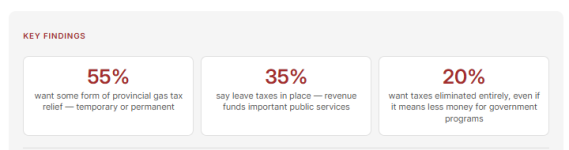
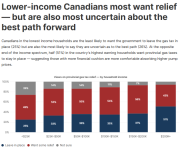
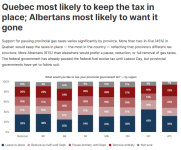
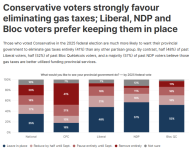
On the gas tax front, survey says, "a majority of Canadians want their provincial government to ease taxes at the pump during this period of high gas prices, though they are divided over how long that relief should last." Some highlights ...
Details: "The Angus Reid Institute conducted an online survey from April 24-28,2026, among a randomized sample of 2,360 Canadian adults. Respondents are drawn from the Angus Reid Forum, a large-scale online panel developed to include Canadian residents in each of the343 federal ridings in Canada and representative of the Canadian population by age, gender, family income, ethnic status and education. The sample was weighted to be representative of adults nationwide according to region, gender, age, household income, and education, based on the Canadian census. For comparison purposes only, a probability sample of this size would carry a margin of error of +/- 2percentage points, 19 times out of 20. Discrepancies in or between totals are due to rounding. The survey was self-commissioned and paid for by ARI. Detailed tables are found at the end of this release."
Details: "The Angus Reid Institute conducted an online survey from April 24-28,2026, among a randomized sample of 2,360 Canadian adults. Respondents are drawn from the Angus Reid Forum, a large-scale online panel developed to include Canadian residents in each of the343 federal ridings in Canada and representative of the Canadian population by age, gender, family income, ethnic status and education. The sample was weighted to be representative of adults nationwide according to region, gender, age, household income, and education, based on the Canadian census. For comparison purposes only, a probability sample of this size would carry a margin of error of +/- 2percentage points, 19 times out of 20. Discrepancies in or between totals are due to rounding. The survey was self-commissioned and paid for by ARI. Detailed tables are found at the end of this release."
There are 18000, sorry to belabour that figure, jobs on the Canadian market that have vanished. Think about the number of businesses that have downsized or gone under to generate that figure. The full time job market has shrunk and more positions have opened part time. That is not goodA better indicator is and always has been, the 'employment-population ratio' - this represents the number of people actually participating in the workforce. Canada typically has had a higher level of participation than the US. Currently (March/April 2026) it was 60.6% of the population, whereas in the US for the same time period it was 59.2%.

HavokFour
Army.ca Veteran
- Reaction score
- 4,377
- Points
- 1,040
A little more pressure on the accelorator.

 www.ctvnews.ca
PM Carney planning new legislation to expedite more project approvals
PM Mark Carney’s government intends to table legislation soon that would expedite the regulatory approval process for all big energy and infrastructure projects, CTV News has confirmed.
www.ctvnews.ca
These reforms are expected to apply more widely than the existing major projects law Carney passed just under a year ago. That legislation, Bill C-5, enabled the government to fast-track approvals for projects deemed to be in the national interest.

- Reaction score
- 13,571
- Points
- 1,160
The Bank of Canada and OECD weren’t warning only about immigration loopholes. They’ve been warning for years about weak productivity, low business investment, and stagnant output per worker. We can't pin everything on the "everyones welcome" LPC immigration.True but the biggest reason for the sharp decline wasnt over all economic performance but an immigration system that was heavily exploited for loop holes.
If anything that argument actually reinforces the criticism. Rapid immigration exposed the weak housing supply, weak infrastructure, low productivity, suppressed wage growth, and overreliance on cheap labour. That stuff showd ourstructural economic weaknesses.
Many hate on the TFW program for example, but i find all the hate is directed at the government for having the program, no one seems to be stopping to ask why businesses are using it so much.
Don't forget about the asylum seekers. Up to 90,000 to 170,000 per year by 2022–2024.
MilEME09
Army.ca Fixture
- Reaction score
- 8,521
- Points
- 1,210
This figure from statscan i beleive also includes refugees not just asylum seekers, which in that time period say a massive spike because of the russian invasion of ukraine.Don't forget about the asylum seekers. Up to 90,000 to 170,000 per year by 2022–2024.
- Reaction score
- 13,571
- Points
- 1,160
Refugees are included in that yes. CUAETThis figure from statscan i beleive also includes refugees not just asylum seekers, which in that time period say a massive spike because of the russian invasion of ukraine.
(Ukraine response) is a separate program and is not counted in asylum claims. I recall it's a temporary residence authorization.

daftandbarmy
Army.ca Fossil
- Reaction score
- 48,489
- Points
- 1,160
The Bank of Canada and OECD weren’t warning only about immigration loopholes. They’ve been warning for years about weak productivity, low business investment, and stagnant output per worker. We can't pin everything on the "everyones welcome" LPC immigration.
If anything that argument actually reinforces the criticism. Rapid immigration exposed the weak housing supply, weak infrastructure, low productivity, suppressed wage growth, and overreliance on cheap labour. That stuff showd ourstructural economic weaknesses.
Don't forget about the asylum seekers. Up to 90,000 to 170,000 per year by 2022–2024.
As much as we like to try and blame specific governments there, has been a decline in productivity ongoing since about 2000.
This would suggest national systemic issues are at play which no one government, or agency, can address on its own.

ArmyRick
Army.ca Fixture
- Reaction score
- 4,247
- Points
- 1,160
Agreed. The sooner the ship turns 180 the better.This would suggest national systemic issues are at play which no one government, or agency, can address on its own.
Enough "clean energy", "Climate competitiveness", "Carbon capture", etc. Many of these are out of date belief driven agendas and hinder the biggest potential economic driver in our nation, good old oil and gas.

- Reaction score
- 3,259
- Points
- 1,140
Summarized by aIOn the topic of Canadian economy and job losses...
This video by Northern Perspective argues that official government claims regarding the strength of the Canadian economy under Mark Carney are misleading and contradicted by recent data. The hosts contend that the current economic narrative is cherry-picked to mask deeper systemic issues.
Key takeaways:
- Rising Unemployment: The video highlights that Canada's unemployment rate has reached 6.9% as of May 8, 2026, which the hosts note is higher than when Justin Trudeau left office (3:25-4:20).
- Loss of Full-Time Employment: A major concern raised is the significant loss of full-time jobs—111,000 lost in the first four months of 2026—suggesting that businesses are shifting to part-time, non-benefited roles to cut costs (8:30-10:50).
- Youth Unemployment Crisis: The youth unemployment rate (ages 15-24) has climbed to 14.3% (6:38-7:59), which the hosts describe as a significant barrier for students and young workers trying to gain necessary career experience.
- Wage Growth Analysis: While Mark Carney has cited wage growth as a positive sign, the video explains this as a statistical anomaly caused by the loss of lower-tenured, lower-paid employees, meaning the remaining average wage appears higher even as the overall economy weakens (11:20-15:20).
- Industry Setbacks: The video references the shelving of a $15 billion Honda EV plant in Canada as an example of economic instability and failed government strategy regarding the auto sector (21:51-22:36).
thanks for taking the timeSummarized by aI
This video by Northern Perspective argues that official government claims regarding the strength of the Canadian economy under Mark Carney are misleading and contradicted by recent data. The hosts contend that the current economic narrative is cherry-picked to mask deeper systemic issues.
Key takeaways:
The hosts conclude that the economic reality for younger Canadians is starkly different from those over 55, and criticize the government's tendency to blame external factors for domestic economic struggles (18:06-19:56).
- Rising Unemployment: The video highlights that Canada's unemployment rate has reached 6.9% as of May 8, 2026, which the hosts note is higher than when Justin Trudeau left office (3:25-4:20).
- Loss of Full-Time Employment: A major concern raised is the significant loss of full-time jobs—111,000 lost in the first four months of 2026—suggesting that businesses are shifting to part-time, non-benefited roles to cut costs (8:30-10:50).
- Youth Unemployment Crisis: The youth unemployment rate (ages 15-24) has climbed to 14.3% (6:38-7:59), which the hosts describe as a significant barrier for students and young workers trying to gain necessary career experience.
- Wage Growth Analysis: While Mark Carney has cited wage growth as a positive sign, the video explains this as a statistical anomaly caused by the loss of lower-tenured, lower-paid employees, meaning the remaining average wage appears higher even as the overall economy weakens (11:20-15:20).
- Industry Setbacks: The video references the shelving of a $15 billion Honda EV plant in Canada as an example of economic instability and failed government strategy regarding the auto sector (21:51-22:36).
- Reaction score
- 3,259
- Points
- 1,140
Using the AI summarize feature and posting it here takes way less time than sitting and watching these masterpieces in full.thanks for taking the time
daftandbarmy
Army.ca Fossil
- Reaction score
- 48,489
- Points
- 1,160
thanks for taking the time
Industry is in full survival mode now too, faced with skyrocketing costs, increasing taxes, lower certainty, and huge amounts of red tape, so the AI related - and non-AI related - job loss is likely to be even more staggering than predicted.
Businesses that can will also flee the country in greater numbers than before.
The huge bureaucracy can then spend its time writing more briefing notes for high level dreamers while the people queue up for their weekly bread ration at the government run grocery stores

MilEME09
Army.ca Fixture
- Reaction score
- 8,521
- Points
- 1,210
I mean the CAF does this too, we place people on rolling, continuous 89 day contracts so we dont have to pay benefits. At one point we had a person go 1.5 years doing this, took awhile to argue and convince brigade to release funds to make it a 3 year to get him benefits
- Loss of Full-Time Employment: A major concern raised is the significant loss of full-time jobs—111,000 lost in the first four months of 2026—suggesting that businesses are shifting to part-time, non-benefited roles to cut costs (8:30-10:50).
Last edited:
- Reaction score
- 3,259
- Points
- 1,140
I might start to regret posting the AI summery of @ArmyRick videos.I mean the CAF foes this too, we place people on rolling, continuous 89 day contracts so we dont have to pay benefits. At one point we had a person go 1.5 years doing this, took awhile to argue and convince brigade to release funds to make it a 3 year to get him benefits
- Reaction score
- 8,670
- Points
- 1,360
FYI, moved all the "changes to how sexual assault is dealt with by the CAF" content to a better fit thread already discussing all facets of the issue:
Army.ca Staff

I saw a tiny bit of the Ombudsman's report on live TV today - not enough to be able to comment intelligently.
However, if this Toronto Star article is correct, then it is unfortunate that whomever destroyed the original letter will not be brought to justice (i.e. not only must justice be done, but it must be seen to be done).
Aug. 13, 02:00 EDT
Report could tarnish military
Allan Thompson
OTTAWA BUREAU
OTTAWA - Canada's armed forces will likely get another black eye with today's release of a report by military Ombudsman André ?arin.
In 300 pages, the ombudsman reviews complaints by...
However, if this Toronto Star article is correct, then it is unfortunate that whomever destroyed the original letter will not be brought to justice (i.e. not only must justice be done, but it must be seen to be done).
Aug. 13, 02:00 EDT
Report could tarnish military
Allan Thompson
OTTAWA BUREAU
OTTAWA - Canada's armed forces will likely get another black eye with today's release of a report by military Ombudsman André ?arin.
In 300 pages, the ombudsman reviews complaints by...
- bossi
- Replies: 1,908
- Forum: Military Current Affairs & News
Army.ca Staff
Similar threads
- Replies
- 395
- Views
- 53K


- Replies
- 6
- Views
- 2K


- Replies
- 262
- Views
- 36K
- Replies
- 505
- Views
- 29K

- Replies
- 1K
- Views
- 121K
