
Halifax Tar
Army.ca Legend
- Reaction score
- 20,514
- Points
- 1,260
Are there penalties for not meeting delivery dates?
Ask Irving.


Are there penalties for not meeting delivery dates?

Based.Ask Irving.

Or Sikorsky…Ask Irving.

Ask the crew and passengers on the Hindenburg ?

Almost every contract has limitations of liability.Or Sikorsky…
Some contracts have max damage amounts. So there is no incentive to push past a point (of failure).

I like the idea of the CEO and Sr Mgmt sailing or failing with the vessel/aircraft after a major refit.Almost every contract has limitations of liability.
Specific Performance is what you want….
I work in the nuclear industry and have worked with quite a number of individuals who have come from the US Navy nuclear program. They were, all of them, excellent workers and extremely knowledgeable.From what I have gleaned on the "Father of the USN Nuclear Sub Force" Rickover could be a dick BUT when you're dealing with nukes.....being a dick is what is needed

I am not a nuclear expert - far from it - but there are some procedures you don't mess with. I reckon you don't make things up as you go...I work in the nuclear industry and have worked with quite a number of individuals who have come from the US Navy nuclear program. They were, all of them, excellent workers and extremely knowledgeable.
The US nuclear navy program has an excellent history of performance. US navy reactors have a stellar record.
One of the keys to that success is strict procedural compliance. Procedures drive everything. Everything that is done is done based on a documented, reviewed and approved procedure. If a situation is encountered not covered by procedure, no one is permitted to come up with a work-around or improvisation. No one (not even the CO) has the authority to deviate from procedures.

I work in the nuclear industry and have worked with quite a number of individuals who have come from the US Navy nuclear program. They were, all of them, excellent workers and extremely knowledgeable.
The US nuclear navy program has an excellent history of performance. US navy reactors have a stellar record.
One of the keys to that success is strict procedural compliance. Procedures drive everything. Everything that is done is done based on a documented, reviewed and approved procedure. If a situation is encountered not covered by procedure, no one is permitted to come up with a work-around or improvisation. No one (not even the CO) has the authority to deviate from procedures.


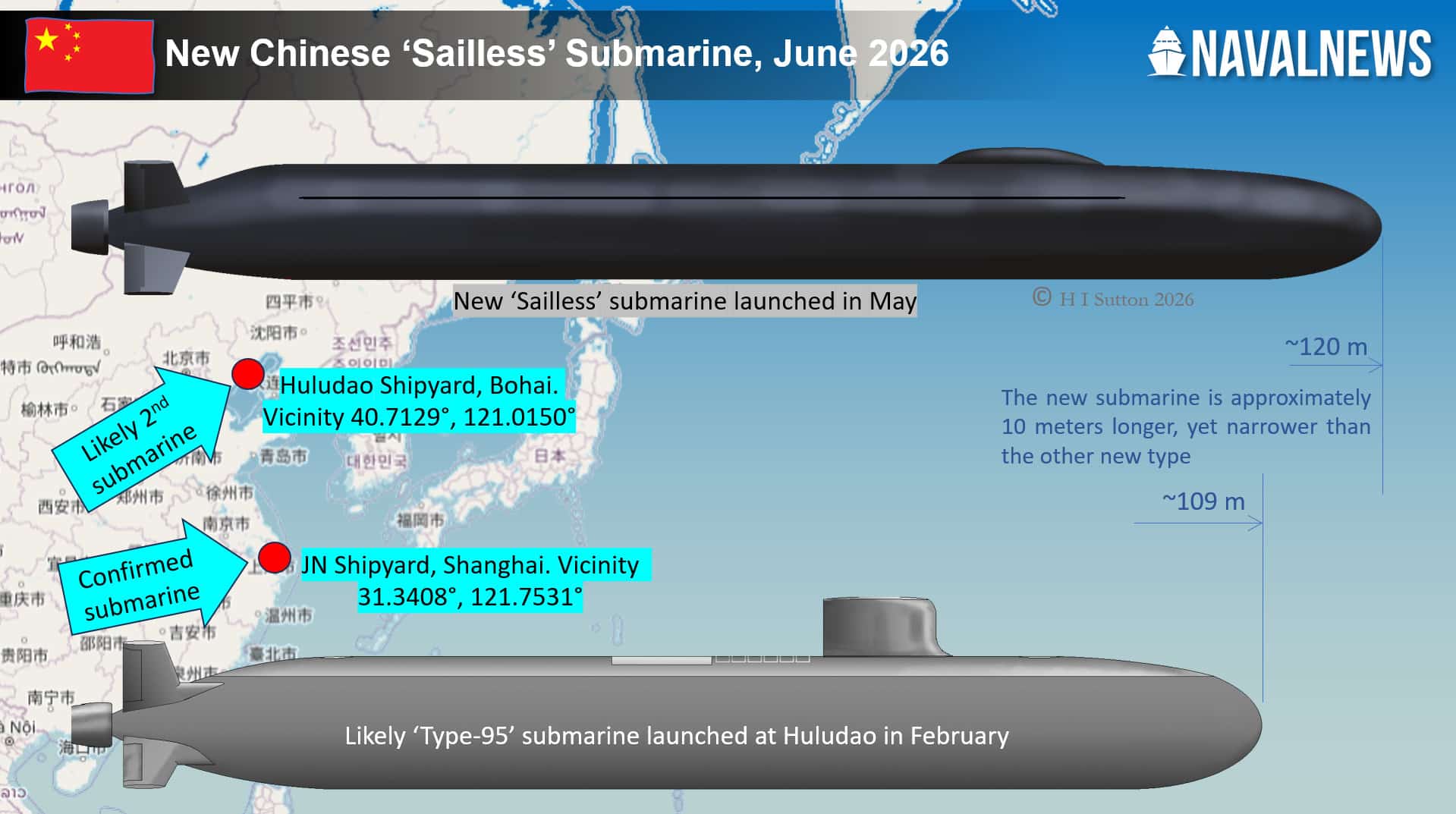
 www.navalnews.com
Questions remain regarding the new submarine’s role and propulsion. For the latter, a standard nuclear propulsion seems most likely given the boat’s size. If it is conventionally powered, then it is by far the largest conventional boat afloat anywhere in the world. China has also been developing a smaller ‘nuclear AIP’ propulsion where a low-power reactor acts as a form of air independent power (AIP). This is similar to other forms of AIP, Stirling generators and fuel cells, but likely offers greater power and effectively unlimited endurance. The first nuclear-AIP submarine, the Type-041 Zhou class, was launched at the Wuchang Shipyard in Wuhan in 2024. It is possible that the same concept is used in the new boat, although this seems less likely than traditional nuclear power.
 www.navalreview.ca
Summary: SLOWPOKE Reactor + Stirling Engine in a Hybrid Nuclear-Assisted AIP Submarine
The concept is a small nuclear reactor (such as a SLOWPOKE-derived design) providing continuous heat to one or more Stirling engines, which generate electricity to power the submarine's hotel loads and recharge batteries. The batteries then supply propulsion power as needed.
Conceptually:
Reactor → Stirling Engine → Generator → Batteries → Electric Motor
This is fundamentally different from a conventional nuclear submarine:
Reactor → Steam Plant → Turbine → Propeller
and also different from conventional AIP:
Diesel Fuel + Oxidizer → Stirling Engine → Batteries → Motor
Advantages
1. Extremely Long Submerged Endurance
The biggest advantage is endurance.
Unlike conventional AIP systems, a reactor does not consume stored oxygen or fuel.
As long as:
the submarine could remain submerged for months.
- reactor fuel remains available,
- food supplies last,
- maintenance requirements are met,
This approaches the endurance benefits of a true nuclear submarine while using a much smaller reactor.
2. Very Low Continuous Acoustic Signature
A small reactor operating at constant power can be quieter than:
Stirling engines are inherently smooth-running compared with turbines and reciprocating diesels.
- diesel generators,
- snorkeling operations,
- large naval steam plants.
Potential benefits include:
This could make the vessel exceptionally quiet during patrol operations.
- reduced machinery noise,
- fewer moving parts,
- lower vibration levels.
3. Elimination of Snorkeling
A conventional diesel-electric submarine must periodically raise a snorkel mast.
Snorkeling creates:
A nuclear-assisted AIP boat could potentially eliminate snorkeling entirely.
- radar signatures,
- infrared signatures,
- visual detection opportunities,
- acoustic emissions.
4. Improved Battery Management
The reactor provides continuous charging.
Benefits include:
- batteries remain near optimal charge levels,
- reduced deep-discharge cycling,
- greater operational flexibility,
- improved readiness for high-speed maneuvers.
5. Lower Reactor Power Requirements
A conventional SSN requires a reactor capable of producing large propulsion power.
A hybrid design only needs enough power to:
This could reduce:
- cover hotel loads,
- recharge batteries,
- support low-speed propulsion.
- reactor size,
- shielding requirements,
- engineering complexity.
6. Potentially Lower Acquisition Cost
Compared with a full nuclear submarine:
In theory this could lower procurement and maintenance costs.
- smaller reactor,
- smaller steam plant (or none),
- simpler propulsion architecture.
Disadvantages
1. Limited High-Speed Capability
This is the biggest operational drawback.
A small reactor cannot sustain high-speed transit.
For example:
The reactor can recharge batteries slowly, but high-speed operations still consume stored energy.
Mode Power Need Silent patrol tens to hundreds of kW Transit hundreds of kW to several MW Sprint 5–20+ MW
The submarine remains fundamentally battery-limited during combat maneuvers.
2. Heat Rejection Challenges
Every watt generated eventually becomes heat.
A 10 MW(th) reactor might produce:
That heat must be transferred into seawater.
- 3 MW electrical output,
- 7 MW waste heat.
Problems include:
This is one of the hardest engineering problems.
- thermal wake generation,
- infrared detectability near the surface,
- cooling system complexity.
3. Nuclear Regulatory Burden
Even a small reactor introduces:
Many countries that operate conventional submarines are not equipped to support nuclear-powered vessels.
- nuclear safety requirements,
- specialized training,
- reactor maintenance infrastructure,
- fuel handling procedures,
- political considerations.
4. Shielding Weight
Even a small reactor requires shielding from:
Shielding can be heavy and may reduce:
- neutron radiation,
- gamma radiation.
This challenge becomes more significant as submarines become smaller.
- payload,
- battery capacity,
- internal volume.
5. Lower Peak Power Than a True SSN
A nuclear attack submarine can sustain:
A SLOWPOKE-assisted submarine cannot.
- high speed indefinitely,
- rapid repositioning,
- continuous pursuit operations.
It gains endurance but not the sustained power of an SSN.
6. Development Risk
No navy has fielded an operational submarine using:
Potential unknowns include:
- a SLOWPOKE-derived reactor,
- Stirling-electric nuclear AIP architecture.
Significant development and testing would be required.
- reactor-Stirling coupling,
- long-term reliability,
- maintenance requirements,
- acoustic behavior,
- survivability under combat conditions.
Strategic Assessment
A SLOWPOKE-Stirling hybrid would occupy an intermediate position between conventional AIP submarines and nuclear attack submarines.
The concept's strongest selling point is that it could deliver SSN-like endurance and stealth without requiring the large reactor plant of a traditional nuclear submarine. Its main limitation is that it would still rely on batteries for high-power propulsion, so it would not achieve the sustained speed and power projection capabilities of a true nuclear attack submarine.
Characteristic Diesel-Electric Nuclear-Assisted AIP SSN Months submerged No Yes Yes Sustained high speed No No Yes Requires snorkeling Yes No No Reactor complexity None Moderate High Acoustic stealth Very good Potentially excellent Good–excellent Strategic range Moderate High Very high
Are there any theories on why it lacks a fin?Here's a report on a new, unknown Chinese submarine type being launched:
New Mystery Submarine Signals China’s Rapid Undersea Expansion
China is launching submarines at a pace unmatched by any other nation. Its latest design, a distinctive and innovative vessel that dispenses with the traditional sail, marks another step in the evolution of an increasingly capable and technologically advanced submarine force. With little...

Lowers the active sonar return?Are there any theories on why it lacks a fin?
Could you use compressed air and a kevlar tube to have an inflatable periscope?Lowers the active sonar return?
Perhaps it is a UUV, so no need for periscopes?

No need, trail it out on a line to ascend, and surface with a stabilized low-profile gimbal.Could you use compressed air and a kevlar tube to have an inflatable periscope?

Unlikely IMHO. Geostationary satellites, which can view part of the earth continuously, at 40,000km are far too distant to have the necessary resolution and sensitivity (given cloud layers they must penetrate).Re: item 2, would such a vessel be a fairly easy target to passively detect by satellite?
That was my other thought- that any sensors/antennae needing to go to the surface are on cables.No need, trail it out on a line to ascend, and surface with a stabilized low-profile gimbal.
At 120m that would be one hell of a large UUV. Boeing's Orca XLUUV is 26m and the RN's XV Excalibur is only 12m. China had a rumoured one in the 40-42m size but this would be 3 x the size of even that.So- maybe it is a really large UUV?
I am not saying that it is. Pure speculation.At 120m that would be one hell of a large UUV. Boeing's Orca XLUUV is 26m and the RN's XV Excalibur is only 12m. China had a rumoured one in the 40-42m size but this would be 3 x the size of even that.


