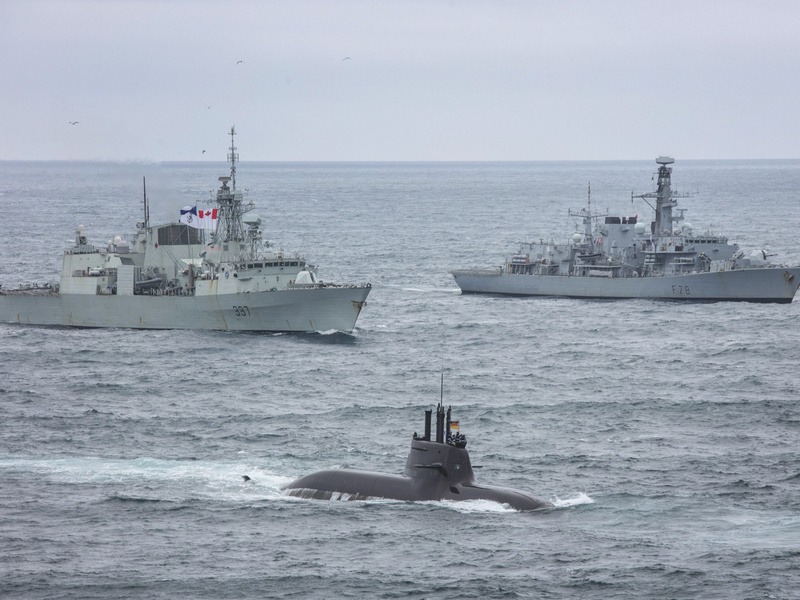
Conventional Subs are not designed with ice strengthens sails and upper hulls, nor are they big and strong enough to emergency breach the ice pack
So any mission sending something like a 212CD under multi-year pack ice would be NLI to justify the risk to personnel and equipment, and would get buried in Secrecy for many many decades.
I in part, agree with this, ... where clearly extra measures are likely needed for sail/fin strengthening, and also modifications needed such as upward looking sonar, and possible strengthening by propellers and extra measures (for cold weather/slush) for hull intakes ... but ... but ...
... but I don't fully agree where there is mention of hull (including upper hull) strengthening.
On a modern double-hull submarine like the Type-212CD I believe the "upper hull" people refer to is the
outer casing or superstructure (the non-pressure steel plating that forms the hydrodynamic fairing over the top of the pressure hull). It doesn't bear the primary hydrostatic loads. While the upper casing needs to be rugged enough not to cave in if it gently brushes icy slush, it doesn't need massive structural steel plate reinforcement because it isn't taking the brunt of the load. Further ...
Further, ... I suspect the operational strategy for an AIP submarine (with weeks of under ice endurance) in the Arctic is
not to smash through ice on top, but rather the strategy would be to head for locations where there are known polynya. I believe polynya can nominally be detected by synthetic aperture radar (SAR) satellite. Some polynya only last for days, but others tend to seasonally re-occur in the very same locations and hence can be present for months.
So presumably, prior to submerging and entering 'under the ice' , up to date satellite radar imagery will have been received, with multiple polynya (primary & backups) locations identified, and then these locations passed to and received by communications (such as using satcom) by the submarine while outside the ice-field. If no suitable multiple location(s) of polynya are within a decent distance, I suspect any under-ice plans would be cancelled. If thou identified, the submarine could proceed ... and once proceeding under ice, the upward looking sonar would help precisely confirm when the submarine is under the exact planned polynya location.
For example (I am looking for unclassified references) for Arctic transit showing how SAR is beneficial :
Read notes
"Iceberg reports—all of which offer excellent information for operational planning. (The NIC also works with the Canadian Ice Service to jointly produce the North American Ice Service products.) The NIC ocean ice and iceberg products are based principally on satellite passive microwave and synthetic aperture radar (SAR) data. The ice charts include a rough characterization of ice thickness and types where available."
Clearly none of this will be easy ...
Reading the early accounts of USN nuclear submarine transits under the ice, and how at times they had to change their course, and try different routes (due to underwater ice blockage) is solid proof such is incredibly difficult. So clearly this would not be done lightly and planning, and experience would be needed.
I suspect the submarine, if under ice-transit is planned, would motor (snorkeling) to the edge of the ice-field on diesel engines, so to preserve AIP reactant for the under ice part of any travels.
It would not surprise me if the USN would if asked offer experience from the USN Arctic Submarine Laboratory (ASL) for any early missions, while the RCN obtained experience. I believe the
NRP Arpão (S-161), a
Tridente-class (Type 214 class AIP/lead-acid) diesel-electric submarine had an ASL Arctic Operations Specialist (AOS) [also referred to as an 'ice-pilot'] embarked for that submarine's very very brief under ice journey and surfacing at a polynya in an ice field .
Clearly this is 'far' in the future, but with procurement of the submarine now active, additional submarine equipment (strengthened fin/sail, upward looking sonar, additional protection over flush/hull sensors, and other Arctic equipment enhancement aspects) likely need to be assessed and agreed upon now in the final contract negotiation stage. Adding such later will IMHO result in a higher price tag.
... and if one can believe 'Global warming' reports ... its likely there will be more and more polynya in the future, as the Arctic ice melts a bit and the Northwest passage opens up more.