• Thanks for stopping by. Logging in to a registered account will remove all generic ads. Please reach out with any questions or concerns.

TKMS Type 212CD (Victoria class replacement megathread)

It sounds like an opportunity that Canada can pursue through directed research grants. I suspect that the successful development would have applications outside of just subs as well. AIP is going to be part of our future and the work to develop a mobile refueling station is likely worthwhile and would likley have beneficial spin offs as well.
 
I see the opposite happening. If the RCN doesn't go for the sub designer to "define, modify, navally certify" and hold them accountable to that for the AIP reactant replenishment system, and if the RCN instead try on their own to fabricate some base RCN design requirement, without the active participation knowledge of TKMS, the RCN will end up paying 2x as much or more, and could very well end up with a system that doesn't work. I see TKMS being held responsible being key here - and that needs IMHO to be done by TKMS designing, modifying, ... etc - where they have existing commercialized Canadian containerized GOX/LOX generation and hydrogen generation systems to use as their basis.

The RCN has a window now, with an existing contract being negotiated - to attempt to get the most possible for the money to be spent - with solid milestone payments tied to the carefully designed deliverables.
oldcpu, I am going to respond to your two posts together because I honestly do not have the patience to split this into two separate replies. I have already spent enough time on this speculative proposal.

Nobody disputes that commercial hydrogen generation, oxygen liquefaction and containerized gas technologies exist. The issue is whether they can be combined into a safe, mobile, naval certified system for producing, storing and transferring submarine grade LOX and hydrogen to a Type 212CD. That involves purity standards, cryogenic handling, transfer pressures, hazardous area controls, emergency shutdowns, fire and explosion protection, exclusion zones, trained personnel, environmental limitations and certification of the complete system. A hydrogen or LOX accident beside a submarine would not be a minor industrial incident. It could kill people, destroy the boat and close the supporting facility. Pointing to Canadian companies that manufacture individual components does not establish that the complete concept is safe, affordable or operationally necessary.

You say other Type 212A and Type 214 operators may be interested. Perhaps they are, but after decades of operating fuel cell AIP submarines, not one appears to use the mobile replenishment arrangement you are advocating, not one! That does not prove it is impossible, but it should tell us something about its practicality, cost and safety. Canada should not volunteer to become the development customer simply because the technology sounds plausible on paper.

You also describe this as merely an assessment, yet you want TKMS tasked to “define, modify and navally certify” the submarine and establish Canadian industrial interfaces during the current contract. That is not simply asking a question. It is the beginning of a Canadian specific engineering requirement for a hypothetical system that does not exist and may never be purchased. Lee, having worked in DND procurement, you should recognize the Canadianization trap here: studies become requirements, requirements become design changes, and design changes add cost, delay, integration risk and long term support obligations.

The sensible approach is to acquire the proven submarine configuration as others have said and its established replenishment arrangements. If Canada later establishes a genuine operational requirement for mobile reactant support, the mobile system should be designed and certified to work with the submarine’s existing interfaces. We should not modify the submarine fleet around an imaginary future support system and risk creating an expensive orphan configuration. Nor is Canada automatically “locked in” for forty years if this is not inserted into the acquisition contract now. Shore infrastructure and support systems can be expanded or upgraded later if an actual requirement and viable business case emerge.

The Arctic argument does not rescue the proposal. Nanisivik is being permanently closed. The only remotely plausible northern options would be places such as Iqaluit or Nuuk, and either would require secure facilities, specialized personnel, hazardous material storage, emergency services, transportation support and, in Nuuk’s case, host nation approval. A few ISO containers sitting on a northern wharf do not constitute a safe submarine replenishment facility. A purpose equipped commercial vessel might theoretically carry such a system into a Greenland or Labrador fjord, but that would introduce an entirely new set of safety, certification, crewing, survivability and transfer risks.

There is nothing wrong with asking TKMS what proven replenishment options are available. What I reject is the insistence that Canada must immediately pay TKMS to define, modify and certify a speculative Canadian system simply because it might conceivably prove useful. A favourable political spending environment is not an excuse to attach every technically imaginable idea to the contract. The priority is delivering proven submarines, weapons, sensors, training, maintenance and safe shore support on time and in sufficient numbers. This proposal is exactly how requirements expand, costs climb and schedules slip.

 
Last edited by a moderator:
TBH, I think instead of all this worry about AIP via fancy chemicals, we'd honestly be better off looking into the small modular nuclear reactors that have been discussed in various spots.

The new ones seem to be truck-sized and portable from a couple of reports I've read, so, that'd fit in the existing hull, and at lower outputs of 1MW, that'd be enough to sustain some level of battery charge for them.

I note that the 212A has a roughly 3MW generator.

Even if it's not enough to provide main propulsion power at full power, if it's enough to charge the batteries at a continuous level to give it a couple of knots of headway, that'd be very worthwhile to have aboard.
 
TBH, I think instead of all this worry about AIP via fancy chemicals, we'd honestly be better off looking into the small modular nuclear reactors that have been discussed in various spots.

The new ones seem to be truck-sized and portable from a couple of reports I've read, so, that'd fit in the existing hull, and at lower outputs of 1MW, that'd be enough to sustain some level of battery charge for them.

I note that the 212A has a roughly 3MW generator.

Even if it's not enough to provide main propulsion power at full power, if it's enough to charge the batteries at a continuous level to give it a couple of knots of headway, that'd be very worthwhile to have aboard.
i note that the eVinci reactor has moved forward with testing and sustained criticality recently
 
TBH, I think instead of all this worry about AIP via fancy chemicals, we'd honestly be better off looking into the small modular nuclear reactors that have been discussed in various spots.

The new ones seem to be truck-sized and portable from a couple of reports I've read, so, that'd fit in the existing hull, and at lower outputs of 1MW, that'd be enough to sustain some level of battery charge for them.

I note that the 212A has a roughly 3MW generator.

Even if it's not enough to provide main propulsion power at full power, if it's enough to charge the batteries at a continuous level to give it a couple of knots of headway, that'd be very worthwhile to have aboard.
Keep an eye on Turkey and NukDEN for SMR / MSR. They are interested in a molten salt reactor for their SSN/SSBM projects and a Canadian company already has a working design of a very compact MSR reactor. I believe it is very close to being in a licensable state.
 
That is interesting, but there is a fairly large jump from “TKMS has worked on a methanol reformer” to “the 212CD may use methanol.”

So yes, a future methanol reformer version of TKMS fuel cell AIP is technically plausible. No, that does not establish that the German, Norwegian or Canadian 212CDs will have it. Until TKMS confirms otherwise, Arctic replenishment planning must be based on the actual contracted AIP configuration, (...)

Fully agree with you. Period.

Yet it seems that the actual system of Hydrogen storage for the 212 CD has not been publicly disclosed, not even before the Canadian announcement to join the program, and there is some speculation on other forums that Methanol reformer might be ready, pending on a final decision go/ no-go.
In other words, it's being assumed here that the system will be the same as in previous iterations of Type 212, but AFAIK it has not been confirmed either. Please correct me and show me evidence. Maybe I missed it.
 
Containerized reactant replenishment is being made by some to look far more difficult than it actually is. Such already exists in different forms, in Canada. Its clear to me at least, this likely has not been investigated by all. When it comes to safety and difficulty, all which are valid observations, they apply equally to fixed shore locations as much as applying to more mobile setups. A fixed location has no inherent advantage, and one could make the argument a fixed setup could be taken for granted, and have less inspections due to routine, while a mobile one would by its very nature, demand such attention and hence be more safe.

In regards to some of the points made.

1. Requirements. There is a firm requirement for replenishment of AIP reactants on these submarines. That surely is very clear. What we are discussing now is how and where such could be implemented.

2. There are no words in any requirements, to the best of my knowledge, dictating how the AIP reactant replenishment must be done, nor words specifying it must only be from fixed pier installations and no other. There are no words preventing other methods being considered, such as via multiple containers - which provide massive flexibility and surviveability, both of which are important military traits.

3. TKMS are experts in AIP replenishment, having been involved with such for a quarter of a century, supporting AIP submarines such as some of the Type-209(AIP variants), Type-212A, Type-214, and Type-218SG, contracted to ensure the AIP replenishment facilities are consistent with the requirments of such submarines. It makes massive sense to take advantage of the RCN under negotation TKMS contract, to assess and price this, as opposed to attempting a brand new effort years from now to have other AIP reactant replenishment options - done by someone other than TKMS.

4. It is far too late to wait until first few Type-212CD submarines show up on Canada's door step, to only then assess the optimal AIP single or mixed methods of AIP replenishment. Rather the time is now (where one would could argue very specific words even earlier in RFI/RFPs would have been better) for a number of reasons, including lead time to assess and negotiate with Canadian industry (which already has commercial mobile/containerized) hydrogen/GOX/LOX creation capability), and further its best to "strike now, while the iron is hot" politically, with government support for the AIP replenishment implementation, as opposed to putting off to years in the future, where different government could mean less navy support. The approach of assessing has potentially significant advantages for TKMS in providing industrial offsets. Now is an optimal time for the pricing and making technical assessments of such mobile/containerization of AIP replenishment, to assess the full viability and cost, with the assessment done by the experts (TKMS) and not deferred to years in the future with arguably less to no funds and argueably done by those with far far less experience than TKMS.

Frankly, it reads to me some are making this look far more difficult than it is.

Commercialized systems already exist. Assessing and evaluating them now, assessing what may need to be changed, and assessing if it makes sense to procure such now after the evaluation, makes now the perfect time to do such, to assess how such may fit into the program. There may be no money, no political will/support later.
 
All of this discussion is way beyond me, but all I will say is that thinking that a fixed, shore-based installation would be the same as some portable collection of components that would be regularly dis-and-re connected is likely a false equivalency.
 
TKMS will be mandated to setup or assist Canada in setting up at least two AIP refueling stations as part of the contract. Asking TKMS what would be the cost of having a mobile system added in to the contract might be a useful discussion. It may be parked for later as the sheer magnitude of brining in a new sub and infrastructure to Halifax and Esquimalt will likley overwhelm our contract and procurement folks for awhile.
 
TKMS will be mandated to setup or assist Canada in setting up at least two AIP refueling stations as part of the contract. Asking TKMS what would be the cost of having a mobile system added in to the contract might be a useful discussion. It may be parked for later as the sheer magnitude of brining in a new sub and infrastructure to Halifax and Esquimalt will likley overwhelm our contract and procurement folks for awhile.
I can see wanting a refueling station somewhere around or north of Goose or possibly in conjunction with a permanent detachment in Greenland. Its a long commute from Iqaluit to Halifax if your gauges are showing empty or if the ice flows are in your way.
 
Let's all take a breather here and remember that AIP is not a panacea that lets you go the long distance. It is a way to let you go about five knots, max. Above that, you start to draw from the batteries. Below that (say at loitering speeds of 2 to 3 knots), you can draw on the AIP to recharge the batteries. So what AIP does is it lets you make a few short sprints of few hours each, like any classic propulsion submarine, and then loiter to recharge instead of coming up to snorkel on diesel to recharge the batteries, thus letting you operate around your station, fully underwater for weeks instead of just days.

It is not, however, how you go to your station if it is a long distance from your port of origin. For that, you would run either on the surface or at snorkel depth, running on the diesel engines. There is no point in expending your AIP fuel just to get there and back if you have a long distance to cover.
 
Let's all take a breather here and remember that AIP is not a panacea that lets you go the long distance. It is a way to let you go about five knots, max. Above that, you start to draw from the batteries. Below that (say at loitering speeds of 2 to 3 knots), you can draw on the AIP to recharge the batteries. So what AIP does is it lets you make a few short sprints of few hours each, like any classic propulsion submarine, and then loiter to recharge instead of coming up to snorkel on diesel to recharge the batteries, thus letting you operate around your station, fully underwater for weeks instead of just days.

It is not, however, how you go to your station if it is a long distance from your port of origin. For that, you would run either on the surface or at snorkel depth, running on the diesel engines. There is no point in expending your AIP fuel just to get there and back if you have a long distance to cover.

Exactly. That is also why I do not see AIP reactant availability becoming the enormous immediate Arctic replenishment problem some are suggesting.

A Canadian submarine would not leave Halifax or Esquimalt and consume hydrogen and liquid oxygen all the way to the Arctic. It would conduct the long open water transit on diesel power, surfaced or at snorkel depth, while keeping its batteries charged and conserving its AIP reactants for the patrol box.

Once under the ice, AIP would support low speed loitering and routine electrical loads while preserving or restoring battery capacity. The batteries would provide the additional power for manoeuvring and short high speed sprints. The published maximum speed achievable using fuel cells is less important than the fact that higher power demand consumes reactants much faster and defeats the purpose of conserving AIP endurance.

Considering that actual under ice time would likely represent only a small part of the patrol, the onboard reactants could provide weeks of flexibility without being consumed continuously. Even two weeks beneath the ice would not necessarily mean two weeks of uninterrupted fuel cell operation because the submarine would manage AIP, batteries, speed and electrical demand as an integrated energy system.

The boat would normally replenish its reactants at its established submarine base between patrols. A forward Arctic replenishment capability might be useful under some future operational concept, but occasional or limited under ice operations do not automatically establish a requirement for containerized hydrogen and liquid oxygen facilities scattered around the Arctic. By all means ask the Germans about such as system but as for needing it right now no I don't think we do at all.
 
Exactly. That is also why I do not see AIP reactant availability becoming the enormous immediate Arctic replenishment problem some are suggesting.

A Canadian submarine would not leave Halifax or Esquimalt and consume hydrogen and liquid oxygen all the way to the Arctic. It would conduct the long open water transit on diesel power, surfaced or at snorkel depth, while keeping its batteries charged and conserving its AIP reactants for the patrol box.

Once under the ice, AIP would support low speed loitering and routine electrical loads while preserving or restoring battery capacity. The batteries would provide the additional power for manoeuvring and short high speed sprints. The published maximum speed achievable using fuel cells is less important than the fact that higher power demand consumes reactants much faster and defeats the purpose of conserving AIP endurance.

Considering that actual under ice time would likely represent only a small part of the patrol, the onboard reactants could provide weeks of flexibility without being consumed continuously. Even two weeks beneath the ice would not necessarily mean two weeks of uninterrupted fuel cell operation because the submarine would manage AIP, batteries, speed and electrical demand as an integrated energy system.

The boat would normally replenish its reactants at its established submarine base between patrols. A forward Arctic replenishment capability might be useful under some future operational concept, but occasional or limited under ice operations do not automatically establish a requirement for containerized hydrogen and liquid oxygen facilities scattered around the Arctic. By all means ask the Germans about such as system but as for needing it right now no I don't think we do at all.
I could see IF the Navy wants to replenish any Submarine capability under or near Ice a moonpool in a future Polar Ice Breaker would be a better option with far more flexibility. Should Davie convince the Government to buy two GLAMM then use them as the Ice capable floating support capability.

G-LAM.jpg
 
I could see IF the Navy wants to replenish any Submarine capability under or near Ice a moonpool in a future Polar Ice Breaker would be a better option with far more flexibility. Should Davie convince the Government to buy two GLAMM then use them as the Ice capable floating support capability.

View attachment 102016
Umm, moonpool?

You aren’t actually suggesting that a submarine be serviced through a moonpool, are you?
 
I could see IF the Navy wants to replenish any Submarine capability under or near Ice a moonpool in a future Polar Ice Breaker would be a better option with far more flexibility. Should Davie convince the Government to buy two GLAMM then use them as the Ice capable floating support capability.

View attachment 102016
More vaporware from Davie.
 
Umm, moonpool?

You aren’t actually suggesting that a submarine be serviced through a moonpool, are you?
A Submarine capability does not have to have sailors in them. Who knows what imagination will be developed for Arctic operations. Of course the most silent of the Naval service won't and shouldn't share.
 
that would be one hell of a big hole to reinforce if it was to be any good as an icebreaker. The 212 is 74 meters long. The new Polar class 2 will be about twice that length so your pool would have to stretch from just forward of the engine room almost to the point where the hull starts to shape up towards the stem. I don't know much about ship building but it seems like a bit of a risky concept to me.
I could see IF the Navy wants to replenish any Submarine capability under or near Ice a moonpool in a future Polar Ice Breaker would be a better option with far more flexibility. Should Davie convince the Government to buy two GLAMM then use them as the Ice capable floating support capability.

View attachment 102016
ld
 
Umm, moonpool?

You aren’t actually suggesting that a submarine be serviced through a moonpool, are you?
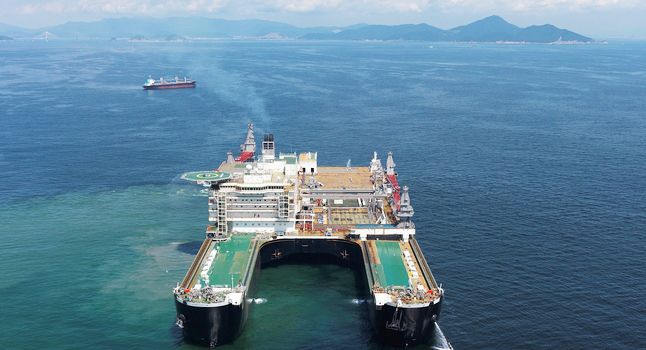
I think he meant a opening in the ice. Mind you it could be done with a large catamaran type vessel, might make an interesting way to service subs. You could have a large gantry between the hulls.

pieter-schelte.jpg


However if we did build a resupply vessel with the ability service and resupply AIP systems, I suspect our allies would be very happy about it.
 
So what AIP does is it lets you make a few short sprints of few hours each, like any classic propulsion submarine, and then loiter to recharge instead of coming up to snorkel on diesel to recharge the batteries, thus letting you operate around your station, fully underwater for weeks instead of just days.

I initially had your view in regards to AIP (back over 2 decades ago) limited only to how you described,

... but AIP has advanced since then, and as AIP advances, how such advances can be used in submarine operations is something that clearly has to be constantly evaluated and re-evaluated. Planning for the future is always essential.

Practical, safe, and operationally viable AIP for submarines emerged in the 1980s and 1990s with the development of Stirling engines (pioneered by Sweden within the Gotland class (A19 class, commissioned starting in 1996 by the Royal Swedish Navy)) and proton-exchange membrane (PEM) fuel cells (developed in Germany—starting with U-1, an upgraded Type 205 experimental boat using a 100-kW alkaline fuel-cell (AFC) system developed by Siemens/HDW/IKL (as the trials platform) in 1988–1989, followed by Siemens proton-exchange membrane fuel cells in the first commissioned Type-212A in 2005). Note - year 2005 for the 212A. That is over 2 decades ago.

Since then, there have been more advances in AIP technology. More modern proton-exchange membrane (PEM) fuel cell systems achieve higher electrical output per unit volume and greater operational efficiency through high-density stacks, optimized thermal management, and advanced material improvements—such as reinforced low-platinum membranes and corrosion-resistant metallic bipolar plates—enabling submarines such as the planned Type-212CD to sustain extended low-speed underwater operations.

These are major advances with 4th-generation fuel-cell technology. This, together with the believed enlarged internal reactant storage in the Type-212CD, supports a projected low-speed endurance the unclassifed press suggests possibly extends up to approximately 41 days submerged for the Type-212CD.

It is not, however, how you go to your station if it is a long distance from your port of origin. For that, you would run either on the surface or at snorkel depth, running on the diesel engines. There is no point in expending your AIP fuel just to get there and back if you have a long distance to cover.

I 100% agree there. The more time spent on diesel, on the transit way to/from the patrol area, the more AIP reactant is available for under water operations.
 
Last edited:
Back
Top