• Thanks for stopping by. Logging in to a registered account will remove all generic ads. Please reach out with any questions or concerns.

Liberal (Minority/Majority) Government 2025 - ???

The Fraser Institute burying the lede. How shocking.

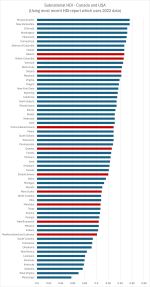
I can also cherry pick something that tells a very different story with something HDI at the sub-national level in North America.

1000040142.png

GDP/capita is also a shit measure of societal well-being. If country of 10 people has nine people making 50,000 a year and one making 500,000 then the GDP per capita of 95,000 isnt very useful and that phenomenon is responsible for a large part of that GDP gap sub-nationally.

That said, Im all in on recognizing we need to improve our national productivity and output.
 
The Fraser Institute burying the lede. How shocking.

I can also cherry pick something that tells a very different story with something HDI at the sub-national level in North America.

View attachment 102588

GDP/capita is also a shit measure of societal well-being. If country of 10 people has nine people making 50,000 a year and one making 500,000 then the GDP per capita of 95,000 isnt very useful and that phenomenon is responsible for a large part of that GDP gap sub-nationally.

That said, Im all in on recognizing we need to improve our national productivity and output.

Which is the first consistently 'Red state' in terms of Presidential and Senate/Congress on this list? Is it Minnesota, flips back and forth? Pretty certain that the bottom 10 are consistently labelled as 'Red' states.
 
The Fraser Institute burying the lede. How shocking.

I can also cherry pick something that tells a very different story with something HDI at the sub-national level in North America.

View attachment 102588

GDP/capita is also a shit measure of societal well-being. If country of 10 people has nine people making 50,000 a year and one making 500,000 then the GDP per capita of 95,000 isnt very useful and that phenomenon is responsible for a large part of that GDP gap sub-nationally.

That said, Im all in on recognizing we need to improve our national productivity and output.
Exactly why its crap for AB to because we have the largest gap between income groups in the country. Top 20% make more then the rest of AB combined which will heavily skew the per capita
 
Last edited:
Sooo some here totally missed the point, again.

With competent leadership in federal government, all those provinces should be well above most or all states.

And the reality is very much there for what this graph places most of our provinces. Food, housing, employment, ability to have children, etc are in a very poor state for most of Canada.

Believe whatever you want.
 
Sooo some here totally missed the point, again.
At me next time lol
With competent leadership in federal government, all those provinces should be well above most or all states.
Do tell what you mean by that? How should Canadian provinces have a higher GDP per capita than US states? Whats your plan, legit critique, gut feeling?
And the reality is very much there for what this graph places most of our provinces. Food, housing, employment, ability to have children, etc are in a very poor state for most of Canada.
What does this mean? How does cost of living play into this when the worst CoL crises in North America are in the states that hold the number 1 and 4 slots respectively? Perhaps youre on board with my point that GDP per capita is of minimal utility?
Believe whatever you want.
 
Sooo some here totally missed the point, again.

With competent leadership in federal government, all those provinces should be well above most or all states.
What specific measures would the Feds have to take, right now, to to have a lasting effect within 12 months?
 
Which is the first consistently 'Red state' in terms of Presidential and Senate/Congress on this list? Is it Minnesota, flips back and forth? Pretty certain that the bottom 10 are consistently labelled as 'Red' states.

Minnesota is usually blue. The last time they voted for a Republican for President was in 1972 for Nixon. It was the only state to go for Mondale in 1984. Their last Republican senator was elected in 2002.

Wyoming has been a safe Republican state for quite a while, I believe.
 
Sooo some here totally missed the point, again.

With competent leadership in federal government, all those provinces should be well above most or all states.

And the reality is very much there for what this graph places most of our provinces. Food, housing, employment, ability to have children, etc are in a very poor state for most of Canada.

Believe whatever you want.
No, we aren’t missing the point. The claim made relied on data that was presented deceptively and that does not measure what the claim suggests it measures. Some of us get that, you fell for it.
 
What specific measures would the Feds have to take, right now, to to have a lasting effect within 12 months?
Interestingly enough the Feds have taken a few initial steps that would help achieve this; Fast track major projects, and eliminate internal trade barriers, for example. However, saying it and doing it are different... none of those have actually happened yet... but maybe when they do we'll see something. This of course assumes there are no long drawn out legal pushbacks.

The Fed could do more, such as aggressive business tax breaks (including cutting that industrial carbon tax) to drive investment.
 
What specific measures would the Feds have to take, right now, to to have a lasting effect within 12 months?
First, its about moving the needle in the right direction. And that takes years. The sooner the better.

Understanding Canadian Sovereignty needs economic strength. And we as a nation, need to stop the money printing. Every time money is printed, its value decreases, period. The more the PRIVATE SECTOR and individual people spend cash here in Canada as well as foreign entities spending money in Canada, its strengthens out dollar.

Number one, my opinion, but everything I hear, we need a deal and its not going to be pretty, period. Take what we can get, leverage the hell out of our natural resources (its gonna be years before those pipelines are going to the west coast), and the minerals as well. Get more deals worked out with EU, India, Middle East, even China (without dependency on them) but that $400 billion a year with America is not going to replaced anytime soon. Expand our markets, sure, repair what we can with America. Not a choice. All the ranting and chanting not going to help either.

Number two, reduce the taxes, fees, etc to the absolute minimum.

Number Three, hand in hand with number two, HALT ALL foreign spending with the exception of the Ukraine. There is still a ton of nonsensical spending go out the door. As an example Millions being spent on Palestine announced two weeks ago? F no. We are way beyond done with that shit.

Number Four, HALT any and all climate related BS spending. Enough. The carbon capture BS is a waste of money.

Number Five. Repeal the old bills from Trudeau era on tanker bans (recently saw a east coast podcaster commenting on how there is NO tanker bans in the Maritimes, funny?). As well repeal Bill C69 and there are few other Trudeau-Guibeault bills, just get rid of them already. Carney lost the fake Greenies vote already and they are no longer pretending to be "climate anything". So any and all oil extraction, should be done as economically as possible, encouraging as much private sector money and less government money. Right now, these projects have a whole lotta tax money tied up in them.

The world needs our Oil and gas, make it as painless as possible. Carbon capture is dangerous and unreliable technology as it is, and can have grave and dire consequences if captured CO2 leaks at a later date.

Number Six. Drop immigration to the bare bones levels and focus ONLY on bringing in people we truly need, in the skills we need. We are NOT short of Coffee servers and walmart chashiers FFS. TFW should be restricted to the ag sector, as they have always use them for the last 70 some odd years. Not all immigration is contributing to the GDP, some are drawing on our health, legal, welfare and other financial resources. Also, make new laws to deport faster and easier temp residents who commit crimes, stop wasting our legal resources (and money) on these losers, who frankly need the boot.

Having too many jobs and not enough home grown Canadians to fill them, has the potential to drive up wages (competing)

Number Seven. On diversifying, Canada really should try to fight for more customers outside the USA for softwood and lumber period. And tie this into a better fire prevention strategy. Normally, I would say yankee bucks are good coming our way but right now, they simply don't want out lumber. I am sure we can find some customers somewhere, hopefully around the pacific who need wood.

Number Eight. Federal funding for Municipal home building (yeah they chip in) now comes from TWO freaking federal government agencies (which is F-ing nonsense). Housing starts are STILL very low. Pierre's plan on this last election would still be valid. Carrot and whip, Reward municipalities for early completion of homes and penalize for late/incompletes.

Number Nine. STOP allowing Chinese steel to be brought in, unless we have used every last bit of Canadian steel and they simply can not meet the demand. Losing jobs is contributing to the shitshow going on.

Number Ten. Ontario's Ring of Fire? Come on, Doug and Uncle Mark, you both talked about this in your last election campaigns.

Number Eleven. Tap into every other resource economically possible. Strongly encourage Quebec to drop Bill 21 and explore and extract its oil and gas. Oil and gas is power in this world, period. BC has natural gas in the Montney and Horn basins, are we maxing out potential there too?

Are Saskatchewan, Manitoba, New Brunswick and Newfoundland also maxing out there Oil and gas extraction?

On the resources note, are we maxing out on these?
BC-Coal, Copper, Gold and Silver mining
Sask-Potash and lots of 'er. Without embrassing Trump and discretely, Carney should use this as a carrot with Trump. Trump needs it and from us.
Ont-Gold, nickel, copper, platinum elements and cobalt mining
Quebec-Iron ore, gold, lithium, titanium and nickel mining
Nfld-Iron ore and nickel
Yuk, NWT and Nun-diamonds, gold, silver, zinc, lead and tungsten

Notice We have gold here, there and everywhere? What if Canada extracted some of that gold, had a bunch processed and held in reserve like we used to? If I am not mistaken, our dollar stands stronger of there is Gold backing it up.

Number Twelve . Relates to 11. I was surprised by Liz May a few days ago in parliament talking about "value adding" on our fossil and wood products. Normally I would expect here to drunkenly screech about oil being all bad and cutting down trees is murder. But she talked about, processing all these natural resources as much as we can before export (increase dollar value), so lets encourage to process, mill and refine as much as we can. If possible, food products too.

Number Thirteen. Not 100% on this, but are AI centers in the northern areas worth it? Naturally cold. I don't know enough on this.

I would encourage Feds and Canad to stop wasting money on these drains
-Wind Mills and Large scale solar (I like small scale solar to boost buildings and equipment like my fence chargers)
-EVs (enough)
-Careful of any future automotive bale outs or help. I listened to an economist (forgot his name from UoT I seem to recall) and he stated out automotive building has been on near life support for a long time. Sucks because I have friends who lost out on the plant in Brampton.
-Encourage western farmers to diversify away from canola and get into cereals, peas, beans and sunflower more. China every now and then holds us hostage with our Canola. Take the power away from them.

Thats just a small start. Most of this I have said before, over and over.

 
Fast track major projects, and eliminate internal trade barriers, for example. However, saying it and doing it are different... none of those have actually happened yet.
Yup, announcements alone are not enough. Liberals make lost of promises and excuses but are short on results.
 
People arent missing the point. They dont like the point and they are disagreeing with it.

Everything is fine Rick. We're getting better every day ;)
Nah, not everything's fine, lots of things need improving, but the point in question was just poorly presented using inappropriate data. Straight GDP per capital has the issues I pointed out and more. It can't be used to honestly and reliably compare the standards of living of normal people; it treats it as if all economic activity is getting roughly equally distributed toactual people to fund their standards of living. We know lots isn't. It didn't even correct for purchasing power parity, never mind income inequality... It was just a bad measure for the claim made. The HDI data posted is closer to the mark, but to really compare' 'standards of living', it would take some work to figure out what economic and social variables add up to define that. Straight GDP per capita, while an attractive measure to the Fraser Institute, ain't it.

Interestingly enough the Feds have taken a few initial steps that would help achieve this; Fast track major projects, and eliminate internal trade barriers, for example. However, saying it and doing it are different... none of those have actually happened yet... but maybe when they do we'll see something. This of course assumes there are no long drawn out legal pushbacks.

The Fed could do more, such as aggressive business tax breaks (including cutting that industrial carbon tax) to drive investment.

I'd suggest the 'mega deduction' to immediately expense capital costs the year new equipment/infrastructure investments become available for use is a really good example of such a policy, should it come to pass. I suspect we'll see that as part of the budget bill, probably in the first half of November. That one would help in that it would be a 'right away' benefit to businesses, and would let them free up more capital for major investments in equipment, property etc. It doesn't depend on some major project being developed and eventually approved, just whatever new machinery XYZ corporation is right away ready to buy.
 
Which is the first consistently 'Red state' in terms of Presidential and Senate/Congress on this list? Is it Minnesota, flips back and forth? Pretty certain that the bottom 10 are consistently labelled as 'Red' states.
Food and resource extraction aren't high on the value chain, but they are the foundation of the (now inverted) economic pyramid.

Rising tides do lift all boats. Eventually everyone in a country shares in its total productivity and prosperity.

So many people who have some degree of concern about implications of the gap between rich and poor individuals in a nation cannot usefully interpret the implications of the gap between rich and poor countries, especially over time.
 
Per capita GDP is a very useful measure - not for making claims about individual standards of living, but for understanding the potential and power of a nation relative to its population.
 
Nah, not everything's fine, lots of things need improving, but the point in question was just poorly presented using inappropriate data. Straight GDP per capital has the issues I pointed out and more. It can't be used to honestly and reliably compare the standards of living of normal people; it treats it as if all economic activity is getting roughly equally distributed toactual people to fund their standards of living. We know lots isn't. It didn't even correct for purchasing power parity, never mind income inequality... It was just a bad measure for the claim made. The HDI data posted is closer to the mark, but to really compare' 'standards of living', it would take some work to figure out what economic and social variables add up to define that. Straight GDP per capita, while an attractive measure to the Fraser Institute, ain't it.


I'd suggest the 'mega deduction' to immediately expense capital costs the year new equipment/infrastructure investments become available for use is a really good example of such a policy, should it come to pass. I suspect we'll see that as part of the budget bill, probably in the first half of November. That one would help in that it would be a 'right away' benefit to businesses, and would let them free up more capital for major investments in equipment, property etc. It doesn't depend on some major project being developed and eventually approved, just whatever new machinery XYZ corporation is right away ready to buy.

Tick, tick, tick, tick.....


Americans’ debt problems are flashing a warning not seen since the Great Recession​


For the three-year period ended 2025, the portion of families behind on loan payments soared from about 12% in the prior survey to nearly 20%, according to a Fed survey released Friday.

Higher earners saw their net worth soar during the period, with those in the top income group reporting an increase of 31%.

A widening of the gulf between the 'haves' and the 'have nots'. Sadly I'm fairly confident that this widening more than likely occurred here in Canada as well. The gulf between the countries may not be as wide or as deep but does it really matter? If a gulf exists and your not able to bridge it the size of the gulf is secondary.


The ability of U.S. families to stay current on their debts worsened over the past three years, hitting levels not seen since the aftermath of the global financial crisis, the Federal Reserve reported Friday.
According to the new findings, the portion of families behind on loan payments at the end of 2025 soared from about 12% in the prior survey to nearly 20%, a gain of some 67%. Those behind by two months or more also accelerated considerably, moving to more than 8% from 5% in 2022.

Friday’s Fed report showed the share of debt to income also posted a large gain. Families with payment-to-income ratios of greater than 40% jumped to 8.6%, up from 6.5% in 2022 and the highest level since 2013.

At the same time, the net worth of higher earners soared, with those in the top income group seeing their median net worth rise 31%.

Amid that climate, the Fed found that real median, or midpoint, family income increased 7% but average income dropped 6%.

“Families in the lower ends of the income and net worth distributions saw modest increases in median and mean income, while families in the upper ends saw declines,” the report stated. “These patterns indicate that income inequality decreased slightly between surveys.”

“The exceptions to the general pattern of a rise in median income were for Black non-Hispanic families, Asian families, and families toward the top of the usual income and net worth distributions,” the report stated. “For these families, both median and mean income fell.”

Overall, net worth generally increased.

Inflation-adjusted average net worth rose 7% to $1.24 million, though median net worth climbed just 2% to $215,900, reflecting gains among those at the higher end. The report noted that net worth was “much slower” than the prior report that covered the 2019-22 period.

Lower-income families “saw some declines” in wealth while those with higher incomes saw gains. Families in the bottom one-fourth of income median net worth declined 6% while average net worth fell 4%.
 
Back
Top