- Reaction score
- 43,450
- Points
- 1,210
I don't hate you that much.Or CFHA!


I don't hate you that much.Or CFHA!
As a lifelong resident of Big Canada I agree 100% - and suspect part of the underlying problem is that Big Canada is all too often deaf to Little Canada's concerns, seeking one size fits all solutions to issues that need nuance - Rosedale is not Tisdale, and firearms rules for one may not meet the needs of the other (for example).This is a classic “Little Canada” vs “Big Canada” debate.
The “Little Canada” usually can’t see beyond their own parochial perspective and continue to see the country as a colonial backwater not worthy of a big project to get the country on a global facing. I often see this at the municipal level in Winnipeg whenever there is a proposal for better infrastructure. “Where do you think this is, Vancouver?” No, but it is a city of 3/4 of a million people, a provincial capital, a major transportation hub, and a major city of a G7 nation. It’s not a small town in some colonial backwater. There is no excuse to not have world class infrastructure other than parochialism and misplaced budget priorities. Maybe don’t rip up the same street every year for three years because Roads, Sewer and Hydro don’t talk to each other. Or maybe use better road building materials and techniques so the road lasts a little longer. There’s a reason why roads are better in Grand Forks and Fargo despite having the same climate as Winnipeg.
I live far away from this area and will probably never ride it. But I can see that it has the potential to be an economic boost to a very important part of the country, in turn boosting the entire country.
I would exclude property owners directly affected by this though. If this was going through my neighbourhood and my property was going to be expropriated, I’d be upset too, even if I could see the benefits. It would be nice if this could be avoided, but that’s not the real world unfortunately.

Sure, as long as the competition for subsidy money doesn't result in bus services being cannibalized to support rail services. (Yes, it happens.) Removal of spokes doesn't help. Nor does removing routes required by people on low incomes, especially in cases where transit is "sold" on the basis of providing transportation for people with low incomes. An end result is that total ridership in a transit system can actually decrease, absolutely or sometimes merely as a fraction of total population.And a lot whose are. More if you build out even the barest hub and spoke system.

I would exclude property owners directly affected by this though. If this was going through my neighbourhood and my property was going to be expropriated, I’d be upset too, even if I could see the benefits. It would be nice if this could be avoided, but that’s not the real world unfortunately.

Didn't think I needed to go into detail about how all the effects of the legs of an end-to-end journey act as incentives or disincentives.Public transit doesnt stop at the train station.
Be grateful. Look at any ongoing project that pre-empts use of streets and private (commercial) property. The costs are generally not compensated.I feel like you and I may be the only ones who seem able to put ourselves in their shoes. Sucks.
Be grateful. Look at any ongoing project that pre-empts use of streets and private (commercial) property. The costs are generally not compensated.
Sure there is. Requirements > resources.There is no excuse to not have world class infrastructure other than parochialism and misplaced budget priorities.
I look at the bright side: they get compensation.I have no idea what this has to do with the empathy I feel for someone getting their property expropriated.

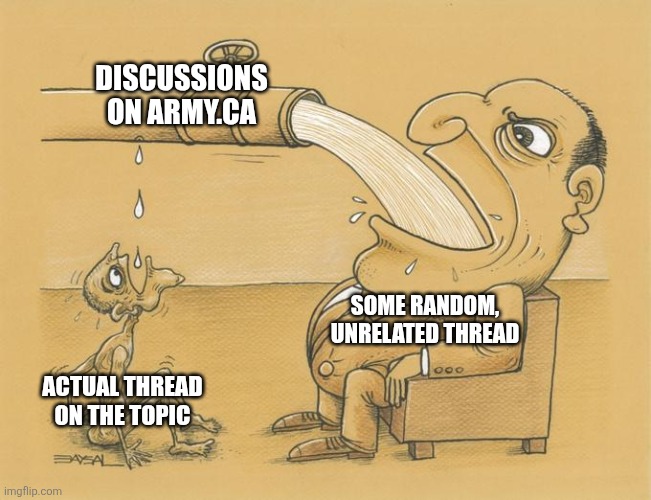
Lets take a pause on the HSR discussion. Part of the reason I really don't take discussions here too seriously anymore is this.
Ahem, excuse me. I right here would consider myself a fiscal conservative. And I 100% believe in changing or abolishing OAS.

Completely concur. I would go one step further, and question the amount of money on extending quantity of life, at great expense, over quality of life. we (Canada) have some very distorted prioritiesAhem, excuse me. I right here would consider myself a fiscal conservative. And I 100% believe in changing or abolishing OAS.
I believe the boomers and before lived an opulent and glutenous lifestyle; mortgaging that on the the backs of the following generations. I think we should think long and hard about leveraging our future for those in their twilight years.
I am fine with social safety nets for those who are incapable physically or mentally from working and contributing. But for those who made choices not too, they should be a burden on their family, not the tax system, especially given the times and opportunities they lived through.
You can have my OAS too.
The “Little Canada” usually can’t see beyond their own parochial perspective and continue to see the country as a colonial backwater not worthy of a big project to get the country on a global facing. I often see this at the municipal level in Winnipeg whenever there is a proposal for better infrastructure. “Where do you think this is, Vancouver?”
Completely concur. I would go one step further, and question the amount of money on extending quantity of life, at great expense, over quality of life. we (Canada) have some very distorted priorities


I had forgotten about that post.Readers interested in HSR may find this discussion of interest,
21 pages
This is where any possible new defense money has been allocated - a desperate legacy that Trudeau is trying to build for himself before he shuffles off to his newest teaching assignment.
Canada is getting high-speed rail
The Prime Minister, Justin Trudeau, today announced that Canada is developing a high-speed rail network in the Toronto-Quebec City corridor.www.pm.gc.ca
- Czech_pivo
- Replies: 1,305
- Forum: Canadian Politics
Jobs man!Just a quick note on the Alto HSR, the fact that Atkins Realis (Formerly SNC Lavalin, yeah the very same) is the main contractor is not bothering anyone here?


That this topic is pretty cleanly split along partisan and rural/urban lines indicates that most are likely approaching it from a partisan perspective, rather than considering it on it's merits alone.On another note, this the Liberal Minority Discussion thread,
in many instances I notice a crowd of people here will discuss at length any potential positives they LPC may be perceived or are actually doing.
But same crowd shys away from say the Court ruling on the emergencies act being illegal (whish is a big F-ing deal), Michael Ma whole fiasco on forced labour (so bad the CBC even called him out) or Carney starting to asked a lot more difficult discussions on cost of living, etc.
Call me an asshole and tell me if I am wrong but in my opinion, many of you won't discuss issues that cast shade on carney and the LPC.
That this topic is pretty cleanly split along partisan and rural/urban lines indicates that most are likely approaching it from a partisan perspective, rather than considering it on it's merits alone.
Faster and easier commuting between the largest cities in the country is a good thing. Even I, raised more rural than most*, can see why HSR makes sense.
HSR, alongside LRT, busses, etc., is far more efficient than yet another road leading to the same 5-10 choke points. How many more lanes leading into the 174/417 interchange, 417/Carling interchange, or 417/416 interchange does Ottawa need?
Sometimes the right solution is the mix of two solutions. @Brad Sallows' more busses, and @ytz's more rail. They aren't mutually exclusive, and since busses are a municipla/provincial issue, the Feds putting money into interprovincial/intermunicipal transit makes sense.
* I grew up a mile outside of a hamlet of 300... The closest "town" had less than 3000.


