• Thanks for stopping by. Logging in to a registered account will remove all generic ads. Please reach out with any questions or concerns.

Liberal (Minority/Majority) Government 2025 - ???

Ok so name one that’s ready to progress save for federal regulatory approval please. I did and it wasn’t hard to find- though blind reliance on AI may not get you there.


Yes, previous government. There’s been quite a bit of turnover and a very clear change in political will and policy approaches.


Prime Minister Carney was neither a member of Parliament nor a member of the government for any of those. The law that has passed during his tenure - C-5, you mentioned it - included establishing the MPO, which is simply awaiting a tabled proposal for an oil pipeline at this point, and which is already considering a major LNG project. Again, that’s the one I mentioned by name.

I’ll also point you to the ‘one project, one assessment’ agreement the Feds and Alberta have recently reached under PM Carney and minister Hodgson. That’s a major, major policy shift for environmental and impact assessments from the Feds.


And, like anything else in the world of permit approvals, if the boss says 'speed things up and get it out the door' that's what the staff will do - laws be damned (kind of)...
 
Ok so name one that’s ready to progress save for federal regulatory approval please.
Used Google AI so take with a grain of salt (subject to errors)

Key "Ready-to-Go" / Nearing Operation Projects:
Major Projects Recently Added for Fast-Tracking:
Major Infrastructure & Expansion Projects:
Yes, previous government. There’s been quite a bit of turnover and a very clear change in political will and policy approaches.
Has there been a change in political will? That is your opinion, period. Previous government? Pretty much the same, different head man. Bill C5 created and remains unused for oil and gas.

Prime Minister Carney was neither a member of Parliament nor a member of the government for any of those.
Great, get rid of those of bills and blame it on Trudeau/"previous government". After all its "dangerous and divided world"

establishing the MPO
Time will tell if this slows things down even more or it actually speeds them up. In my OPINION, I don't think it is going to speed anything up.
 
And, like anything else in the world of permit approvals, if the boss says 'speed things up and get it out the door' that's what the staff will do - laws be damned (kind of)...
Political WILL is the key term. When any government really wants things to happen, the speeds at which it moves is amazing.


Danielle Smith seems pretty pleased with the Carney government's approach, compared to its predecessor. Hard to claim that the current government and its O&G policy is simply a continuation of the Trudeau approach. A few excerpts:

---

"Premier Danielle Smith says the relationship Alberta has with the federal government feels more positive and that it’s been years since she’s seen this level of collaboration."

"I don’t think I’ve seen so much collaboration with the feds since I got elected – and it’s probably been over a decade since we saw that kind of collaboration, so that’s very positive."

"Smith said almost all of the “nine bad laws” have been addressed by Ottawa -- they’re still fighting out one on plastics in court -- but did acknowledge that the proof for most Albertans will see is movement on a proposed new pipeline to the west coast.

We are going to put in a submission for west coast pipeline -- a million barrels a day -- by June, ” she said. “We want the Major Projects Office to give the go ahead to start the approvals by the end of the year and then when we identify -- the public will see which port we’re identifying -- that’s where we’ll look for the carve outs to take place so that’s part of our MOU (Memorandum of Understanding) agreement.”"

---

Seems like there is optimism in the Premier's office, and progress being made in getting to the submission stage for a new pipeline.

It also sounds like Smith has a good working relationship with Energy and Natural Resources minister Tim Hodgson.

Edited for spelling
 
  • Like
Reactions: ytz

"The energy deal stipulated that Alberta's industrial carbon price would eventually reach $130 per tonne, and Smith said how quickly that price is reached is what is still being negotiated."

"Smith pointed to other jurisdictions, like the United States, that currently don't have carbon pricing systems, and said they are more attractive investment environments."

"..Smith said she didn't want to see Alberta ramp up its price to $130 per tonne too quickly."

Just a few tidbits to consider. Its not there yet. And for god sakes DROP the f-ing carbon pricing, its BS.

And look at me, quoting CBC of all news agencies.
 
"Smith pointed to other jurisdictions, like the United States, that currently don't have carbon pricing systems, and said they are more attractive investment environments."

Carbon pricing is probably the dumbest thing canada has implemented. Just pure lunacy.
 
Used Google AI so take with a grain of salt (subject to errors)

Key "Ready-to-Go" / Nearing Operation Projects:
I've already pointed this out about a week ago - its full steam ahead on this expansion - they have already moved up the timelines on this. By early 2028, TMX will be producing 1.3m/barrels a day in oil. That's greater than 23% of all oil that Canada exports a day.

The 2yr timeline is the time if physically takes to build/install all the additional pumping stations needed along the pipeline. There is nothing stopping this from occurring other than the owners of the pipeline spending the money to make it happen.
 
Carbon pricing is probably the dumbest thing canada has implemented. Just pure lunacy.
Pure cash grab and a vote grab of the "greens" thinking voters. I wish people got it through their heads carbon not evil. It is simply a life essential element
 
Carbon pricing an impact at all? Other fees?
Trans Mountain will be at capacity by next month, April, over 18+months ahead of schedule.

That capacity will be at 890,000 barrels/day.

They are spending another 9$ million (which is absolute peanuts) by Jan 2027 to add 'drag reducing agents' that will increase the flow by 10%. That will bring the number of barrels/day to 979,000.

In addition, they are constructing more pumping stations that will be completed in 2028. That will add another 360,000 barrels/day to the pipeline.

By the 2028 Trans Mountain will be shipping 1,339,000 barrels/day to the docks for shipping somewhere in the world.

At 70$ USD/barrel that's 93.7m USD/day or 34.2b USD a year.

 
Sure, as long as the competition for subsidy money doesn't result in bus services being cannibalized to support rail services. (Yes, it happens.) Removal of spokes doesn't help. Nor does removing routes required by people on low incomes, especially in cases where transit is "sold" on the basis of providing transportation for people with low incomes. An end result is that total ridership in a transit system can actually decrease, absolutely or sometimes merely as a fraction of total population.
So we've gone from - "only well off white collar workers will benefit" to "non-white collar people don't work in the impacted areas" to "well okay they do but if we're not careful the good might be offset by detrimental changes to other aspects of the transit system"
 
So we've gone from - "only well off white collar workers will benefit" to "non-white collar people don't work in the impacted areas" to "well okay they do but if we're not careful the good might be offset by detrimental changes to other aspects of the transit system"
I'm passing along information I've acquired from reading results of studies - empirical observations - of some of the effects of rail transit, and the preferences people reveal through surveys.

Maybe just re-state my actual statements instead of making up your own more absolutist statements.

"Build an expensive rail to meet the business commuting needs of classes of people who are already WFH, telecommuting, telemeeting, etc" is not "only well off white collar workers". The particular point there is that, like overland high-speed internet being replaced by Starlink, it's an evolving model in which the need for physical transit is shrinking.

"You're describing a lot of people whose work places mostly aren't going to be near a HSR terminal" isn't "non-white collar people don't work in the impacted areas".

It doesn't matter what kinds of strawman statements are constructed - the non-leisure users of HSR between cities are going to overwhelmingly be white collar workers, particularly knowledge workers.

As always, every dollar spent benefits somebody. The questions are whom, and by how much. Just as EV subsidies tend to benefit people who already have money in pocket, and OAS without much lower income caps benefits people who are not living on low incomes, HSR benefits mostly people who don't need much assistance and could make do with existing solutions. Public funds being fungible and limited, expenditures on people who don't need help necessarily displaces funding of things that might be more productive or targeted at people with greater needs.

I'm confident that given the tendency of big projects to massively overrun cost and schedule, capital costs will be much higher than forecast. I'm confident that given the political reluctance to set fares high enough to cover operating costs, the relevant authorities will be scrambling to find other sources of money, which includes dipping into other pots, which includes other components of transit controlled by an authority. I'm confident that the forecasted economic figures provided by boosters are based on the most optomistic assumptions they can justify, and that the results will be lesser.

A lot of money, not necessarily where it will produce the most utility, sunk into one risk.
 
Curious. How many here buy into the theory of "the Laurentian elite" and its alleged influence on Ottawa and thus Canada?


The well known elitist political power block in Canadian society centred around Ottawa?

Oh hell yeah, it's a thing ... probably before the whole 'Upper and Lower Canada' thing too...

 
t doesn't matter what kinds of strawman statements are constructed - the non-leisure users of HSR between cities are going to overwhelmingly be white collar workers, particularly knowledge workers.
Saying something (again) doesn't make it true

More people report to non knowledge- work/laptop jobs within 10-15 minute by foot or transit of Union Station And 610 bay there are people in most Canadian towns/cities. Bank street/Tunney's not quite as massive but still huge. Quebec metro back to Toronto scale.

Toronto to Montreal or Quebec city trips fit the white collar /leisure dichotomy. But the peterborough to Toronto-Ottawa, Ottawa to Montreal, and trois riviere-Montreal sub legs create viable transit based commutes and have potential to merge labour markets
 
Last edited by a moderator:
Curious. How many here buy into the theory of "the Laurentian elite" and its alleged influence on Ottawa and thus Canada?


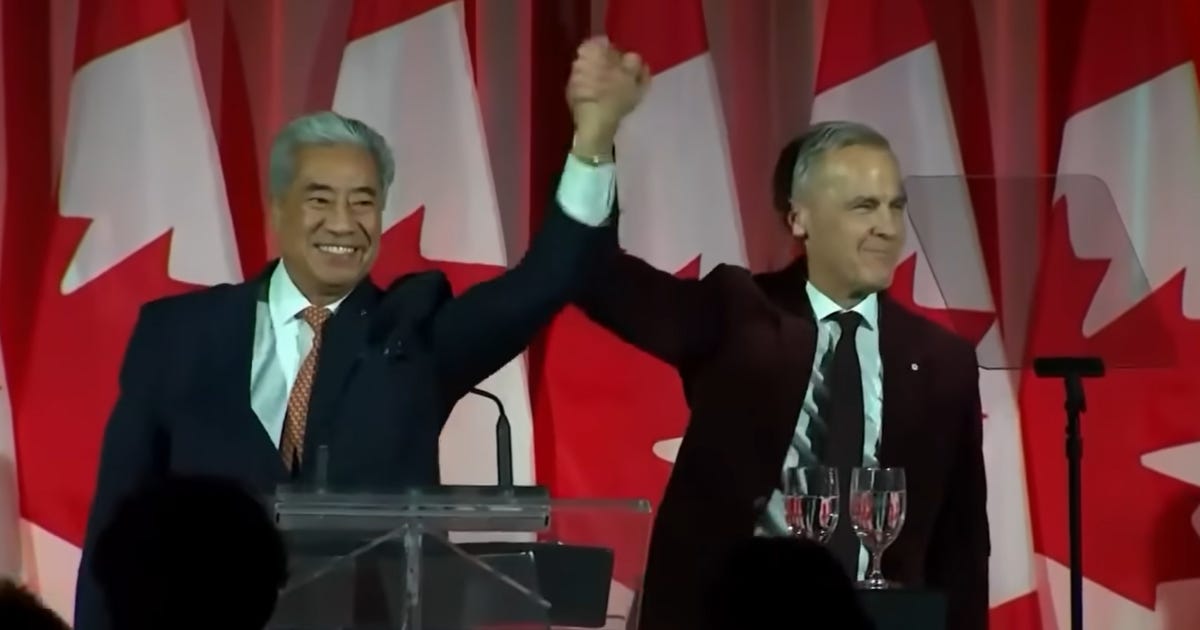
Carney caught on camera praising Michael Ma at Liberal fundraiser

Prime Minister Mark Carney praised the “fundamental Canadian values” of MP Michael Ma


Real elbows up kind of guy.
 
Back
Top