• Thanks for stopping by. Logging in to a registered account will remove all generic ads. Please reach out with any questions or concerns.

Liberal (Minority/Majority) Government 2025 - ???

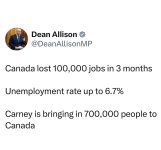
Mark Carney cranks up immigration while pretending not to

The previous Liberal immigration plan called for 365,000 permanent residents in 2027. Carney's plan increases that target to 380,000 annually.
Slight increase, but the 380,000 figure doesn't tell the whole story. The government has also announced additional measures to accelerate the transition of existing temporary residents and protected persons to permanent residency:
  • Up to 115,000 protected persons and their dependants
  • Up to 33,000 temporary workers
  • A further time limited initiative providing permanent residency opportunities for people already living in Canada

Budget 2026 puts the broader transition initiative at up to 200,000 temporary residents by the end of 2027.
[These are additional permanent-residency admissions, but an important distinction is that these people are already in Canada. They are not 200,000 additional newcomers arriving at the border]


Now consider the temporary resident targets for 2027:
  • 50,000 through the Temporary Foreign Worker Program.
  • 170,000 through the International Mobility Program.
  • 150,000 international students.
That's another 370,000 temporary resident arrivals - many of whom we know don't like to leave when their time us up.

Canada's published targets are:
  • 380,000 permanent resident admissions.
  • 370,000 new temporary resident arrivals.
750,000 planned admissions and arrivals in 2027, before accounting for visitors and other categories outside these targets.


Canada is still bringing in substantial numbers of temporary workers and international students while simultaneously trying to reduce its temporary population to below 5% of the national population. The government also intends to transition up to 200,000 people already here into permanent residency. That means a significant number of people currently classified as temporary residents will become permanent residents rather than leave Canada.


The big questions are whether housing, healthcare, infrastructure and public services can accommodate the population growth. Almost a million per year. Another question is whether the government has a credible plan to manage temporary residents when their permits expire.

 
Mark Carney cranks up immigration while pretending not to

The previous Liberal immigration plan called for 365,000 permanent residents in 2027. Carney's plan increases that target to 380,000 annually.
Slight increase, but the 380,000 figure doesn't tell the whole story. The government has also announced additional measures to accelerate the transition of existing temporary residents and protected persons to permanent residency:
  • Up to 115,000 protected persons and their dependants
  • Up to 33,000 temporary workers
  • A further time limited initiative providing permanent residency opportunities for people already living in Canada

Budget 2026 puts the broader transition initiative at up to 200,000 temporary residents by the end of 2027.
[These are additional permanent-residency admissions, but an important distinction is that these people are already in Canada. They are not 200,000 additional newcomers arriving at the border]


Now consider the temporary resident targets for 2027:
  • 50,000 through the Temporary Foreign Worker Program.
  • 170,000 through the International Mobility Program.
  • 150,000 international students.
That's another 370,000 temporary resident arrivals - many of whom we know don't like to leave when their time us up.

Canada's published targets are:
  • 380,000 permanent resident admissions.
  • 370,000 new temporary resident arrivals.
750,000 planned admissions and arrivals in 2027, before accounting for visitors and other categories outside these targets.


Canada is still bringing in substantial numbers of temporary workers and international students while simultaneously trying to reduce its temporary population to below 5% of the national population. The government also intends to transition up to 200,000 people already here into permanent residency. That means a significant number of people currently classified as temporary residents will become permanent residents rather than leave Canada.


The big questions are whether housing, healthcare, infrastructure and public services can accommodate the population growth. Almost a million per year. Another question is whether the government has a credible plan to manage temporary residents when their permits expire.


Follow the money, who will this benefit ?
 
Follow the money, who will this benefit ?

Well 150,000 international 'students' will benefit the Universities/Colleges across the country full stop. If the average student spends 35k/yr in tuition/food/accommodations that is a significant chunk of money that the schools will receive which in turn is a direct savings to the Pro Gov't in not having to transfer that funding over to the schools.

150k * 35k = 5.25b a yr in direct revenue to schools, landlords, grocery stores, etc.

I don't have issues with this necessarily - except for 100% certainty - that we should be DIRECTLY following the US and the EU's laws on what employment these 150k international students can undertake and the amount of hours they can work weekly.

The current laws allow for them to work up to 24hrs/week off campus during the school year in any job type they can find and unlimited hours/week when school is not in session. For 'on-campus' work there are no weekly hour/week restrictions.

In the US, an international student can work up to 20hrs/week on campus (vs our NO restrictions on the # of hrs/week). For off-campus - strictly regulated to ONLY employment directly related to their field of study (in other words, they can't be working at Duckin Donuts or McD's), which can ONLY occur after 1yr successful completion of studies and then only 20hr/week.

See the difference between the two? With ours there is zero restrictions on the type of work, the need to complete 1yr of schooling in your programme before be able to work at all, either on or off campus, and the stipulation that your employment must be directly related to your field of study - i.e. you're studying engineering so you work in a job related to engineering not pouring coffee or flipping burgers.....
 
Back
Top