- Reaction score
- 8,307
- Points
- 1,260
FTFYThese arerookieclick-bait numbers...


FTFYThese arerookieclick-bait numbers...

FTFY


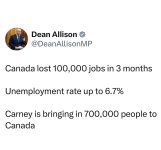
Mark Carney cranks up immigration while pretending not to
The previous Liberal immigration plan called for 365,000 permanent residents in 2027. Carney's plan increases that target to 380,000 annually.
Slight increase, but the 380,000 figure doesn't tell the whole story. The government has also announced additional measures to accelerate the transition of existing temporary residents and protected persons to permanent residency:
- Up to 115,000 protected persons and their dependants
- Up to 33,000 temporary workers
- A further time limited initiative providing permanent residency opportunities for people already living in Canada
Budget 2026 puts the broader transition initiative at up to 200,000 temporary residents by the end of 2027.
[These are additional permanent-residency admissions, but an important distinction is that these people are already in Canada. They are not 200,000 additional newcomers arriving at the border]
Now consider the temporary resident targets for 2027:
That's another 370,000 temporary resident arrivals - many of whom we know don't like to leave when their time us up.
- 50,000 through the Temporary Foreign Worker Program.
- 170,000 through the International Mobility Program.
- 150,000 international students.
Canada's published targets are:
750,000 planned admissions and arrivals in 2027, before accounting for visitors and other categories outside these targets.
- 380,000 permanent resident admissions.
- 370,000 new temporary resident arrivals.
Canada is still bringing in substantial numbers of temporary workers and international students while simultaneously trying to reduce its temporary population to below 5% of the national population. The government also intends to transition up to 200,000 people already here into permanent residency. That means a significant number of people currently classified as temporary residents will become permanent residents rather than leave Canada.
The big questions are whether housing, healthcare, infrastructure and public services can accommodate the population growth. Almost a million per year. Another question is whether the government has a credible plan to manage temporary residents when their permits expire.

Follow the money, who will this benefit ?
The economy? And hence all of us? Canada has a demographic crisis - if only because our domestic market is stagnant to shrinking, let alone the labour shortageFollow the money, who will this benefit ?
So there a couple of concerns with this...Mark Carney cranks up immigration while pretending not to
The previous Liberal immigration plan called for 365,000 permanent residents in 2027. Carney's plan increases that target to 380,000 annually.
Slight increase, but the 380,000 figure doesn't tell the whole story. The government has also announced additional measures to accelerate the transition of existing temporary residents and protected persons to permanent residency:
- Up to 115,000 protected persons and their dependants
- Up to 33,000 temporary workers
- A further time limited initiative providing permanent residency opportunities for people already living in Canada
Budget 2026 puts the broader transition initiative at up to 200,000 temporary residents by the end of 2027.
[These are additional permanent-residency admissions, but an important distinction is that these people are already in Canada. They are not 200,000 additional newcomers arriving at the border]
Now consider the temporary resident targets for 2027:
That's another 370,000 temporary resident arrivals - many of whom we know don't like to leave when their time us up.
- 50,000 through the Temporary Foreign Worker Program.
- 170,000 through the International Mobility Program.
- 150,000 international students.
Canada's published targets are:
750,000 planned admissions and arrivals in 2027, before accounting for visitors and other categories outside these targets.
- 380,000 permanent resident admissions.
- 370,000 new temporary resident arrivals.
Canada is still bringing in substantial numbers of temporary workers and international students while simultaneously trying to reduce its temporary population to below 5% of the national population. The government also intends to transition up to 200,000 people already here into permanent residency. That means a significant number of people currently classified as temporary residents will become permanent residents rather than leave Canada.
The big questions are whether housing, healthcare, infrastructure and public services can accommodate the population growth. Almost a million per year. Another question is whether the government has a credible plan to manage temporary residents when their permits expire.

Canada isn't going to invest and immigrate its way to prosperity with the lowest wage jobs.IF the solution to the economy is to keep flooding the market with cheap labour....
100% agree with high value immigrant values. Worked with too many international backgrounds in professional roles over the years from all over the globe to not see that. Almost every doctor I know is international backgrounds for example - Irish and South African mostly. Chemists, Research Scientists that are subject matter experts.Canada isn't going to invest and immigrate its way to prosperity with the lowest wage jobs.
Immigration support has a cost. It's better if that cost is divided among as many high-value immigrants as possible. Students can be high-value immigrants, depending on what they are studying and whether they are actually studying it.
We're long past the time when money could just be scattered around with the assumption that some of it would take seed and the rest was just the cost of doing that business.
A study of how ethnicities seem to be concentrated in particular small businesses, or categories of small businesses, in different regions of the country, would be interesting.Gas station attendants and waitresses is where I struggle on large scale immigration
The economy? And hence all of us? Canada has a demographic crisis - if only because our domestic market is stagnant to shrinking, let alone the labour shortage
Well 150,000 international 'students' will benefit the Universities/Colleges across the country full stop. If the average student spends 35k/yr in tuition/food/accommodations that is a significant chunk of money that the schools will receive which in turn is a direct savings to the Pro Gov't in not having to transfer that funding over to the schools.
150k * 35k = 5.25b a yr in direct revenue to schools, landlords, grocery stores, etc.
I don't have issues with this necessarily - except for 100% certainty - that we should be DIRECTLY following the US and the EU's laws on what employment these 150k international students can undertake and the amount of hours they can work weekly.
The current laws allow for them to work up to 24hrs/week off campus during the school year in any job type they can find and unlimited hours/week when school is not in session. For 'on-campus' work there are no weekly hour/week restrictions.
In the US, an international student can work up to 20hrs/week on campus (vs our NO restrictions on the # of hrs/week). For off-campus - strictly regulated to ONLY employment directly related to their field of study (in other words, they can't be working at Duckin Donuts or McD's), which can ONLY occur after 1yr successful completion of studies and then only 20hr/week.
See the difference between the two? With ours there is zero restrictions on the type of work, the need to complete 1yr of schooling in your programme before be able to work at all, either on or off campus, and the stipulation that your employment must be directly related to your field of study - i.e. you're studying engineering so you work in a job related to engineering not pouring coffee or flipping burgers.....
Yup - 100%. Find and deport.Interesting stat:
AI ASSISTED Official investigations by immigration authorities reveal that as many as 47,175 foreign students may currently be in Canada illegally after failing to show up for classes or dropping out of contact. [1, 2]
The issue involves a mix of organized visa fraud, unaccredited or non-compliant institutions, and predatory immigration consultants.
Search
There was several small franchise type stores in the area - both gas stations and restaurants - where staffing was 100% one ethnicity. Locals could not find work there...but TFW's were common. Part of the game was to hire TFW at one location and then re-locate them to another location due to "shift availability" or other such terms.A study of how ethnicities seem to be concentrated in particular small businesses, or categories of small businesses, in different regions of the country, would be interesting.
For example, in some neighbourhoods with which I am familiar the wait staff in casual restaurants seem to overwhelmingly be young and female and not often of the same ethnicities as the people working behind counters in fast-food restaurants in the same area.
Interesting stat:
AI ASSISTED Official investigations by immigration authorities reveal that as many as 47,175 foreign students may currently be in Canada illegally after failing to show up for classes or dropping out of contact. [1, 2]
The issue involves a mix of organized visa fraud, unaccredited or non-compliant institutions, and predatory immigration consultants.
Search
"IRCC has flagged 47,175 international students as potentially non-compliant with the conditions of their study permits, including students reported as not attending classes or whose institutions could not confirm their status. Canadian officials have not confirmed that all of these individuals are illegally in Canada."
In the US, its the Universities that are on the 'hook' to verify that the work that the student is doing OFF campus is line in with their field of study as its the University that signs off on the student visa for them to study/live in the US.After a little digging...
The claim is partly true, but it is often stated more strongly than the available evidence supports.
What immigration officials have publicly said is that 47,175 international students were identified as potentially non-compliant with their study permit conditions, based largely on reports from post-secondary institutions that could not confirm their attendance or had lost contact with them.