• Thanks for stopping by. Logging in to a registered account will remove all generic ads. Please reach out with any questions or concerns.

Logistic Vehicle Modernization Project - Replacing everything from LUVW to SHLVW

We in the CAF tend to grab new equipment when it appears with two hands afraid we'll miss out on the opportunity to replace kit or get something new. I think we can do better than the current version by using iterative design buy X number. give feedback improve design and then buy x number more of the mk2 version and on.
That kind of iterative development is not how our procurement system is set up to fund. You'd spend years recompeting every design change to new bidders.
 
The US used iterative procurement for the ISV. Though too late for this project this is what should be used for "consumable" projects.

I'm going off on a tangent however.

I am afraid we'll end up with a mrap only suitable for hardpack that's not very user friendly.
 
I don't think that you understand where I'm coming from. I'm all for a domestic design that fills the role and gives good value for the taxpayer dollar. The gwagon is worn out and was pushed into roles it really had no business doing.

Now I don't know the cost per unit...but to compare the Patria 6x6 (which i would push into a capability above this) which has confirmed sales for under a million euros... It's a bit of an anomaly: an amphibious 6x6 APC that uses a body-on-frame design (I think this helps keep costs low), but I'm going on a tangent.

We in the CAF tend to grab new equipment when it appears with two hands afraid we'll miss out on the opportunity to replace kit or get something new. I think we can do better than the current version by using iterative design buy X number. give feedback improve design and then buy x number more of the mk2 version and on.

View attachment 101913


I'm really interested in this if you have any info. did they move away from solid axles to independent suspension?


1.49 million euros per unit. Also if your concerned about size i dont know why you' bring up Patria which is a) an entirely different class of vehicle, and b) the size of a bus.


Roshel at 600k CAD per unit.
 

1.49 million euros per unit. Also if your concerned about size i dont know why you' bring up Patria which is a) an entirely different class of vehicle, and b) the size of a bus.


Roshel at 600k CAD per unit.

I bring them up as an example of a clean sheet design by a "smaller" defense company. Though I'm not sure you can call the roshel clean sheet with the COTS recycling.

I'll have to look it up but there was a northern European nation that purchase a tranche of them sub 1mil in euros.

What's your preferred COA for the program?
 
I bring them up as an example of a clean sheet design by a "smaller" defense company. Though I'm not sure you can call the roshel clean sheet with the COTS recycling.

You think Patria is a small company? Its a subsidiary of Konsberg jointly owned by Finland lol. I dont know what you mean by "clean sheet" or why it really matters.

I'll have to look it up but there was a northern European nation that purchase a tranche of them sub 1mil in euros.

Latvia and Finland joint ordered for 1 million USD each so 800k Euro. Which is still double the price of a Senator.... for a vehicle thats entirely different.

What's your preferred COA for the program?

Well i want a lighter utility vehicle, ie something than a Patria Pasi (they're the size of a LAV). I would prefer they be combat proven, reasonably priced, and produced in Canada. Honestly id be happy if we bought a couple thousand Hiluxs or Rangers painted matte green for the COTs option and very basic senators for the other.
 
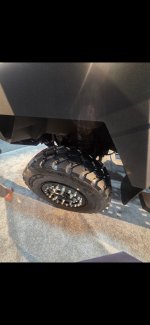
I'm really interested in this if you have any info. did they move away from solid axles to independent suspension?
They unveiled independent suspension this year at CANSEC on the Senator. You can also see a CTIS.

Photo from Noah Gairn.
1000039501.jpg
Did the model you saw have these as well?
 
You think Patria is a small company? Its a subsidiary of Konsberg jointly owned by Finland lol. I dont know what you mean by "clean sheet" or why it really matters.


Latvia and Finland joint ordered for 1 million USD each so 800k Euro. Which is still double the price of a Senator.... for a vehicle thats entirely different.


Well i want a lighter utility vehicle, ie something than a Patria Pasi (they're the size of a LAV). I would prefer they be combat proven, reasonably priced, and produced in Canada. Honestly id be happy if we bought a couple thousand Hiluxs or Rangers painted matte green for the COTs option and very basic senators for the other.
Compared to BAE, GD, KNDS and Rheinmetall it is a small company with barely 1 billion euros in revenue.

Clean sheet is just A new purpose-designed vehicle from scratch, as opposed to adapting or modifying an already completed design. A clean sheet has higher development risk as opposed to the higher risk of not being fit for purpose with an adapted design...something the Brits are experiencing with the Ajax.

I'm not trying to suggest the patria instead; I'm just giving it as an example of a vehicle that can be built with good functionality(hell its amphibious) for an affordable price. Its a breath of fresh air to look at one compared to the ACSV which would be not a 1:1 but closer comparison.

I really like the idea of something simple and easy to keep repaired for the COTs option 70 series landrovers maybe?

At any rate the simplicity of the senator is definitely a breath of fresh air I just wish they had a couple more pers with field experience to advise them on designs and put some work into the interior. I understand if their order books are full the first priority has to be production though.

Prariefella it had solid axles if I recall correctly.
 
Compared to BAE, GD, KNDS and Rheinmetall it is a small company with barely 1 billion euros in revenue.

Clean sheet is just A new purpose-designed vehicle from scratch, as opposed to adapting or modifying an already completed design. A clean sheet has higher development risk as opposed to the higher risk of not being fit for purpose with an adapted design...something the Brits are experiencing with the Ajax.

Ajax is virtually unique from ACOD II.

I'm not trying to suggest the patria instead; I'm just giving it as an example of a vehicle that can be built with good functionality(hell its amphibious) for an affordable price. Its a breath of fresh air to look at one compared to the ACSV which would be not a 1:1 but closer comparison.

I really like the idea of something simple and easy to keep repaired for the COTs option 70 series landrovers maybe?

Famously reliable.

At any rate the simplicity of the senator is definitely a breath of fresh air I just wish they had a couple more pers with field experience to advise them on designs and put some work into the interior. I understand if their order books are full the first priority has to be production though.

Prariefella it had solid axles if I recall correctly.

You dont think they've learned for the Ukranians, who are the number one user of the Senator? Like that seems like a bit of field experience.
 
I really like the idea of something simple and easy to keep repaired for the COTs option 70 series landrovers maybe?
Your COTS solution would be a vehicle not sold on the continent? Hardly seems like a great COTS option... Particularly when contrasted against the ISV, based on a vehicle sold in the 10s of thousands every year in North America.

Simple to maintain isn't really simple when the parts are all special order items from foreign markets. Particularly when compared against vehicles that offer parts commonality with commercial/civilian vehicles sold in Canada, with large dealer networks.
 
You dont think they've learned for the Ukranians, who are the number one user of the Senator? Like that seems like a bit of field experience.
Thats certainly a perk we'll be getting with the platform. JTLV cant say its been incrementally upgraded based off LSCO experience.
 
Thats certainly a perk we'll be getting with the platform. JTLV cant say its been incrementally upgraded based off LSCO experience.
What special features has Roshel put in for LSCO that JLTV doesnt have? We're buying an armoured box on wheels, not a tank. I'm certain Roshel will win because we have to buy domestic and they're an actual successful company without porkbarrelling but let's not be disingenuous here and make it sound like Roshel makes the perfect vehicle for LSCO that no one else can make.
 
What special features has Roshel put in for LSCO that JLTV doesnt have? We're buying an armoured box on wheels, not a tank. I'm certain Roshel will win because we have to buy domestic and they're an actual successful company without porkbarrelling but let's not be disingenuous here and make it sound like Roshel makes the perfect vehicle for LSCO that no one else can make.
Nor is that my intent to make it out to be a wunderwaffe. Im merely pointing out its getting actual feedback about what works and doesnt.
 
Your COTS solution would be a vehicle not sold on the continent? Hardly seems like a great COTS option... Particularly when contrasted against the ISV, based on a vehicle sold in the 10s of thousands every year in North America.

Simple to maintain isn't really simple when the parts are all special order items from foreign markets. Particularly when compared against vehicles that offer parts commonality with commercial/civilian vehicles sold in Canada, with large dealer networks.

Not saying it's a good option with all the variables considered just speaking to personal bias and tastes. They do see a fair bit of use in the mining sector in this country which is notoriously hard on equipment.

Honestly the Milcot (aside from bizzaro electrical issues) has done stellar service. Perhaps an equally simple vehicle makes sense. New pattern rangers/Colorado's aside from not being in the same class weight wise are filled with too many electronics(again just an opinion).

I'd also be curious on ISV VOR rates in the US/Canada

As for the roshel senator does anyone have a list of what's been changed since there started fielding them in Ukraine? It would be great to hear that they are making changes.
 
Not saying it's a good option with all the variables considered just speaking to personal bias and tastes. They do see a fair bit of use in the mining sector in this country which is notoriously hard on equipment.
Fair, but is mining a good analog for training? Hard use means a lot of things, and their hard use might not really align with what we need.

Honestly the Milcot (aside from bizzaro electrical issues) has done stellar service. Perhaps an equally simple vehicle makes sense. New pattern rangers/Colorado's aside from not being in the same class weight wise are filled with too many electronics(again just an opinion).
Electronics are the future, and aren't going away. Just because Tpr Blogins doesn't pay the fuel bill doesn't mean someone, somewhere, isn't.

What made the "simple" vehicles of WWII, and the early post-war years "simple" to fix was a deep parts bin. The mechanic in the field didn't need to rebuild anything or trace a fault in a wiring harness, they just replaced the part. Just like mechanics should be doing with ISV, or whatever COTS solution we go for. The real advantage would/will be in selecting a vehicle that makes having a deep parts bin possible/palatable.

There is also the reality that young soldiers today didn't grow up fixing the family car in the garage on Saturday, like (rural) kids did in the 50s/60s/early-70s. Having a vehicle a moderately skilled kid, with a wrench and years of know-how, can fix in the field isn't a realistic COA these days. A 70 series Landcruiser might be more "simple" to fix for a backyard mechanic, but to the average vehicle user/soldier today, it's just as complex as the '25 Colorado sitting in my driveway.
 
TBH the dash/instrument panel on the Patria is clearly purpose built.
One suspects that shortly it will become practical for Roshel to go that route as well / mainly to be able to incorporate various features on the displays there, and not have a lot of clunky crap in the center.

The inside cab area of the Roshel reminds me of the Lenco Bearcats that US DoS had in Afghanistan at the Embassy circa 2005.
 
Fair, but is mining a good analog for training? Hard use means a lot of things, and their hard use might not really align with what we need.


Electronics are the future, and aren't going away. Just because Tpr Blogins doesn't pay the fuel bill doesn't mean someone, somewhere, isn't.

What made the "simple" vehicles of WWII, and the early post-war years "simple" to fix was a deep parts bin. The mechanic in the field didn't need to rebuild anything or trace a fault in a wiring harness, they just replaced the part. Just like mechanics should be doing with ISV, or whatever COTS solution we go for. The real advantage would/will be in selecting a vehicle that makes having a deep parts bin possible/palatable.

There is also the reality that young soldiers today didn't grow up fixing the family car in the garage on Saturday, like (rural) kids did in the 50s/60s/early-70s. Having a vehicle a moderately skilled kid, with a wrench and years of know-how, can fix in the field isn't a realistic COA these days. A 70 series Landcruiser might be more "simple" to fix for a backyard mechanic, but to the average vehicle user/soldier today, it's just as complex as the '25 Colorado sitting in my driveway.

There are design considerations that can assist with maintenance.

I agree procurement of simpler vehicles overall is not likely. However if we become embroiled in MCO we will not be able to produce the same vehicles we are currently using in time to maintain the vehicle consumption.

Relatively simple vehicles that have modules that are complicated to enable capabilities is the way to go imo.

And to support what your saying large reserves of those modules to support ongoing consumption.

A good example is the ACSV vs the Bison and the quantity of cable runs is jaw dropping when you look inside.

Does the commander need a separate screen for the health and monitoring system? Why can they not just ask the driver or God forbid climb into the driver position and look at the gauge.

I'm sure it sounds great in a brochure but it's more screens,chips and cable runs that is unnecessary adding complexity and cost.

As for soldiers fixing vehicles if you keep them sufficiently simple/modular you can train simple troubleshooting and repairs.

Tank crews routinely fix suspension components and even swap engine packs(modular) under vehicle tech supervision.

Super fancy vehicles brief well but the reality seems to be lower availability due to vehicles being down for repairs lav III vs 6.0 for example. Perhaps I don't have all the info and it's just correlation not causation though.
 
Back
Top