Reading the transcript of the Roundtable it doesn't sound as is JRTC OpFor Geronimo was taking it easy on the Rakkasans. They were applying EW an CUAS as they were able.
....
Drew Lawrence (Defense Scoop): Got it. I do. I talked to some of the folks from Geronimo a few weeks ago, specifically about their EW and cyber capabilities that they were throwing at rotating forces. How did you fare against that? Did anything surprise you, and how did you have to adapt to it?
Colonel Richard Ryan Bell: Knowing we were going into an operating environment that is highly contested in the communications spectrum, we did a few things. First, for our mission command nodes, we separated them. My main command post, which was predominantly focused on planning, stayed at Alexandria Airfield for the first four days before they jumped in. We got it small enough that it functionally fit on three LMTVs with a tarp. My forward command post was made up of five Humvees and a tarp. Inside both of those, we hardwired everything. We had no Wi-Fi, and we had the EW teams do signals audits to get rid of all Bluetooth signals. We focused primarily on our beyond-line-of-sight capabilities using Starshield. As a result, in the box, the electronic emission signature for my command posts was less than a rifle platoon with ITN radios.
The result was that Geronimo was never able to locate either one of my CPs during the entire rotation, and they were able to operate and plan continuously. Added to that was excellent tactical discipline: the CPs were in miserable locations buried in gulches, hidden by terrain, covered by trees and camouflage, and we jumped locations every 18 to 30 hours. That enabled us to effectively fight the brigade while remaining hidden in the spectrum.
For the battalions, companies, and below, we adopted an operating concept of "silent, violent, silent." How do you go black in the comms spectrum, maneuver silently to a position of advantage, and then, when you're there and ready to attack, come up on the communications network, leverage joint and combined arms fires, destroy the enemy, and then get off the objective and go silent again? We trained on this, going back to our platoon lanes through Operation Lethal Eagle in January and through JRTC, teaching elements to use specific communication windows and otherwise remain silent to avoid detection.
That is what enabled that 17-kilometer infiltration by Iron (3-187 IN), and it enabled Kurhe (1-506 IN) to infiltrate two companies 22 kilometers behind Geronimo, because they were able to operate off the spectrum. Part of that was training myself and the leaders to get used to not talking to the formation—knowing that I may have a company that is going to be off comms for four, five, six, or eight hours, and being okay with that. There is a significant cultural component to it.
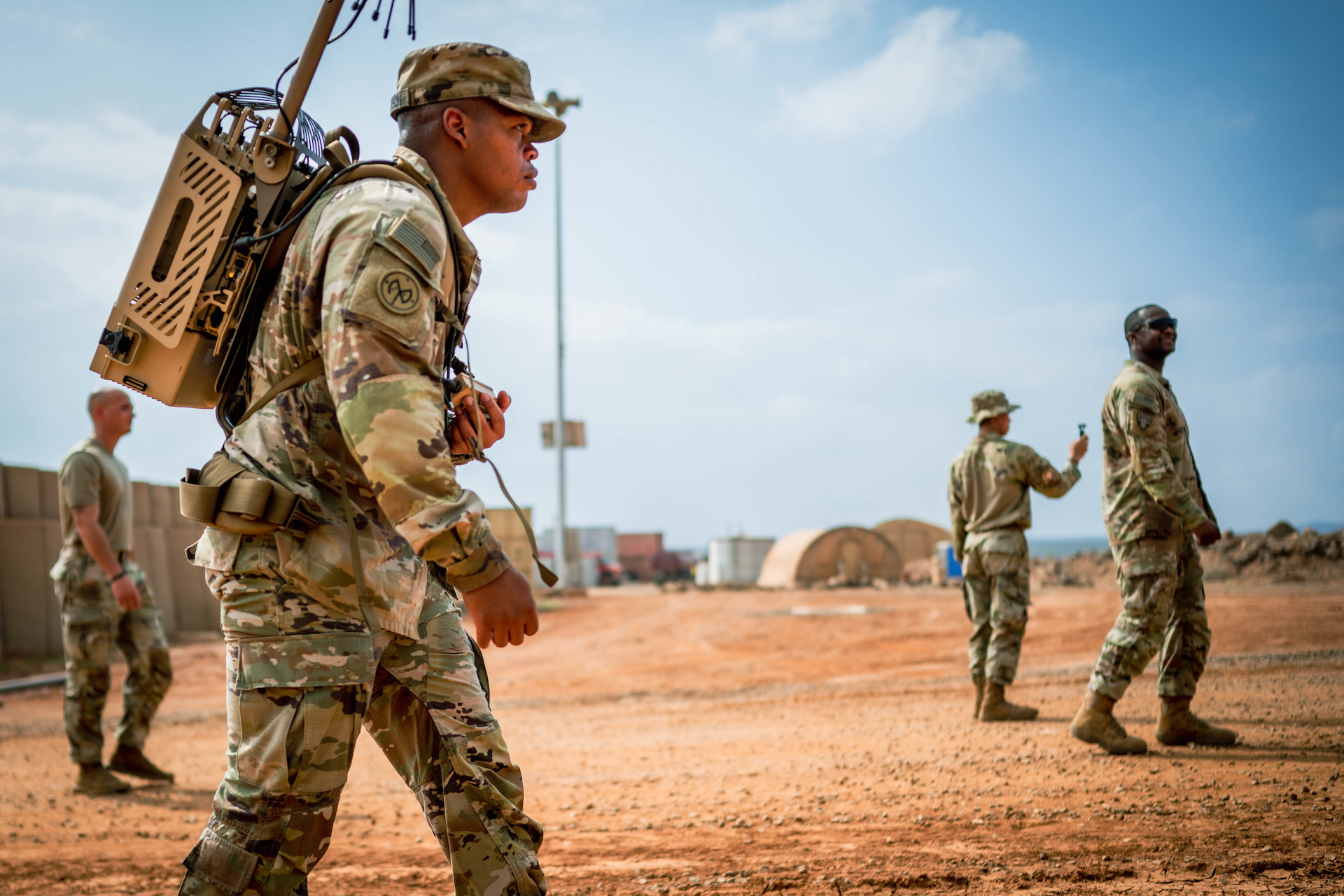
We also took our own EW systems there. I had Kraken and TEWS-I (Tactical Electronic Warfare System - Infantry), so we were doing the same thing to Geronimo that they were doing to us—tracking them, identifying their locations, and calling for fire or sending drones anytime they transmitted. We changed how we organized and took those same capabilities to cause him some stress as well.
...
For the record the LMTV is the Stewart and Stevenson 2.5 ton cab-over 4x4.
....
Starshield - Military Starlink

en.wikipedia.org
...
Kraken
Mastodon Design's award for a dismounted jamming capability is leveraging existing work with Special Operations Command, significantly shortening the timeline for fielding the equipment to conventional soldiers.

defensescoop.com
TEWS-1
FORT POLK, La. — The 101st Airborne Division (Air Assault) took another major step toward Army transformation this month as Soldiers from the Multi‑Func...

www.army.mil