
That sounds like a truty diabolical power grab, if I'm reading this correctly??If it's power it will be business as usual.
If it's speeding things along, expect a vote in the house about changing the standing orders of committees to give the LPC the majority on all of them.

You are using an out of date browser. It may not display this or other websites correctly.
You should upgrade or use an alternative browser.
You should upgrade or use an alternative browser.
Liberal (Minority/Majority) Government 2025 - ???
- Thread starter Altair
- Start date
We are so fucked.They now have 4 years to either be effective or face the wrath of the electorate after being in power for 15 years.
Like actually...

- Reaction score
- 4,386
- Points
- 1,190
Has anything in the last year drastically changed for the negative? Legit question, from your perspective.We are so fucked.
Like actually...

- Reaction score
- 8,366
- Points
- 1,160
You mean a completely normal thing that happens every new parliamentary sessions? That's why people were suggesting proroguing for a day to reset the committee membership.That sounds like a truty diabolical power grab, if I'm reading this correctly??
Minority government works by doing things like sharing committee membership and leads, and why if the politicians act like adults they share the authority, responsibility and influence.
Think it was a quote from before the announcement, but this kind of thing smacks more of a pre-teen with defiant oppositional disorder than a mature statesman; seems like it would be too much to just acknowldege a win for all Canadians and something positive, and trying to actually work to get things implemented. Guess that's what happens when you've never had a real job where you have to compromise and work with people you may or may not be friends with or like.
“It is true the prime minister and the Liberals would not have done anything were it not for the leadership of the Conservatives in fighting for affordability,” Poilievre said. “And it is true that imitation is the highest form of flattery.”
Liberals promise measure to lower gas prices by 10 cents per litre this summer

- Reaction score
- 4,330
- Points
- 1,160
That sounds like a truty diabolical power grab, if I'm reading this correctly??
If you look at the current membership of commons committees, you may notice that the chairmanship of the majority of committees (especially the ones that matter) already follows normal commons practice, in that the chair is from the government party. I doubt there will be much, if any change (other than some members replacing others on specific committees). Of the floor-crossers, Gladu was, as a Conservative, chair of the Status Of Women committee (according to the 5 Nov 25 change). Once she crossed, the chair of that committee is vacant and she is now listed only as a Liberal member.
Chairs
They are elected by the members of the committee and chosen from among the government members of the committee with the exception of four standing committees and one standing joint committee where the chairs are chosen from the official opposition. The chair serves as the presiding officer of the committee and the spokesperson through whom all matters are channelled.
Vice-Chairs
They are two per committee and they are elected by the members. The first vice-chair is chosen from the official opposition members of the committee, and the second vice-chair from an opposition party other than the official opposition, except for the five committees chaired by the official opposition. A vice-chair presides over meetings when the chair is absent.
Establishing Committee Membership
20.13
Committees cannot meet until their membership has been established. The House appoints the members and associate members of its committees, as well as the members representing the House on joint committees. The Speaker has ruled this to be a fundamental right of the House. The committees themselves have no powers at all in this regard.
The number of members for each standing committee is established by the Standing Orders. From time to time, the Standing Orders are amended by special order to change the number of members on a committee. The breakdown of members representing each of the recognized parties is negotiated and agreed to by the parties at the beginning of each Parliament. The result generally reflects the proportions of the various recognized parties in the House; therefore, members who are not part of a recognized party and other independent members rarely sit on a committee.
Members may belong to more than one committee, as either regular or associate members. Current practice normally excludes members with other parliamentary functions, such as the Speaker and the other chair occupants and the leaders of recognized parties, from being appointed members of a committee. Ministers, including the Prime Minister, cannot serve on or act as a substitute on any committee. Pursuant to the Standing Orders, parliamentary secretaries cannot be appointed to standing, special and legislative committees except as non-voting members, who may not vote, move motions or be part of a quorum.
To view the membership of committees:
Welcome to Committees - House of Commons of Canada
Committees examine matters the House of Commons may refer to it or empower it to examine. They report conclusions of those examinations, and recommendations, to the House.
www.ourcommons.ca

Must everything be viewed through a falsely zero-sum lens?
I don't care if it is good or bad for the opposition. I don't' care if it is good politics. I only care if this is good policy.
They could have announced it before the byelections and bought votes. It's at least a smidge of good faith to do it after.
On that, my feeling are mixed, as the offset will of course have to be borrowed, but that will balanced against the stimulus (or cauterisation) of the economy.
Federal coffers benefit from higher oil prices. Some of this tax break is being funded by those higher revenues. And the other point here is to forestall inflation driven by higher gas prices.

- Reaction score
- 3,259
- Points
- 1,140
I think the committees have 10 members, currently 5 for LPC, and 5 for the opposition.That sounds like a truty diabolical power grab, if I'm reading this correctly??
The chair is from the governing party, which drops the voting members from the LPC to 4 to the oppositions 5. The chair only votes in the event of a tie. So the opposition can jam up the LPC in the committees, slowing the government down.
The LPC will give themselves 6 members, one the chair, and they will maintain voting majority and in the event of a tie the chair will vote with their fellow party members.
Is this a power grab? Depends. If Carney had won 3 more seats in 2025 this would have have been the status quo.
What I do know is that if the CPC was working in good faith on the committees I think the LPC would just keep the standing orders as is.
But we have heard the stories from both the liberals and some disgruntled CPC members that this is not the case.
- Reaction score
- 43,448
- Points
- 1,210
I admire everyone's faith that the tax reduction won't disappear in a matter of weeks into higher profit margins.

- Reaction score
- 8,918
- Points
- 1,260
Did that happen when they cut the carbon tax?I admire everyone's faith that the tax reduction won't disappear in a matter of weeks into higher profit margins.
- Reaction score
- 8,918
- Points
- 1,260
Also, a great way to offset rising oil/gas prices is to invest your RSP/TFSA holding in oil/gas ETF’s or individual holdings.I admire everyone's faith that the tax reduction won't disappear in a matter of weeks into higher profit margins.
Gas goes up, you make money in the end.

- Reaction score
- 13,577
- Points
- 1,160
Has anything in the last year drastically changed for the negative? Legit question, from your perspective.
Drastically? No. More of a steady march.
Cost of living hasn’t just risen it’s eroded.
Purchasing power for groceries, rent, and insurance are all materially higher with no matching wage growth for most people. Food bank use all time high.
Housing affordability continues to deteriorate. Ownership is further out of reach and rents are less stable.
Public services feel more strained with longer wait times in healthcare, backlogs, and reduced accessibility (which has nothing to do with recent cut).
Crime and disorder perception (and in some areas reality) has increased, which affects how safe people feel day to day.
Tax burden vs visible return is a common frustration. People feel like they’re paying more but not seeing proportional improvements.
Economic confidence is weaker. More people are cutting back, delaying major purchases, or carrying debt.
- Reaction score
- 3,259
- Points
- 1,140
Canadian inflation numbers in 2025 was 2.1 percent year over year.Drastically? No. More of a steady march.
Cost of living hasn’t just risen it’s eroded.
Purchasing power for groceries, rent, and insurance are all materially higher with no matching wage growth for most people. Food bank use all time high.
Wage growth for Canada in 2025 was 3.1 percent.
Home prices dropped 4.1 percentHousing affordability continues to deteriorate. Ownership is further out of reach and rents are less stable.
September 15 2026 News Release | CREA Statistics
 stats.crea.ca
Rents dropped as well
- National home sales edged down 1.3% month-over-month.
- Actual (not seasonally adjusted) monthly activity came in 8.1% below February 2025.
- The number of newly listed properties declined by 3.9% on a month-over-month basis.
- The MLS® Home Price Index (HPI) fell 0.6% month-over-month and was down 4.8% on a year-over-year basis.
- The actual (not seasonally adjusted) national average sale price was little changed (-0.2%) on a year-over-year basis in February 2026.
The Daily — Quarterly rent statistics, second and third quarters 2025
In the third quarter of 2025, the average asking rent for a two-bedroom apartment fell year over year in the three largest metropolitan areas in the country: Montréal (-1.0%), Toronto (-3.9%) and Vancouver (-5.9%).

Average asking rents fell every month of 2025, report says
Asking rent in Canada fell 2.3% year-over-year in December, marking a full calendar year of declines
 www.theglobeandmail.com
Archied version https://archive.ph/MKbBA
Asking rents in Canada fell 2.3 per cent year-over-year in December to an average of $2,060, marking a full calendar year of declines as prices reached their lowest level in 30 months.
The latest monthly report from Rentals.ca and Urbanation says when measured across the full year, average asking rents in Canada declined 3.1 per cent in 2025, which was a larger annual drop than seen during the COVID-19 pandemic.
I never know what people want the feds to do in terms of healthcare. When they bring the hammer on the provinces we hear about federal overreach, when they let the provinces predictably fail in 10 spectacular ways we hear about how the feds are failing on healthcare.Public services feel more strained with longer wait times in healthcare, backlogs, and reduced accessibility (which has nothing to do with recent cut).
The last crime statistics I can find are for 2024 but they show a decrease of 3.6 percent of Police-reported crime rate per 100,000 population and a decrease of 4.1 percent in crime severity. And these follow a continued trend of going down year over year.Crime and disorder perception (and in some areas reality) has increased, which affects how safe people feel day to day.
Yeah, sure. Cannot prove or disprove this, although, in my opinion....bravo sierra.Tax burden vs visible return is a common frustration. People feel like they’re paying more but not seeing proportional improvements.
Economic confidence is weaker. More people are cutting back, delaying major purchases, or carrying debt.

Consumer Confidence Canada: Monthly Update
Take a look at our latest Canadian Consumer Confidence data.
-3 is not great but its not terrible either, especially considering our largest trading partner delights in trying to screw us over and has launched a war that is destabalizing the global economy.In March, overall consumer confidence remained steady at -3%. The gap between personal and national realities remains stark. Canadians feel relatively positive about their own current financial situations but are pessimistic when looking at the state of the broader national economy. This gap is a defining tension of the Endurance Economy.
Data for Ipsos’ Consumer Confidence is powered by Global Advisor. Every month, Global Advisor surveys 30 countries, including Canada. This month’s results for Canada are based on online interviews with 1,000 adults aged 18-74, interviewed between February 20 and March 6, 2026.
Stephen Colbert coined the term in 2005, and I think it applies here.
Truthiness.
- Definition: "Truth that comes from the gut," prioritizing personal belief, emotion, or desire over established facts or intellectual examination.
I admire everyone's faith that the tax reduction won't disappear in a matter of weeks into higher profit margins.
How many times has gasoline retailing been investigated for collusion and found none?
Sure if oil prices rise cause if the war, the 10.5¢ break can be swallowed up. But that's still better than not having it. And more importantly still helps suppress inflation.
It's an effort. Not much can be done when the orange man is driving the bus.
My wife and I have the only grand child on her side.
In our cohort of friends only 1 couple has more than 1 kid.
The collapse is coming.
What I really fear is for our kids generation.
We have an entire generation of only children (like China) whose parents are about to get an insane amount of money or nothing. Imagine, how f'd up that society will be.
- Reaction score
- 3,259
- Points
- 1,140
Oh for sure. It's being papered over by immigration.My wife and I have the only grand child on her side.
In our cohort of friends only 1 couple has more than 1 kid.
The collapse is coming.
But immigration only fuels things like healthcare and the housing crisis.
I'm not sure anyone talked about it, but Canada shrunk last year. The pipeline of immigration was closed, and we almost immediately went into negative population growth for the first time in the history of Confederation. And it's not just all the immigrants went home. We also got older.
Future taxpayers are not being born while medical science pushes the limits of those living longer.
God forbid there is a war.

- Reaction score
- 9,434
- Points
- 1,360
OAS/CPP discussion is now here. Seniors Benefits Discussion- split from Liberal (Minority/Majority) Government 2025 - ???Mods, I think we need a thread split here.
Lets keep this one on the present Govt/Opposition/ etc.
Last edited:

daftandbarmy
Army.ca Fossil
- Reaction score
- 48,522
- Points
- 1,160
Oh for sure. It's being papered over by immigration.
But immigration only fuels things like healthcare and the housing crisis.
I'm not sure anyone talked about it, but Canada shrunk last year. The pipeline of immigration was closed, and we almost immediately went into negative population growth for the first time in the history of Confederation. And it's not just all the immigrants went home. We also got older.
Future taxpayers are not being born while medical science pushes the limits of those living longer.
God forbid there is a war.
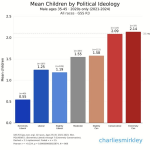
Meanwhile, along the political spectrum....
God forbid there is a war.
I mean Ukraine and Russia have like 40 and 50 yr old men fighting each other. Ukraine gets shit for not sending 20 yr olds to the front. But that whole cohort suffered a post-communist demographics collapse and they don't want to make it worse.
Meanwhile, along the political spectrum....
I question how much of this is correlation. Like "Extremely Liberal" just being a college aged kid or in this case man child I guess.

- Reaction score
- 10,668
- Points
- 1,260
Its men aged 35-45, so if they're still a "man child", they will likely remain in that state forever.I question how much of this is correlation. Like "Extremely Liberal" just being a college aged kid or in this case man child I guess.
Similar threads
- Replies
- 395
- Views
- 53K


- Replies
- 6
- Views
- 2K


- Replies
- 262
- Views
- 36K
- Replies
- 505
- Views
- 29K

- Replies
- 1K
- Views
- 121K
