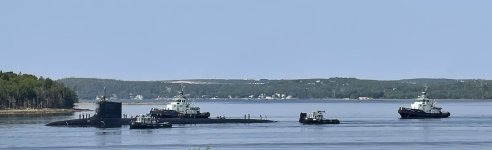
Selecting TKMS as the preferred supplier means Canada has entered negotiations for up to 12 Type 212CD submarines. It does not mean every speculative support concept associated with Arctic operations has suddenly become part of the Canadian Patrol Submarine Project. The government’s announcement says nothing about an Arctic mobile base, submarine tender or at sea AIP reactant replenishment capability.
The Arctic mobile base idea was floated by then Commander RCN Vice Admiral Angus Topshee as a broader ice capable amphibious and logistics ship. It was not announced as a funded project, much less as a submarine support vessel. Topshee is also no longer Commander RCN. Vice Admiral Dan Charlebois assumed command on June 16, 2026. Everything I have heard indicates that the mobile base concept has not progressed into the formal planning stage whatsoever.
Even supposing such a ship were eventually built, AIP replenishment would not be a simple matter of adding another hose reel. As you already know, it would require specialized storage, transfer equipment, safety systems, trained personnel and submarine compatible support facilities for hydrogen and oxygen reactants. A genuine submarine tender would also need repair shops, spares, weapons handling, medical facilities, communications and some form of submarine rescue support. Fuel cell AIP provides extended submerged endurance, but the reactants remain finite and the system does not turn a conventional submarine into an SSN as you might exspect.
The mobile base would also remain a surface ship limited by its own ice classification and by where it could safely operate. The submarine would still have to leave the deeper under ice operating area to meet it. That does not eliminate the fundamental issues surrounding speed, battery and energy management, emergency surfacing and rescue beneath heavy ice.
All good points.
There is though, the other side of the assessment.
The RCN attempted to set up a fixed Arctic base at Nanisivik that did not work out so well . It was that which prompted the staff (?) of then Commander RCN Vice Admiral Angus Topshee to propose an Arctic capable mobile base be considered. From my recollection it was independent of ANY consideration in regards to submarines. So this was a proposed idea, and it is not to the best of my knowledge a project/program. Whether consideration of submarine support might give it added emphasis is not something I have any insight into official defence thinking.
It is clear in my view, that AIP equipped submarines, if they wish to dwell at in the Arctic and still have AIP reserves for contingencies , can not do so with the submarine's on-board embarked AIP reactants. They don't have enough.
Simply put, AIP equipped submarines can not, without replenishment venture far into the Arctic. Having a distant base such as St.John's, in my view, does not cut it.
If AIP equipped submarines could replenish their reactants while in the Arctic, it would be a game changer. Dare I say a massive game changer.
But as you note, this is not easy from a Mobile base. Frankly, IMHO it is very difficult. Yes. There are major safety concerns re: AIP reactant generation, AIP reactant transportation & stowage, and even AIP replenishment. Do such in the Arctic adds an even further layer of complexity and difficulty.
So that does beg the question. Is it worthwhile to investigate further?
I think that question should be asked, assessed, and debated, much like we are doing now.
Some press articles claim, that over the Canadian Patrol Submarine project lifetime, the Canadian public could in effect be spending $80-billion to $100 billion Canadian dollars. The justification in part is Canada has a massive coastline with 3 oceans. 3 Oceans. Not 2. THREE. ...
Yet ... yet at the same time, after 'selling' the government on such, we go and then say, .. but ... but ... but ... we won't send the submarine into one of those 3 oceans, despite spending all of that money. We will only monitor Canadian east/west coast Arctic access from Canada/Alaska vicinity (and ignore any Russian access from the other side of the pole which is, frankly, viable). We will ONLY go for 2 ocean operations for the subs, despite using the 3 ocean argument to justify the expenditure.
Well - $80 billion to $100 billion is a lot of money, to then turn around and, only now, claim: "the 3rd ocean is not allowed for our new submarines. It was only a selling point". ???
Again, my view? I think that question should be asked, assessed, and debated, much like we are doing now.
I think the RCN is letting down the Canadian government and the Canadian tax payer, if the RCN does not take a hard look as to what would be involved to go beyond only monitoring the choke point entrances on the Canadian side of the Arctic.
My view is the RCN is letting down the Canadian government and the Canadian tax payer if the RCN does not consider an Arctic base, such as a mobile Arctic base ship (or even a new design of an Arctic (polar class) capable supply ship that can replenish submarine's reactants in the Arctic).
My view? Study the risks of the stowage requirements. Study the risks of the in-situ (on site) reactant generation, and study the difficulty/feasibility/risk of Arctic AIP replenishment. If possible, even dream up some smaller scale tests to assess viability.
To reject out of hand because it is clearly seen as difficult? Again, my (probably isolated) view, is if we right now, reject such, we are letting down the Canadian taxpayer in terms of them not getting full money for their expenditure for the submarines, and we are not adequately doing the appropriate job to assess what is viable, and what is not viable, without first looking into such in depth.
So - for the 3rd time, I think it is important that the viability of Arctic AIP replenishment question is asked, assessed, and debated, much like we are doing now.